Imperial Tramways Company
History
The Imperial Tramways Company was registered on the 28th June 1878 by the London-based Tramways and General Works Company, which was itself only set up the previous year. Although more research is necessary, it seems that the ITCo was a vehicle that the T&GWCo used to raise the capital necessary to build a number of horse-drawn tramways that it was then in the process of obtaining powers for, namely, Dublin Southern District Tramways, Gloucester Tramways, and Reading Tramways. In the enabling orders, the promoters of these tramways were companies of the same name, which had doubtless been set up and/or funded by the T&GWCo, the powers being granted in July and August 1878. The T&GWCo had also reached agreement to take over an existing horse tramway — operated by the Middlesbrough and Stockton Tramways Company — as well as the Corris Railway Company, both of which it probably either acquired, or had at least made binding agreements to acquire, in August 1878.
Following the first statutory meeting of the ITCo on the 18th October 1878, the T&GWCo placed numerous advertisements in periodicals and newspapers across the length and breadth of the British Isles, offering shares in the new company, which unusually for a tramways company, was set up from the off as a holding company that would issue dividends based on the performance across all its holdings, rather than each individual concern. It is unclear how the T&GWCo was paid for the assets it handed over, but most probably by a mixture of cash and shares in the ITCo. It doubtless also had more money coming its way during construction of the three new tramways, as it was, in at least one case, and very probably in all of them, also the construction contractor.
The three new horse tramways were all opened within a few months of each other in 1879: Dublin Southern District Tramways on the 17th March, Reading Tramways on the 5th April, and Gloucester Tramways on the 24th May.
The Gloucester operation was not a success, the ITCo offering it for sale on the 23rd April 1881. The buyers were a group of investors from Bristol who were all directors of the Bristol and Bath Tramways Company; they quickly set up a new company — the City of Gloucester Tramways Company — to raise the necessary capital, and to operate the tramway, the formal sale taking place on the 24th September 1881. The Secretary of the new company was George White, a shrewd Bristol-based stockbroker and entrepreneur, who had the confidence and backing of major investors in and around Bristol. He had been initimately involved in setting up the Bristol Tramways Company in 1874, and was appointed secretary to that company in his early twenties. He built up extensive contacts in the transport industry, with a focus on taking over ailing concerns (tramways, docks, railways etc.), turning them around, and eventually selling them on at significant profit. Another tramway that fell into this category was that owned by the York Tramways Company, where he was appointed as the liquidator (in February 1884), only for him to demonstrate that it could be run at a profit, and for it to then be sold to a new company — the City of York Tramways Company — on the 1st January 1886, of which he was a director. The major shareholder in the CofYTCo was the Imperial Tramways Company.
Other than the CofYTCo, however, the ITCo seemed content to manage its small portfolio of concerns as best it could, failing to take advantage of the many expansion opportunities that presented themselves during the 1880s and early 1890s. By 1892, the company was in financial difficulty, which allowed George White to engineer a take-over, following which he cleared out the directorial incumbents, installing himself as chairman and his talented friend and technical expert, James Clifton Robinson, as the managing director. From then on, the ITCo was run out of Bristol rather than London, and was effectively controlled by George White, members of his family, and his close business associates.
White and Robinson had ambitious plans for tramway electrification, both in Bristol and in London, but also in the towns and cities where the ITCo owned horse tramways. The horse-tramway systems in Reading and York, however, eventually succumbed to municipal opposition, Reading Tramways being sold to Reading Corporation on the 1st November 1901, and the City of York Tramways to York Corporation on the 27th February 1909.
As part of the ITCo's electrification scheme for Dublin, a small horse tramway — the Blackrock and Kingston Tramway — was acquired by the company on the 2nd August 1893, before being handed over to its subsidiary (the DSDTCo) on or around the 24th August 1893. The first electric trams on the DSDTCo ran on the 16th May 1896, but plans to expand into central Dublin ran into serious opposition from the Dublin United Tramway Company (and its charismatic chairman WIlliam Martin Murphy), which was implacably opposed to the DSDTCo expanding into what it viewed as its territory. The DSDTCo suffered a major blow two months later (on the 22nd July 1896) when its bill aimed at expanding its lines into Dublin was rejected. This development, however, was certainly anticipated by the ITCo, which no doubt under the guidance of George White, decided that it was time to take a profit and move on, selling its entire shareholding in the DSDTCo to the British Thomson-Houston Company, the constructor of the tramway. On the day the DSDTCo's bill failed, the 22nd July 1896, the BTHCo, now the sole owner, sold the tramway to its erstwhile rival, the DUTCo.
George White's ambitions in London started with a much-troubled horse tramway, the perenially loss-making and poorly run West Metropolitan Tramways Company. White was appointed as the receiver of the company by the latter's debenture holders, of which he was one, on the 24th August 1893. He was, however, soon at odds with the directors, which resulted in the concern being put up for sale, and with no bidders coming forward, the tramway was sold by private treaty — on the 6th August 1894 — to an agent acting on behalf of the Imperial Tramways Company. Shortly beforehand, on the 19th July 1894, a new company — the London United Tramways Company — was incorporated, to which the tramway was transferred on the 20th August 1894. The Chairman of the newly formed LUTCo was none other than George White. The way was now open for White and Clifton Robinson to build an electric tramway system in West London, though it was to be a long hard slog, the first electric services only commencing on the 4th April 1901. The company was restructured that year, becoming London United Tramways (1901) Limited, in which 80% of the Ordinary Shares were owned by White. Following a great deal of municipal obstruction, and negotiations with various potential partner companies, White sold his controlling interest in the LUTCo in September 1902 to Speyer Brothers, the financers of the Underground Electric Railways Company of London. Once again, White showed a willingness to make a profit — a very large one in this case — and move on. The ITCo, however, continued to benefit from the tramway, as it still held a significant number of Preference Shares in the company, and its successor (from 1912), the London Suburban Traction Company.
In the northeast, where the ITCo already owned the horse tramway in Middlesbrough, and as a prelude to electrification, it purchased the assets of the neighbouring Stockton and District Tramways Company from the liquidator in 1896. The new electric system, which opened for business on the 13th July 1898 was called the Middlesbrough, Stockton and Thornaby Electric Tramways, even though no company of that name ever existed, the ITCo operating it directly. Following the Great War, and with expensive renewals in the offing, the company was happy to sell the enterprise to the local authorities, Middlesbrough Corporation and a Joint Committee of Stockton and Thornaby Corporations taking over on the 3rd April 1921.
The tramway system most associated with George White was that in Bristol, initially operated by the Bristol Tramways Company, and from the 1st October 1887, the Bristol Tramways and Carriage Company. The B&TCCo was never part of the Imperial Tramways Company, though the two were intimately entwined, with many directors and investors in common, Although not without its municipal difficulties, the Bristol horse system was converted to electric traction, the first electric services commencing on the 14th October 1895. George White was made Chairman of the BT&CCo in 1900, and retained the chairmanship — as well as that of the ITCo — up until his death on the 22nd November 1916. He was elevated to a Baronetcy on the 26th August 1904, so in later life was called Sir George White.
Following the municipalisation of the MSTET in 1921, the ITCo no longer possessed an operational tramway, being left with shareholdings in the London Suburban Traction Company, as well as the wholly owned Corris Railway. The company struggled throughout the 1920s, selling its shares in the London Suburban Traction Company during the 1928 financial year. The following year, the Great Western Railway Company bought the White Family's controlling interest in the BT&CCo, as well as the Corris Railway from the ITCo. This effectively brought the Imperial Tramways Company to a close, a decision to formally wind the company up being taken on the 12th May 1930.
Uniforms
The ITCo's horse tramways in Gloucester, Reading, and York did not issue uniforms to their staff; this was also the case for the the DSDTCo when it was horse operated. The one surviving photograph of a Middlesbrough and Stockton Tramways Company employee hints at a uniform, but does not confirm it. The only ITCo horse tramway where uniforms were definitely issued was the former West Metropolitan Tramways, which was operated by the ITCo's subsidiary, the London United Tramways Company (see link).
Uniforms were certainly issued to staff working the new electric services in Dublin (see link), Middlesbrough (see link) and London (see link). However, and unlike the British Electric Traction Company, which imposed a strict house style on almost all of the numerous tramway systems that it either owned or controlled, the ITCo seems to have allowed each of its tramway concerns a degree of control over the design of uniforms, badges and buttons. The uniforms were generally similar in style (at least initially), with at least two bearing script-initial buttons (London United Tramways [see link], and Middlesbrough, Stockton and Thornaby Electric Tramways [see link], as did the uniforms of the closely associated Bristol Tramways and Carriage Company (see link). Whilst the uniform buttons of the Middlesbrough system bore 'ITCL ' script-lettering buttons, the cap badges in later years were clearly marked 'MS&TET' (see link).
Several examples of Imperial Tramways Company licence badges have survived (see below), though it is not known where they were used. A possibility, however, may be the company's horse-drawn services in Middlesbrough and Darlington.
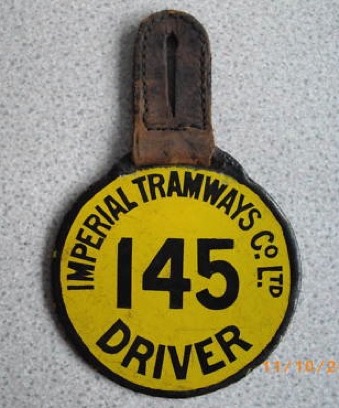
Possible tramway-era driver licence badge
(with thanks to Mr Tait)