Lea Bridge, Leyton and Walthamstow Tramways
History
Powers to construct 3.48-miles of horse-drawn tramway between Lea Bridge Corner in Upper Clapton and the Rising Sun public house at Whipps Cross, were granted on the 11th August 1881 by the Lea Bridge, Leyton and Walthamstow Tramways Act 1881. The act also incorporated a company — the Lea Bridge, Leyton and Walthamstow Tramways Company — to finance, build and operate the tramway.
The company wisely avoided constructing the section of tramway in Clapton, as this would have involved the company in expensive road widening, a requirement introduced into the enabling act at the insistence of Hackney Local Board. Instead, construction focused on the section from the East London Water Works gates at Lea Bridge (in Essex), northeastwards along Lea Bridge Road, to the latter's junction with Wood Street in Whipps Cross; this opened to the public on the 7th May 1883.
The company was, however, not in good financial health, not only were passenger journeys fewer than had been hoped for, but the company was significantly undercapitalised, such that it was not in a position to finish constructing the eastern section of the line (Wood Street to the Rising Sun on Woodford New Road), let alone fund the expensive western section. The company had in fact let its powers for the latter lapse, as the two years allowed for construction had expired without work being started; it had also, therefore, had to go to the additional expense of renewing the powers, which it did on the 7th August 1884 under the Lea Bridge, Leyton and Walthamstow Tramways (Extensions) Act 1884. The powers did, however, include a double line rather than a single line from the Water Works gate to Lea Bridge Corner.
Meanwhile, having failed to pay its contractors, the latter applied for a winding-up order in May 1884, which was granted on the 13th November 1884, though it was suspended for a month as the company successfully pleaded that the end of the tunnel was now in sight. Quite why it thought this is unclear, as it had neither the money to build the western extension to Clapton, where its tracks would be just a few feet short of those of the North Metropolitan Tramways Company, nor to pay the contractors. The financial situation was in fact so acute that the company had to completely cease running services, which it probably did in October 1884, having apparently run a fairly sporadic service prior to this.
The company was finally put out of its misery on the 15th January 1885 with the appointment of a liquidator, who was, however, unable to find a buyer for the tramway. It is unclear how long the tramway was operated by the liquidator, as he was fined (for the second time) on the 18th July 1885 for running four tramcars without the requisite licences.
A buyer was eventually found for the moribund tramway — essentially for the track and powers — but not until over 3 years had elapsed. The buyer was a local stone merchant — William Griffiths — who seems to have immediately put money into his new acquisition, given that the eastern extension to the Rising Sun was completed and passed as fit for use on the 16th October 1888, though it was to be several months before services recommenced (13th May 1889).
Meanwhile, Griffiths had registered a new company on 19th October 1888 — the Lea Bridge, Leyton and Walthamstow Tramways Company Limited — to take over and operate the tramway.
Powers were then sought to transfer the assets (and powers) of the LBL&WTCoLtd to a new statutory company, which rather confusingly, had the same name as the original company (i.e., the Lea Bridge, Leyton and Walthamstow Tramways Company). This may have been done to tidy up the legal niceties, as it is seems likely that the LBL&WTCoLtd could not legally take over a statutory company, i.e., the old LBL&WTCo. The new powers, which formally transferred the assets to the new LBL&WTCo from the LBL&WTCoLtd, dissolving the latter in the process, also authorised 1.44 miles of new tramway from the junction of Lea Bridge Road and High Road (Leyton), along the latter to Leyton Station; the powers were granted on the 12th August 1889 under the Lea Bridge, Leyton and Walthamstow Tramways Act 1889.
The new company lost no time in constructing the new branch line to Leyton Station, services commencing over it on the 31st March 1890. The company followed this up with provisional powers to extend the main line westwards from the East London Water Works for 0.43 miles, though still some way short of the ultimate goal of connecting to the North Metropolitan Tramways Company's tracks at Upper Clapton Road, as Hackney Local Board were still insisting on expensive road widening. The provisional powers were confirmed on the 4th August 1890 under the Lea Bridge, Leyton and Walthamstow Tramways Order 1890, which was passed into law by the Tramways Orders Confirmation (No.2) Act 1890. The extension opened to the public on the 18th April 1892.
This took the system to its final size of 4.8 Miles. From the western terminus at the junction of Cornthwaite Road and Lea Bridge Road in Clapton, the main line ran northeastwards along Lea Bridge Road to its junction with Woodford New Road in Whipps Cross, whereupon it turned almost north along the latter road to a terminus outside the Rising Sun. The line to Leyton Station branched off Lea Bridge Road near the Bakers Arms, running broadly southwards along High Road (Leyton) to a terminus just short of Leyton Station opposite Trelawn Road. No further tramways were built, the company instead expanding through the introduction of numerous horse bus services.
This second incarnation of the tramway was very profitable, and was eventually operated by around 22 double-deck tramcars. It is likely that these were all procured either second-hand or new, as the liquidator had probably sold off the old horsecars.
The outlook was, however, far from rosy, as the threat of municipalisation loomed ever larger. On the 2nd August 1898, Leyton Urban District Council obtained powers — under the Leyton Urban District Council Act 1898 — to take-over and operate (or lease) the existing tramway lines within the U.D.C. boundary, by either animal or mechanical power. For the moment the council chose to wait, as it did not have the right to compulsory purchase the tramway within its boundaries until August 1902, and there was also the unresolved question of what would happen to the portions of the company's tramway outside Leyton, i.e. in Hackney and in Walthamstow.
The company, seeing which way the wind was blowing, separated off its substantial horse-bus operations into a new company, the Great Eastern Omnibus Company Limited, in 1900. Although it then offered to sell the tramway to Leyton U.D.C., negotiations were protracted, such that agreement was only reached on the 13th April 1905. Meanwhile, on the 15th August 1904, the council had obtained further powers to expand its planned electric tramway system; these were granted under the Leyton Urban District Council Act 1904.
On the 1st June 1905, Leyton U.D.C took over ownership of the tramway, including the tracks in Walthamstow (by agreement with Walthamstow U.D.C), the short section of track in Hackney being leased to the council by the company, which still owned it. The horse tramway was operated by the company under a lease arrangement until the 31st October 1905, operation thereafter being by Leyton U.D.C.
Although Leyton's overhead electric tramway opened on the 1st December 1906, the horse services continued to operate over the short section of tramway from the River Lea to Clapton until the 9th December 1908, London County Council having bought this section from the company in July 1908, but now wishing to commence its reconstruction for electric conduit working.
Uniforms
Photographs depicting tramway staff are extremely rare, either under the auspices of the first company (1883-1884) or the second company (1889-1905). Those that have survived suggest that in common with the majority of horse tramways in the UK, drivers simply wore heavy duty informal attire — trousers, jackets, knee blankets and the normal headgear of the day, the near ubiquitous bowler hat. Conductors possibly wore informal jackets and trousers (this is unclear), perhaps with kepi-style caps, though whether they carried a cap badge or not is unknown.
Photographs of inspectors have not survived, so it is unclear what uniforms, if any, they wore.
Further reading
For a history of the system, see: 'The Tramways of East London' by Rodinglea; The Tramway & Light Railway Society and The Light Railway Transport League (1967).
Images
Horse tram drivers and conductors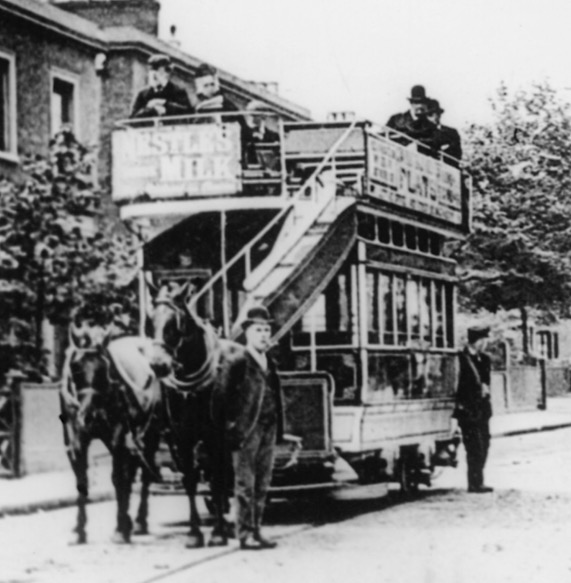
An unidentified Lea Bridge horsecar and crew, captured at the Clapton terminus in August 1905. The driver (left) is in informal attire, whilst his conductor (rear) appears to be wearing a kepi-style cap, though this is far from certain. Photo courtesy of the Tramways and Light Railway Society, with thanks to David Voice.