Leeds Tramways Company
History
Prior to the passing of the Tramways Act of 1870, Leeds Borough Council had rejected several tramway schemes, primarily due to concerns over its highways and the services beneath them. However, following the passing of the aforementioned act, which included key protections for local authorities, the council was in a more receptive mood, soon agreeing to a scheme promoted by the Liverpool-based tramway entrepreneurs, William and Daniel Busby. The way had no doubt been smoothed by the offer to pay a concession — to the borough — as well as an agreement to pay compensation to local entrepreneur and omnibus proprietor, William Turton, who also happened to be a leading councillor.
Powers to build 11.4 miles of tramway were granted to William and Daniel Busby on the 14th August 1871 under the Leeds Tramways Order 1871, which was passed into law by the Tramways Orders Confirmation Act (1871). Construction commenced on the 15th June 1871, i.e., before the aforementioned act had even received its Royal Assent, so relations between the Busbys and the council must have been very cordial, the standard-gauge, horse-drawn line from central Leeds (Boar Lane) out to Shaw Lane on Otley Road in Headingley opening to the public on the 16th October 1871. The council's Highways Committee had, however, insisted on the use of macadam between the rails, which the tramway promoters, probably against their better judgement, had acquiesced to; the horses' hooves soon tore this up, which led to the first disagreement between the two parties, though in this instance it was quickly resolved.
The Kirkstall line was the next to open, the first section, from Boar Lane to the Cardigan Arms on Kirkstall Road opening on the 1st April 1872, and from there to the Star and Garter in Kirkstall Village on the 18th May 1872. The company consistently sited its termini outside pubs, so it clearly suspected, or indeed knew, something about its target audience.
The Busbys meanwhile set about forming a new company to take over the newly built tramways (and the powers), and to finance and construct the remaining lines. The new company — the Leeds Tramways Company — was incorporated by an act of parliament, which also authorised the transfer of the various assets from the Busbys to the new company. The aforementioned act — the Leeds Tramways Act 1872 — received its Royal Assent on the 6th August 1872; it also included an extension of the time allowed to construct the remainder of the lines authorised by the 1871 Act. A share issue was soon announced, which was closed on the 3rd October 1872; the Busbys were paid in cash and shares, so maintained their interest in the enterprise, the transfer to the new company taking place 10 months later in August 1873. By this time, Daniel Busby had become a director of the company, joining William Turton, who clearly saw the tramway as the future of public transport in Leeds.
The Headingley line was extended from Shaw Lane to the Three Horse Shoes in Headingley in early October 1873, and this was followed by the Hunslet line (Briggate to the Crooked Billet Inn in Hunslet) on the 3rd March 1874, and the York Road line (from the junction of Boar Lane and Briggate to the Woodpecker Inn at York Road) on the 29th August 1874. Within three months, the first section of the Chapeltown line was then opened (from Briggate to Cross Roads in Chapeltown) on the the 14th November 1874, and from there the short distance to yet another pub (the Queens Arms) on the 1st December 1874.
The tramways company also ran horse omnibuses in connection with the tramway — as feeder services — though these often became a bone of contention with the corporation, who had successfully inserted a clause in the 1871 Act giving them the power to compel the tramway company to provide a replacement service should the company withdraw a service.
The company generally paid good dividends throughout the 1870s, though these dropped towards the end of the decade due to track renewals and a general recession, which impacted passenger numbers. The company was, however, ably steered though these choppy waters by William Turton, who became chairman in 1877.
Powers to build a further 3.32 miles of tramway, to Wortley and to Meanwood, were obtained on the 2nd August 1877 under the Leeds Tramways Act (1877). The company had in fact only wanted to construct the Wortley line as far as the Crown Inn, but was persuaded by the corporation to extend it to the Star Inn, which involved a steep climb up Tong Lane that would inevitably make it expensive to operate. By now there was a large group within the council which firmly believed that all the tramways within the borough should be owned by the corporation, and it was undoubtedly with this in mind that a clause had been included in the Act enabling the corporation to build the new lines within 6 months of the passing of the Act, though in the end, the corporation chose not to exercise this right.
The company had also tried, unsuccessfully, to secure powers to operate steam trams, primarily to reduce costs, as several of the lines included steep gradients, which necessitated the use of 3 and sometimes 4 horses per vehicle, greatly increasing costs, not to mention the toll on the animals themselves. This clause was, however, struck out at the last minute, in favour of awaiting the outcome of a bill that was passing through parliament, which would address the issue of steam traction country wide.
The lines authorised by the 1877 Act were opened as follows: Meanwood (from a junction with the Chapeltown line at Golden Cross to the Primrose Inn at Buslingthorpe) on the 16th April 1878; Wortley (from a junction with the Kirkstall line at Wellington Bridge to the Crown Hotel in Wortley) on the 1st January 1879; and Upper Wortley (to the Star Inn) on the 5th April 1879. Both lines were, however, barely remunerative, which made the company extremely reluctant to construct any more lines. These openings took the standard-gauge tramway system to its final size of 14.16 miles.
The company had meanwhile conducted a small trial of steam traction (in October 1877), with which it was impressed, so was now awaiting the parliamentary act that would govern its use; the latter was passed into law on the 11th August 1879 as the Use of Mechanical Power on Tramways Act (1879). A formal 3-month Board of Trade-approved trial of steam traction on passenger services (on the Wortley line) began on the 14th June 1880, and proved successful, the LTCo subsequently seeking parliamentary approval to introduce steam traction on a permanent basis. Powers to this end were obtained on the 18th July 1881, when the Leeds Tramways Act (1881) passed its Royal Assent; the Act also authorised the company to run horse-omnibus services within the Borough of Leeds. Although the company already operated a limited number of omnibuses, this was often at the insistence of the corporation rather than of its own volition, due to a clause in the Act of 1871. The company was, however, still hardly free of corporation interference, as the Act of 1881 included a clause requiring the company to sell all its omnibus (and cab operations) should the council request it — at 6 months' notice — to a party nominated by the council, and for a price set by an arbitrator.
On the 28th July 1882, the LTCo purchased the entire omnibus operations of William Turton, who was by this time no longer a councillor, which it then used in competition with other operators. Turton stepped down from the chairmanship for a while due to this conflict of interest, his friend and busy colleague Daniel Busby resigning his directorship in 1883. The two were in fact close business associates, together promoting and constructing numerous tramways across the north of England.
The introduction of steam traction, however, came at some cost, as most of the existing track was far too lightly laid for the much heavier steam trams, necessitating the relaying not only of the track, but also the foundations thereof. Unfortunately, this was not always done particularly well, which would eventually place the company on a collision course with the Highways Committee as the track was destined to deteriorate alarmingly. Steam services on the Headingley line began on the 1st January 1883 using a Thomas Green engine, a local manufacturing company whose chairman happened to be none other than William Turton.
In 1881, the company had offered to seek powers to build a tramway out to Roundhay Park, which the corporation had purchased in 1871, but the two parties could not reach agreement, so it was not included in the Act of 1881. The need for a reliable and high-capacity transport link to the park was, however, not in doubt, but the council seemed unable to decide exactly what form this should take, various factions supporting a railway, an elevated railway and an extension of the tramway. Finally, on the 29th September 1887, the council decided to construct a tramway, obtaining powers on the 28th June 1888, to build 3.91 miles of tramway; the powers were granted by the Leeds Corporation Tramways Order (1888), which was passed into law under the Tramways Orders Confirmation (No.1) Act (1888).
The Act allowed the corporation to build two lines, the first from a junction with the LTCo's Chapeltown line at Sheepscar, through Harehills, and along Roundhay Road to the Park entrance, and the second from a junction with the LTCo's York Road line at Kirkgate, along York Street, Burmantofts Street, Beckett Street and Harehills Road to a junction with the first line at Harehills. The corporation commenced construction of the Sheepscar to Roundhay Park line on the 12th December 1888, which proved to be a rather precipitate decision given that it hadn't yet worked out who would operate the tramway, let alone reached an agreement with anyone. Rather predictably, the LTCo was not keen to operate a line that was seasonal in nature, and would require a significant outlay by the company — primarliy in additional tramcars and engines/horses — in the absence of a commitment from the corporation as to the rest of the system, most of which the corporation could compulsorily purchase in 4 years' time. A temporary solution was, however, found, the LTCo attempting to run a service — with as many horsecars as it could muster (not many) — between the 3rd and the 15th August 1889. After this, all services ceased and the corporation was left with a brand-new tramway, over which no services operated!
The corporation at first sought to advertise for tenders to work the new Roundhay line, as well as the lines currently owned by the LTCo, but quickly realised that it was on shaky legal ground. Instead the Highways Committee re-opened negotiations with the LTCo, eventually reaching a draft agreement — on the 18th June 1890 — for the corporation to buy the company's lines, relay them, and to then lease them (and the Roundhay Park line) back to the company for 14 years at a fixed rate. Unfortunately, neither the LTCo's shareholders, nor the full council were much enamoured with the agreement, so it proceeded no further. The line was destined to lay dormant for over two years, the corporation eventually being rescued from its self-inflicted predicament by an offer from the Thomson-Houston Company (on the 16th September 1890) to electrify and operate the line. The LTCo did, however, play a small role in temporarily operating the line with steam trams — between 15th May and the 10th November 1891 — whilst the electrification of the line was undertaken.
Meanwhile, the LTCo's licence to use steam traction had expired on the 18th July 1888, though no-one seems to have noticed, the company continuing to run the steam trams without authorisation. By 1891, however, with the Headingley track having badly deteriorated, such that it was a palpable danger to other road users, the corporation suddenly realised that the company no longer had a licence, and that it perhaps had more leverage than it thought, though it was in fact always empowered to force repairs to the roads if it so chose. The tramway system was subsequently inspected by the B.O.T. on the 10th July 1891, which resulted in a number of findings, some of which were clearly going to require significant expenditure. The company was, however, far from keen to undertake any work, as the corporation had the right — under the Tramways Act of 1870 — to purchase the 1871 lines (including the Headingley line) 21 years after the passing of the enablement act, i.e., on the 14th August 1892. It had of course been abundantly clear for some years that the corporation intended to exercise its right, so any money spent by the company improving a tramway that was about to be municipalised made no financial sense whatsoever. The B.O.T itself also seemed reluctant to force the company into action, probably because they knew that the end of its tenure was only a year away.
The corporation's hands were, however, forced by a group of Headingley ratepayers, who threatened it with legal action if it didn't put the Headingley line — or rather the road — back in order, as it was entitled to do by law. As a consequence, the corporation carried out some track remediation in January 1892, then followed this up with a request for another B.O.T inspection, which unsurprisingly — due to the state of the track — led to the withdrawal of steam services on the 10th March 1892.
Two weeks later, on the 22nd March 1892, the corporation and the company met to see under what conditions the latter would agree to sell the tramway system. Although this meeting seems to have gone reasonably well, the subsequent letter from the LTCo to the Corporation Highways Committee outlining the way forward, was not well received, the corporation for the moment breaking off further discussions.
On the 4th May 1892, and in the absence of an agreement, the council formally resolved to buy the tramway, including the lines that would not expire for another 6 years. After yet more discussions, the two parties (the corporation and the LTCo) approached the B.O.T. requesting it to appoint an arbitrator. It is unclear what the exact motivation of the company was, but it then chose to dispute the process that was being used for the lines that were not expiring in 1892, which led to a further delay. A way forward was, however, eventually agreed, and on the 15th September 1892, the corporation served notice on the LTCo of its intention to purchase the tramway, as it was required to do by law.
On the 27th February 1892 the company offered to sell its undertaking to the corporation for £240,136, which it viewed as a going concern, and therefore included loss of future income. The LTCo was not alone in facing compulsory purchase of its tramway — under the Tramway Act of 1870 — many companies up and down the country being in dispute with their respective councils, which were attempting to purchase the enterprises at scrap value. This was in large measure due to the imprecise wording of the 1870 Act, but after two precedent-setting cases had come to court elsewhere, the Leeds arbitrator awarded the LTCo £114,590, i.e., less than half what the company considered it to be worth. The price covered just over 22 miles of track (track miles not route miles), 45 horse-drawn trams (and the horses necessary to work them), 25 steam trams, 24 steam-tram trailers, the company's horse omnibuses, and all the ancillary buildings and equipment. Needless to say, the company was far from satisfied with this, but could do little as it had agreed to abide by the arbitrator's valuation.
The corporation took possession of its new asset on the 2nd February 1894, the company distributing the money received to its shareholders, and voting to wind itself up on the 28th May 1895.
Uniforms
In common with the majority of horse tramway operators in the UK, Leeds Tramways Company drivers wore informal but smart attire — trousers, overcoats, jackets, waistcoats, shirts and ties, often supplemented with leather aprons. Headgear appears to have largely followed the fashion of the day, predominantly the bowler hat; no badges of any kind were worn on either the jackets or the hats. Conductors on the other hand appear to have worn long jackets, and company-issued kepi-style caps. Documentary evidence indicates that the jackets were dark blue, with 'L. T. Co.' on the collars, presumably embroidered. The caps were in a kepi style and bore a prominent metal cap badge, which appears to have been oblong in form, with a semi-circular protrusion at the top; unfortunately, an example appears not to have survived. It is likely that conductors were required to buy the jackets and caps themselves, either from the company or from a local outfitter.
Horse-tram drivers and conductors were divided into three classes, and paid accordingly; unlike some other tramway systems, this does not appear to have resulted in the issue of 'class' badges.
Steam tram drivers (and stokers) wore typical railway footplate attire (heavy cotton jackets and trousers, light in colour) with grease-top or cloth caps (without badges). Conductors working the steam services wore identical attire to their horse-tram counterparts.
A single photograph of an inspector has survived, which shows that in the 1880s (at least) they were issued with elaborate single-breasted jackets with stand-up collars, edged in a finer material than the main body and with elaborate frogging. Headwear took the form of a kepi-style cap, though whether this and collars bore insignia, remains unknown.
Further reading
For more information on the Leeds Tramways Company, see: 'Leeds Transport Volume 1, 1830-1902' by J Soper; Leeds Transport Historical Society (1985) and 'A History of the British Steam Tram, Volume 3 by David Gladwin; Adam Gordon (2007).
Images
Horse-tram drivers and conductors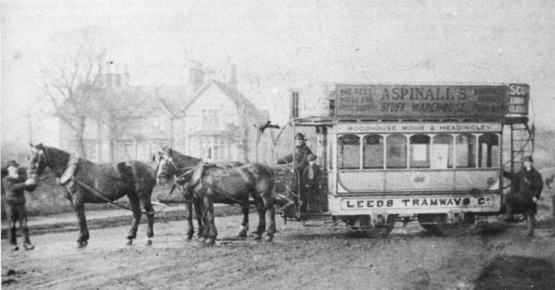
A poor-quality but early photograph of Leeds Tramways Company Horsecar No 28 standing outside Headingley depot around 1880. Photo courtesy of the Tramways and Light Railway Society, with thanks to David Voice.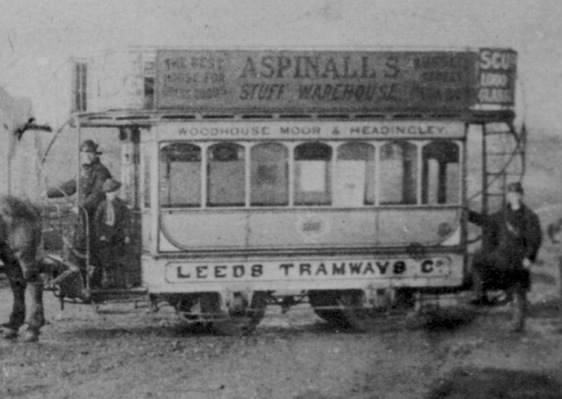
An enlargement of the above photograph showing the driver and the conductor. The driver is wearing a bowler hat with upturned brim, typical of the period, whilst the conductor sports a kepi-style cap and a long overcoat.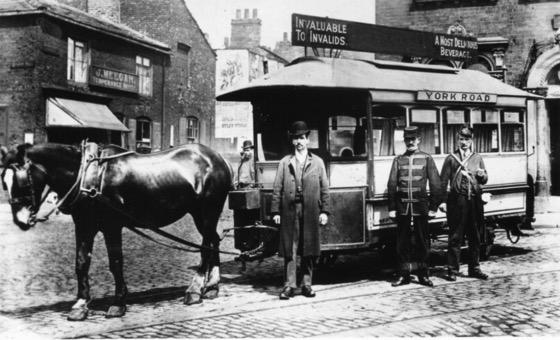
The crew of Horsecar No 1 (the second vehicle to carry that number) pose for the camera outside the Woodpecker Inn at the terminus of the York Road line — photo undated, but probably taken in the late 1880s or early 1890s. Photo courtesy of the Tramways and Light Railway Society, with thanks to David Voice.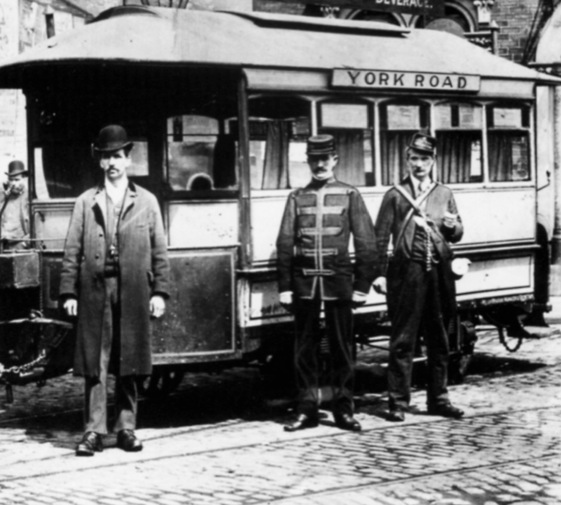
An enlargement of the above photograph showing the assembled individuals in more detail. The driver (left) is smartly but informally attired, whilst the conductor is wearing a kepi-style cap bearing a prominent metal cap badge; it is unclear whether his coat was company issued, but in all likelihood it was bought by the individual himself. The individual in the centre of the photograph is probably an inspector.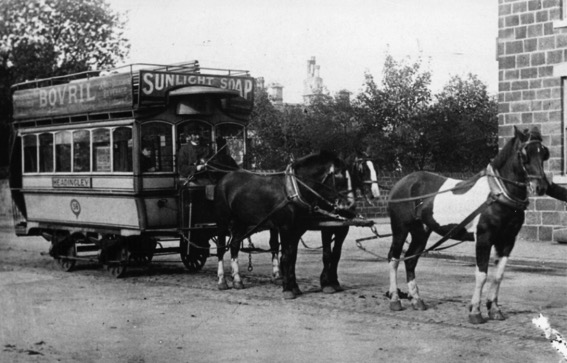
Eades reversible car No 58 stands outside the Woodman Hotel in Otley Road, Headingley — photo undated, but probably taken in the early 1890s. Photo courtesy of the Tramways and Light Railway Society, with thanks to David Voice.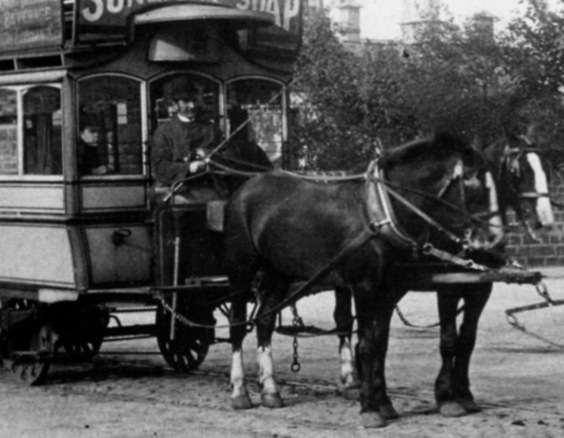
An enlargement of the above photograph showing the driver, who is wearing a bowler hat and a leather apron.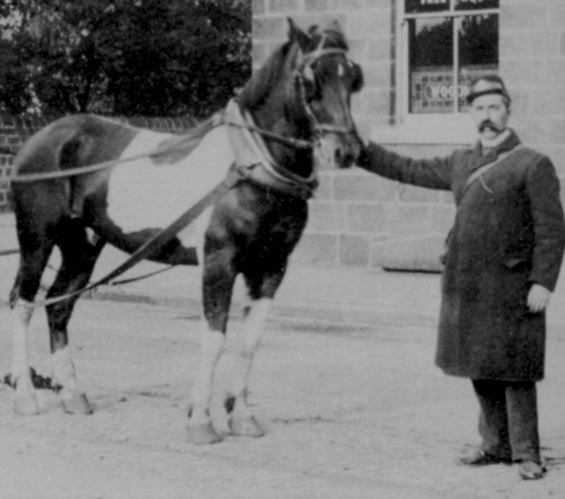
Another blow-up of the photograph above, this time showing the conductor, who is holding the third horse, possibly a trace horse. He is wearing a company-issued kepi-style cap with its prominent metal cap badge.
Steam-tram drivers and conductors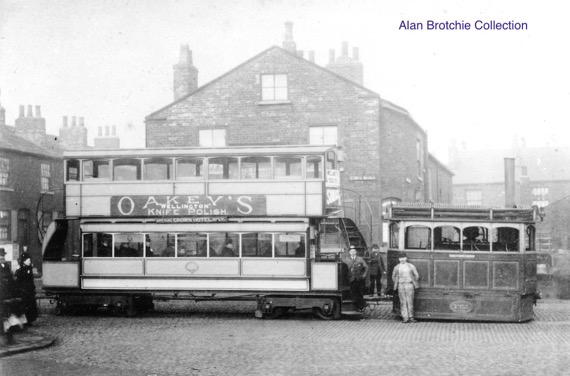
The crew of Steam Tram No 11 (Kitson T192 of 1885) pose for the cameraman outside the Crown Inn terminus at New Wortley — photo undated, but probably taken in the early 1890s.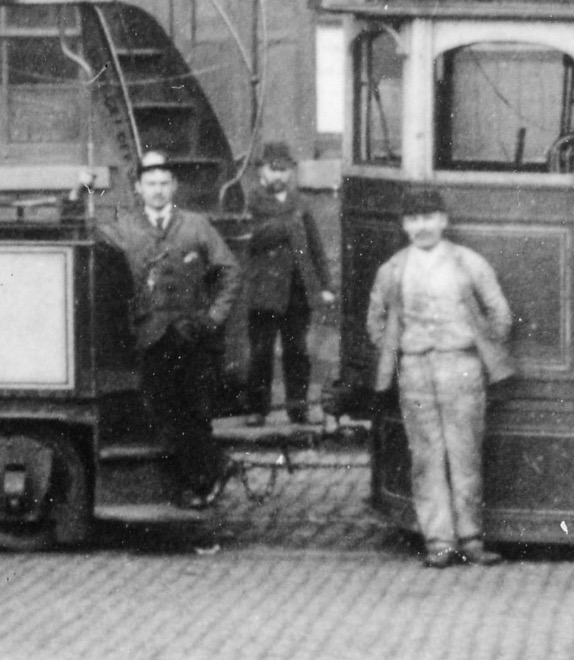
An enlargement of the above photograph showing the conductor and the driver; although slightly out of focus, the latter man is clearly wearing light-coloured cotton footplate attire, whilst the former has a short single-breasted jacket and kepi-style cap with prominent metal cap badge.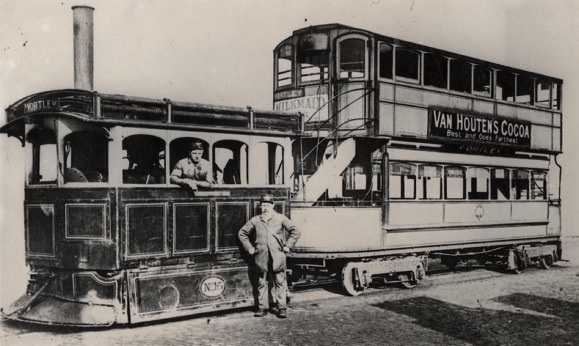
A driver and a conductor with Steam Tram No 16 (Kitson T212 of 1886) on a service for Wortley — photo undated, but probably taken around 1890. Author's Collection.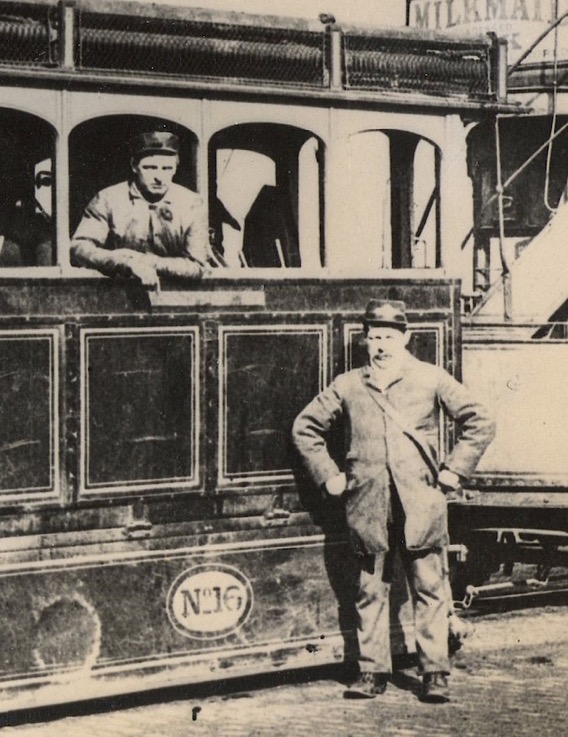
An enlargement of the above photograph showing the driver and the conductor. Whilst the driver is in railway footplate-like attire, the conductor is wearing a long jacket and a kepi-style cap bearing a cap badge, the latter almost certainly the same pattern as that worn by horse tram conductors. Author's Collection.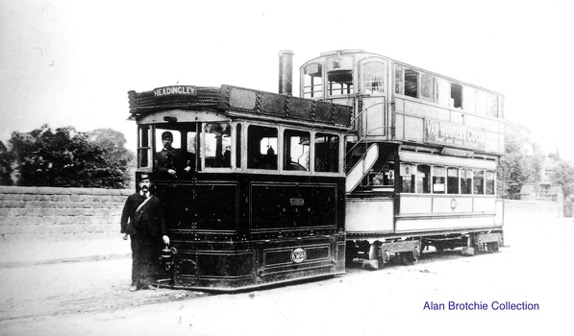
Leeds Tramways Company Steam Tram No 23 (a Thomas Green product) and Milnes trailer, both delivered in 1889, pictured at Headingley — photo undated, but probably taken not long after delivery, so circa 1890.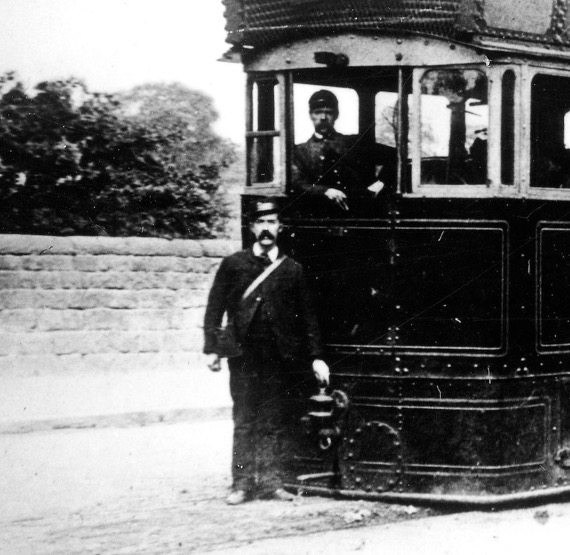
An enlargement of the above photograph showing the conductor (in kepi-style cap with prominent cap badge) and the driver (in railway footplate-like attire).
Senior staff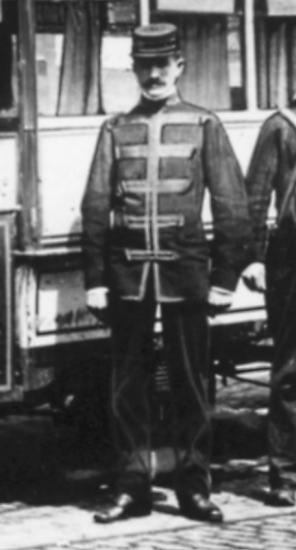
An enlargement of the photograph of Horsecar No 1 above, showing the inspector in his elaborate uniform and kepi-style cap.