Isle of Thanet Electric Tramways
History
Powers to construct 8.91 miles of electric tramway between Margate, Broadstairs and Ramsgate were granted on the 13th August 1898, under the Isle of Thanet Light Railway Order 1898. The promoter was the Isle of Thanet Light Railways (Electric) Company, which already held powers for electric lighting in Margate. Prior to this, and in anticipation of a successful outcome, another company — The Isle of Thanet Electric Tramways and Lighting Company — was registered on the 3rd November 1897, to raise the capital to build the electric tramway system, as well as the associated electricity generation and supply infrastructure.
The initials powers were quickly followed by an application for further lines, and though not all were approved, 2.65 miles were, including extensions at each end (to Westbrook, and to Ramsgate Railway Station); these powers were granted on the 23rd February 1900 under the Isle of Thanet Light Railways (Extension) Order 1900. Prior to this — on the 11th May 1899 — the various powers and assets held by the ITLR(E)Co were transferred to the ITET&LCo.
Construction commenced in early 1899, but proceeded slowly, such that the ITET&LCo was eventually forced to seek an extension of the time allowed, this being granted on the 13th June 1901 under the Isle of Thanet Light Railways (Amendment) Order 1901. The first section of the new 3ft 6ins-gauge overhead electric tramway, from near the stations in Margate through to Ramsgate Harbour — via the Top Road (which was in large part a tram-only reservation) — opened to the public on the 4th April 1901. The rest of the system quickly followed: the main line through Broadstairs on the 5th May 1901, Ramsgate Harbour to Ramsgate Station on the 29th May 1901, and the stations at Margate to Westbrook on the 6th July 1901.
This took the system to its final size of 10.84 miles. From the northwestern terminus in Canterbury Road, Westbrook, the line ran northeastwards through Margate (via Marine Terrace and Marine Drive), before turning inland through Cliftonville (along Northdown Road and Northdown Park Road), then southwards down Northdown Hill to the main tram depot at St Peters (just off Westover Road). From here the line proceeded southeastwards via Albion Road and St Peters Road to the latter's junction with Broadstairs Road, where the tracks split, the Top Road heading south via Osborne Road and a tram-only reservation (now Salisbury Road/Avenue), the main line heading eastwards down the High Street into Broadstairs, along Victoria Parade, before looping back up to meet the Top Road via another tram-only reserved track section (now Dumpton Park Drive). From here the line headed southwest via Belle Vue Road, before dropping down to Ramsgate Harbour, continuing along the Royal Parade and the Paragon, then turning inland — via Grange Road and High Street — to a terminus outside Ramsgate Station.
The initial services were delivered by just 8 tramcars, but by the end of 1901, the fleet had risen to 50. These were joined by a further 10 cars, the last acquired, in 1903.
It was only after the opening of the tramway that a share issue was announced — in December 1901 — the construction having largely been financed by the constructors (the Thanet Construction Company) in exchange for a large number of shares in the ITET&LCo; it was in fact these shares that were being offered for sale, though there is a suspicion that a deal for them had already been agreed. Both the tramway company and the construction company had been set up by William Martin Murphy, a charismatic Irish tramway entrepreneur, who is best known to history as the chairman of the Dublin United Tramways Company. It may have been at this point that the British Thomson-Houston Company (effectively a subsidiary of General Electric of America) — a major player in the tramway, engineering and electrical equipment industry — took a controlling interest in the ITET&LCo. The BTHCo and William Martin Murphy worked closely together on several other electric tramways (e.g. Cork Electric Tramways; Paisley District Tramways), and it is entirely possible that the BTHCo were in on the scheme from the start, providing the financial wherewithal for the TCCo to build the tramway.
The system was initially plagued by accidents, with several serious runaways resulting from a combination of driver inexperience, some very steep hills, and the absence of track brakes. After one accident, the company was directed to fit track brakes, though this was to prove impractical for the the 20 bogie trams (Nos 21 to 40), the company having to shorten them and fit new trucks, all at considerable expense.
The tramway was well-patronised, and despite the tribulations of the early years, it made healthy profits right through to the Great War. Despite this, the company did not see fit to modernise its trams, though its hands were to some extent tied by the Board of Trade, which forbade top-covering of 3ft 6ins-gauge tramcars.
Having suffered from a degree of motorbus competition in the years immediately before the Great War, the company bought three second-hand vehicles of its own in 1913, deploying them to reach destinations that the trams could not. It is likely that these services were one of the first casualties of the Great War. The tramway was particularly badly affected by the conflict, not only losing men (and their skills) to the armed forces, but also suffering from a dramatic decrease in passengers due to the coastal location and several enemy bombardments. The heady pre-war years must have seemed a distant memory, the profits turning into losses, and the system deteriorating due to the lack of maintenance and severe restrictions on spares and new material. By the end of the conflict, only 14 tramcars were serviceable. Following the cessation of hostilities, the company attempted to set the system in order, which included an extensive though gradual rebuilding of many of the trams.
The 1920s saw the appearance of intense motorbus competition, particularly with the East Kent Road Car Company, which was based in Canterbury. The ITET&LCo fought back by purchasing some small rivals, and expanding its own fleet of motorbuses, which by the end of the decade numbered 35 vehicles.
Since the mid-1920s, however, the company had been increasingly directing its energies to electricity supply, renaming itself the Isle of Thanet Electric Supply Company in June 1924.
Although the company was making very healthy profits during the early 1930s, these were driven by the electric supply side of the business, rather than the tramway system, In 1933. Following an increase in electricity prices, the company drew fire from both ratepayers and the local councils, for increasing prices in order — as they saw it — to subsidise a loss-making tramway service operated by 30-year-old vehicles on increasingly decrepit track. Eventually, the three local councils — Margate, Broadstairs and Ramsgate — approached the company requesting it to abandon the tramway and replace the services with motorbuses, which in May 1936 it agreed to do, committing to a date not later than the 31st March 1937.
Meanwhile, the ITESCo sold its motor omnibus business to its erstwhile rival — the East Kent Road Car Company — on the 1st October 1936, and following authorisation (presumably from the Ministry of Transport), the last tram of all ran on the 27th March 1936.
Uniforms
Early photographs indicate that tramcar staff wore double-breasted, lancer-style tunics with five pairs of buttons (narrowing from top to bottom and bearing the full company name around a plain centre — see link) and stand-up collars; the latter carried system initials — 'I T T' — on both sides in individual brass letters. Caps were in a soft-topped style with a glossy peak, and bore a large oval, brass and deep-blue enamel cap badge with the bearer's grade and an employee number, surrounded by the company name; 'MOTORMAN' is known (from photographs), and 'CONDUCTOR' presumably existed too. The caps appear to have been changed in the mid-Edwardian era to a more modern tensioned-crown type, the cap badge, however, remained the same.
At some point during or shortly after the Great War, a switch appears to have been made to single-breasted jackets with stand-up collars; the latter presumably bore the same insignia as the previous tunics, though confirmation must await the discovery of further photographic evidence.
A final change in uniform appears to have been made in the mid-1920s, possibly around 1924 when the company name was changed to the Isle of Thanet Electric Supply Company. Motormen and conductors were now issued with double-breasted jackets with four pairs of buttons and lapels; the latter collars 'I T T' initials on the bearer's right-hand side, though not apparently on the left-hand side. The large oval cap badge was replaced by a small enamel, shield-shaped badge bearing the owning company initials — 'I T E S Co' — worn above an employee number.
Tramcar staff were also issued with greatcoats, though it is currently unclear whether or not they bore company insignia of any kind.
Photographs of inspectors are rare, but those that have survived, indicate that they wore single-breasted jackets with hidden buttons (or an hook and eye affair), edged in a finer material than the main body of the jacket (with faux frogs), and with a slit breast pocket and stand-up collars; the latter probably carried the grade — 'Inspector' — in embroidered script lettering, though this cannot be made out with certainty on surviving photographs. Although it is unclear what caps were worn during the first decade of operation, an oval cap badge has survived which is identical in form to the oval cap badges issued to tramcar crews. The badge was brass, with the company name above ('ISLE OF THANET') and below ('ELECTRIC TRAMWAYS CO LD') in ribbons inlaid with deep-blue enamel; the grade 'INSPECTOR" was written across the middle on a raised brass bar, but with the grade itself in deep-blue enamel rather than inlaid in it. This badge appears to have fallen out of use some time before the Great War, as the inspectors in a circa 1914 staff photo are not wearing it, despite the fact that it was still being used for motormen and conductors. By this time, inspectors were wearing tensioned-crown peaked caps, very probably with the bearer's grade — 'Inspector' — in embroidered script-lettering on a hat band.
In common with the vast majority of British tramway systems, the ITETCo employed female staff during the Great War to replace men lost to the armed services. These ladies were issued with tailored, single-breasted jackets with five buttons, high fold-over collars, a waist belt with button fastening, and long matching skirts. Photographs indicate that individual 'I T T' system initials were worn on the collars. The ladies were provided with baggy caps, generally known as motor caps; these bore the same oval cap badge worn by male tramcar staff.
Further reading
For more information on the Isle of Thanet Tramways, see: 'Tramways of Kent, Volume 2' by 'Invicta'; Light Railway Transport League (1975).
Images
Motormen and conductors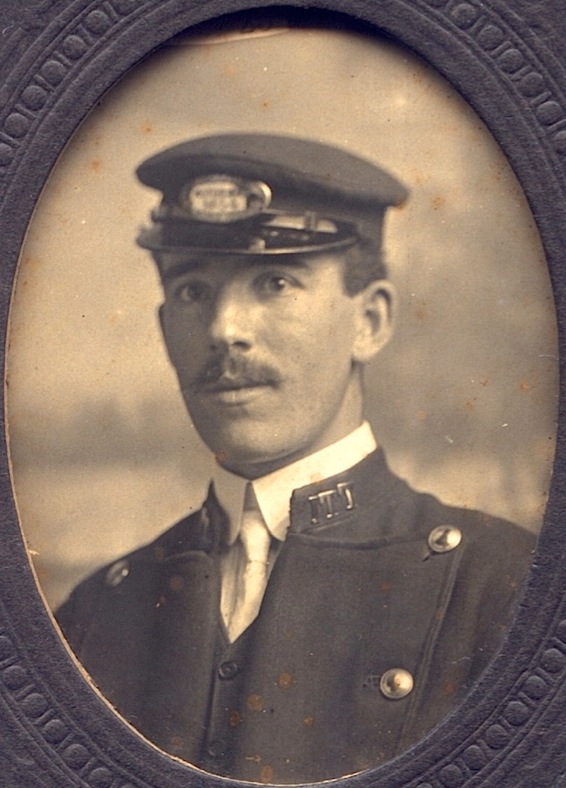
A studio portrait of Employee No 54, an Isle of Thanet Electric Tramways motorman — photo undated, but probably taken in the early Edwardian era. The large oval cap badge was brass with deep-blue enamel. With thanks to Richard Rosa.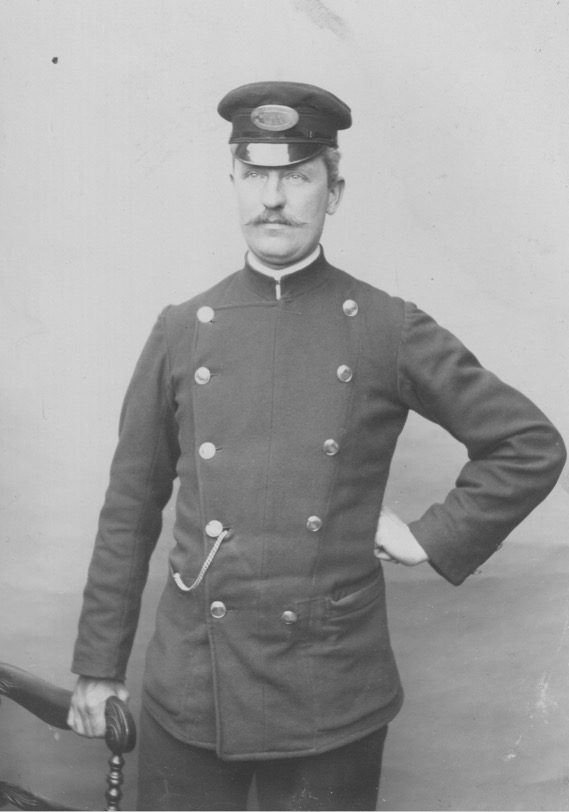
Another studio portrait of an Isle of Thanet Electric Tramways motorman, undated, but again probably early Edwardian. Author's Collection.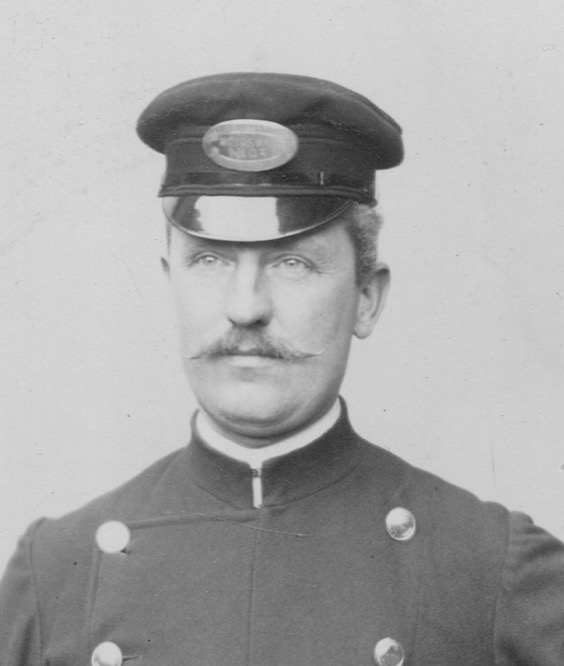
An enlargement of the above photograph showing the uniform in more detail. The subject is a motorman, possibly Employee No 93, though the precise number cannot be made out. It is unclear why he has no badges on his collars.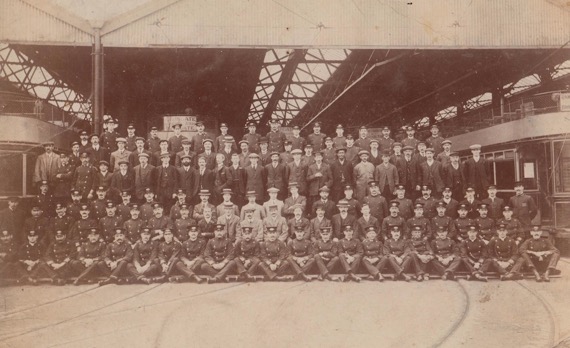
A staff photo taken at St Peters' depot — photo undated, but probably taken between 1911 and 1914, given the presence of tramcar destination enamels on the top deck, which were only used in this form from 1911 through to the Great War. Of the uniformed tramwaymen, 64 are wearing double-breasted, lancer-style tunics, one man has a single-breasted jacket (with stand-up collars), and three men have single-breasted jackets (with lapels). The remaining four uniformed personnel would appear to be inspectors. Photo with kind permission of Martyn Jolly, whose great grandfather worked at St Peters depot after being invalided out of the army in 1916.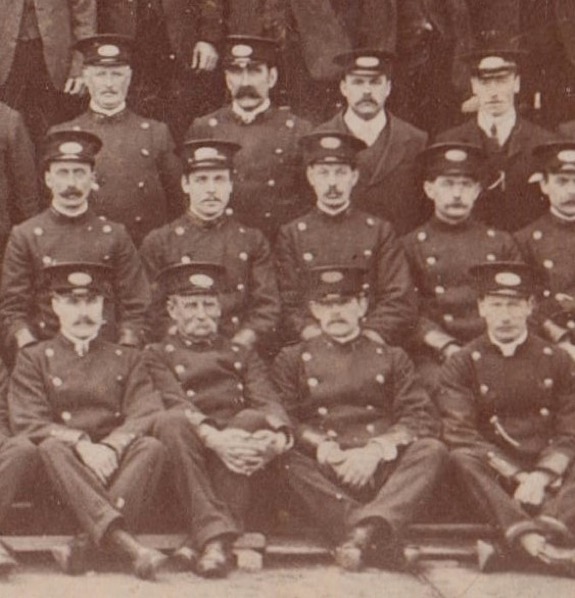
An enlargement of the above photograph showing some of the staff. Most of those depicted are wearing double-breasted, lancer-style tunics and tensioned-crown peaked caps rather then the earlier soft-topped type. The two gentleman at the top right are wearing single-breasted jackets and waistcoats; it is unclear whether these jackets indicate that the wearer held a different grade to the other men. 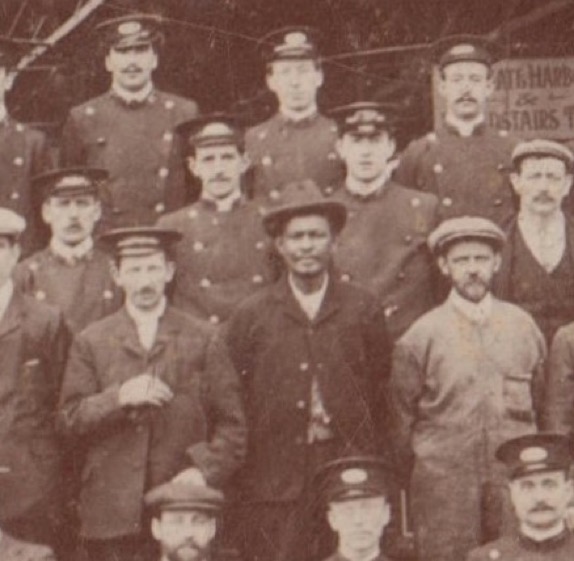
Yet another blow-up of the staff photograph above, showing a gentleman wearing a trilby, who appears to be of African extraction. This is in fact the only photo of a British Tramway system that I am aware of, which clearly shows a tramwayman of non-European origin.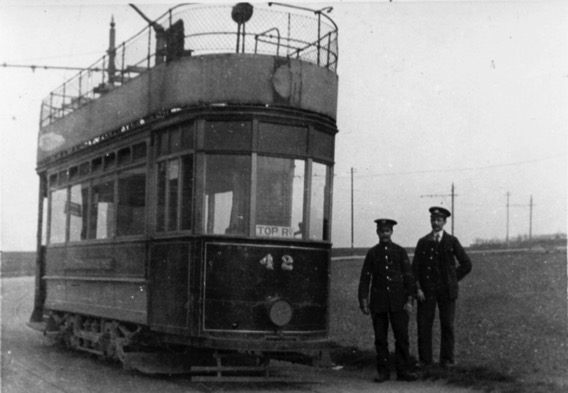
A motorman and a conductor stand with Tramcar No 42 on a Top Road working — photo undated, but probably taken in the mid 1920s given that this vehicle was fully vestibuled and converted to one-man operation (as shown here) in the early 1920s. Photo courtesy of the Tramways and Light Railway Society, with thanks to David Voice.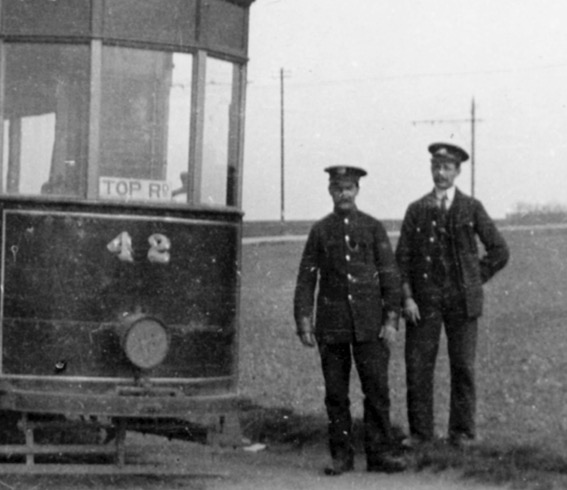
An enlargement of the above photograph showing the crew, both in single-breasted jackets and tensioned-crown peaked caps bearing the large oval cap badge. 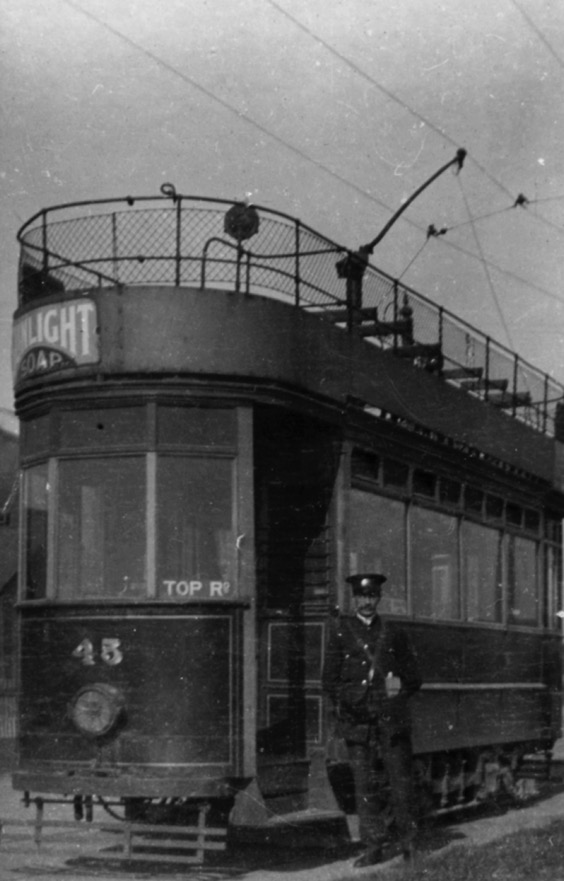
Another Top Road car converted for one-man operation, this time No 45 — photo undated, but once again probably taken around the mid 1920s. Photo courtesy of the Tramways and Light Railway Society, with thanks to David Voice.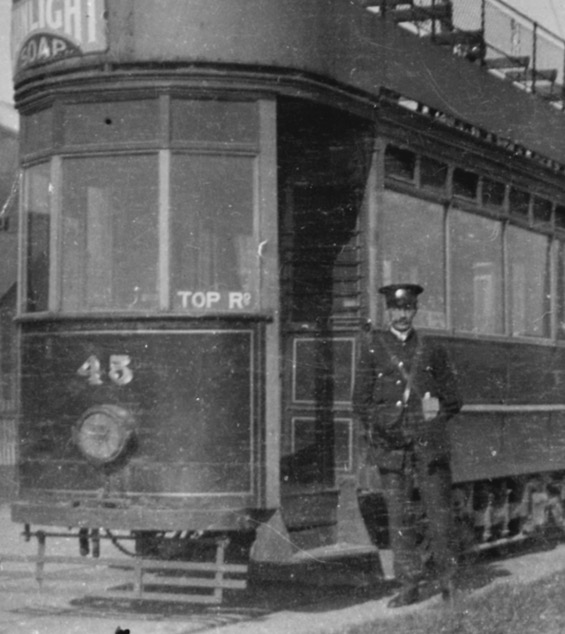
An enlargement of the above photograph showing the conductor, once again in single-breasted jacket and with tensioned-crown peaked cap.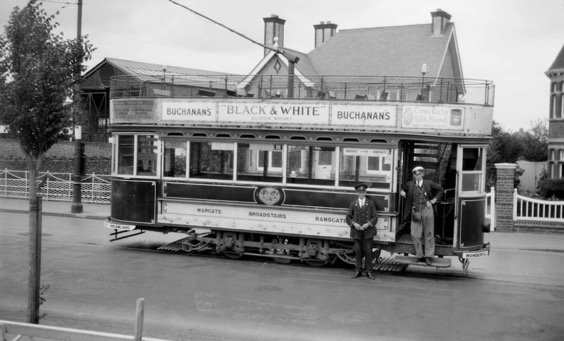
The crew of an unidentified tramcar at the Westbrook terminus — photo undated, but probably taken in 1928. Photograph by Dr H Nicol, courtesy of the National Tramway Museum. 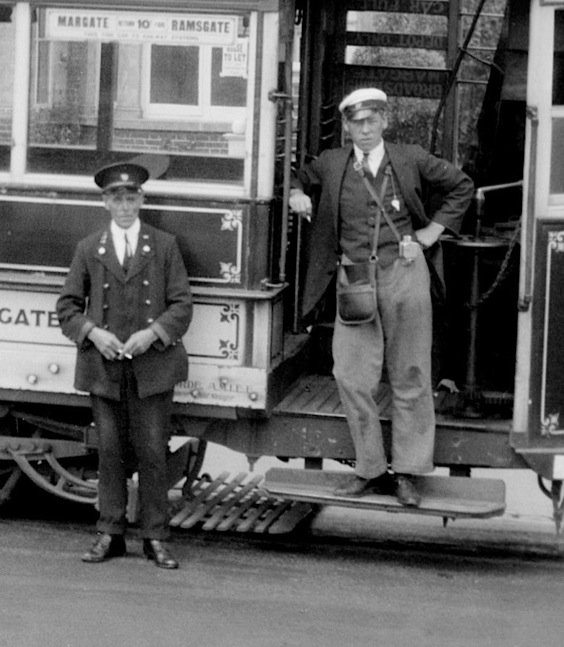
An enlargement of the above photograph showing the crew. The conductor is wearing informal attire, and may be a member of the depot staff providing cover (a common occurrence in summer); the motorman is wearing a double-breasted jacket with lapels, and a cap bearing the new, shield-shaped ITESCo cap badge (see below). Photograph by Dr H Nicol, courtesy of the National Tramway Museum. 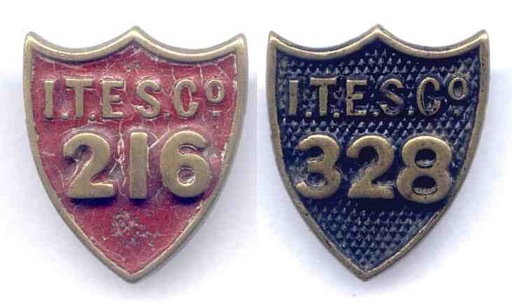
Isle of Thanet Electric Supply Company cap badges — these were probably worn from 1924 onwards when the Isle of Thanet Electric Tramways and Lighting Company changed its name to the Isle of Thanet Electric Supply Company (ITESCo). Given the high numbers on the two badges above, it seems highly probable that the ITESCo issued these badges to all its staff (whether employed in the tramway, bus or electricity supply departments), with the colours possibly denoting the different departments. 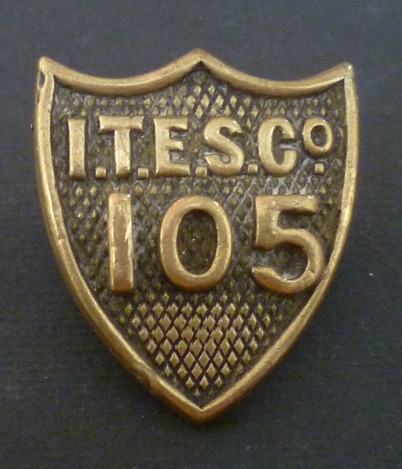
Isle of Thanet Electric Supply Company badge — plain brass. Author's Collection.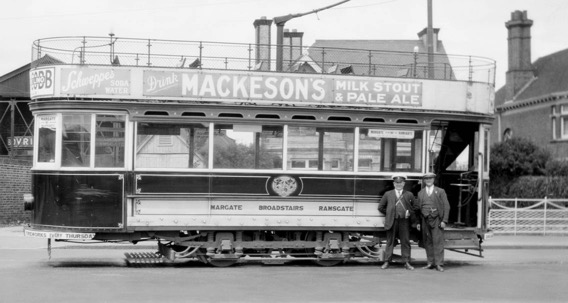
Another view taken at the Westbrook terminus, probably on the same day in 1928 as the preceding shot. Photograph by Dr H Nicol, courtesy of the National Tramway Museum. 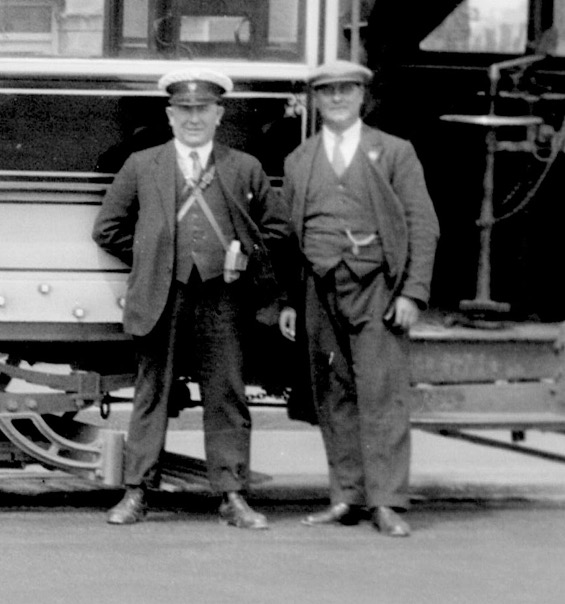
An enlargement of the above photograph showing the crew. This time even the motorman, assuming the figure on the right is indeed the motorman, appears to be wearing informal attire.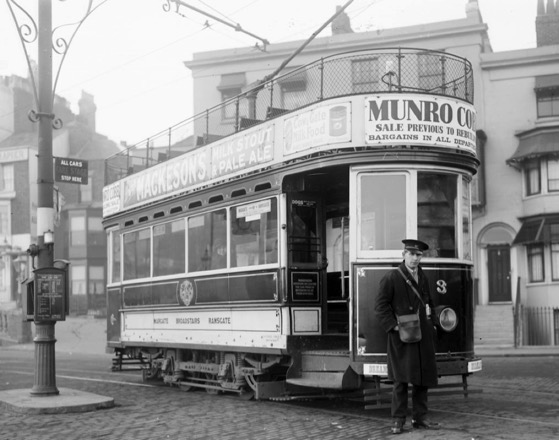
An ITESCo conductor poses with Tramcar No 3 for the camera of Dr H Nicol on 9th December 1928. Photo courtesy of the National Tramway Museum. 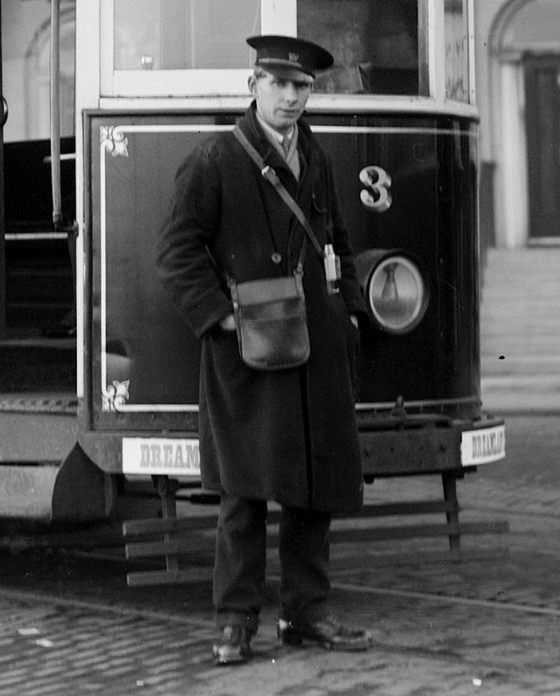
An enlargement of the above photograph showing the conductor, in what would appear to be an unmarked greatcoat.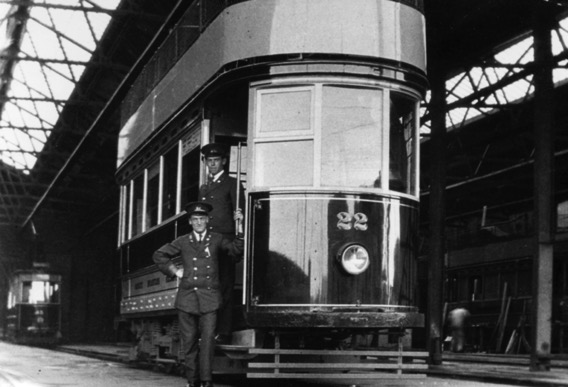
A depot shot of the crew of Tramcar No 22 — photo undated, but probably taken in the late 1920s or 1930s by D.W.K Jones. Photo courtesy of the Tramways and Light Railway Society, with thanks to David Voice.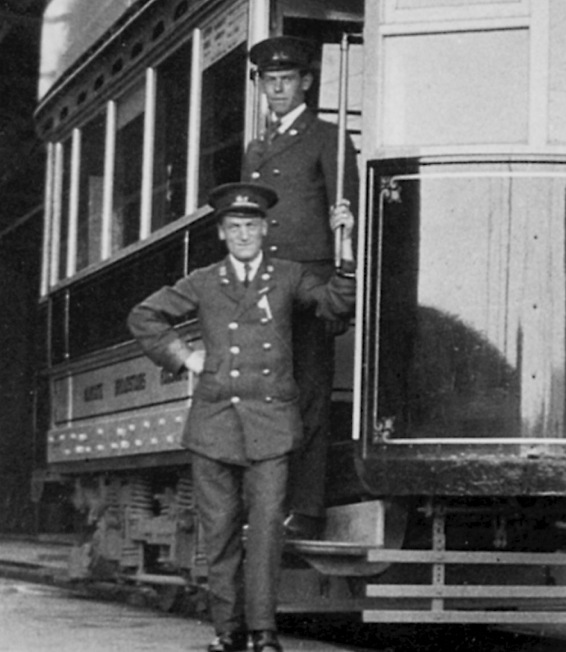
An enlargement of the above photograph showing the crew.
Senior staff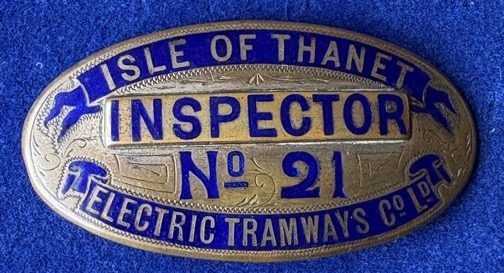
An Isle of Thanet Electric Tramways Company Inspector's cap badge (Employee No. 21) — brass and deep blue enamel. These badges appear to have been worn by inspectors from the inception of services 1901, but seem to have fallen out of use by the time of the Great War.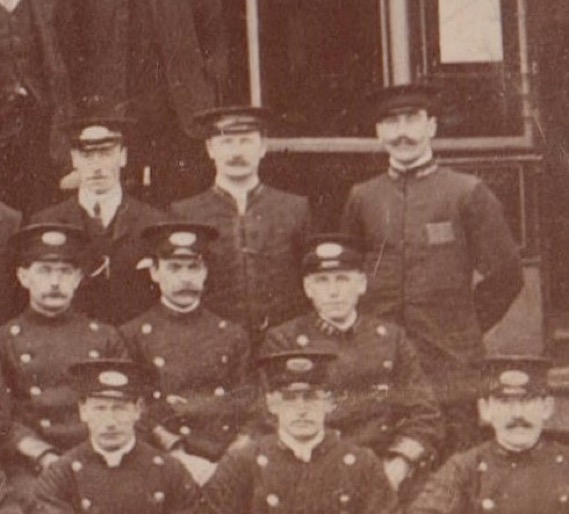
An enlargement of the St Peters depot staff photograph above, probably taken between 1911 and 1914, showing two individuals (back row, right) who are, in all probability, inspectors. Neither is wearing the cap badge shown above, suggesting that it had fallen out of use by this time.
Female staff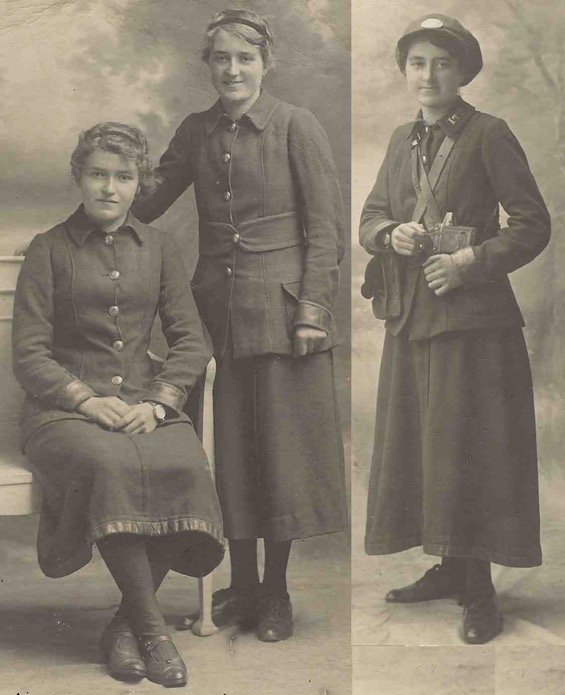
Two photos of ITT Great War conductresses. The lady who is standing appears to be the same person in both photographs; in the right-hand photo she is clearly wearing the standard oval cap badge. Photo courtesy of Richard Rosa.