Kirkcaldy Corporation Tramways
History
Kirkcaldy Corporation obtained powers to build 5.62 miles of electric tramway in the Royal Burgh of Kirkcaldy and the neighbouring Burgh of Dysart, on the 1st August 1899, under the Kirkcaldy Corporation and Tramway Act 1899.
The council was initially undecided as to whether it should operate the proposed system itself or lease operation to a company, one of the front runners being a local consortium backed by the British Electric Traction Company. Eventually, after much discussion and visits to several electric tramway systems, it decided to build and operate the tramway itself.
Construction finally commenced in November 1901, but took some considerable time due to the need to demolish a significant amount of property to make the narrow roads wide enough for tram traffic. Track laying was effectively completed by June 1902, though this did not include the line to Dysart, due to what Kirkcaldy Corporation viewed as unreasonable demands from the Burgh of Dysart (in exchange for the its approval). The 3ft 6ins gauge main line — from West Bridge to Gallatown, via what became known as the 'Lower Route' along High Street — was opened to the public on the 28th February 1903. The 'Upper Route' from Whytes Causeway to Junction Road via Victory Road, together with a short branch to the Park Gates, followed on the 27th August 1903.
The corporation quickly applied for more powers, which were granted on the 15th August 1904 under the Kirkcaldy Corporation Confirmation Act 1904. The act included powers for: an additional 2.78 miles of tramway; an extension of the time allowed to build the Dysart branch; and a double line where the council had been forced to build a single line due to the objection of frontagers.
The initial services were provided by 10 tramcars, these being joined by 5 more in August 1903, and another 5 in June 1904.
In 1904, the corporation reached agreement with Randolph Wemyss, owner of the extensive Wemyss Estates (and its associated coal field), who was planning to build a tramway from Leven through to Kirkcaldy. This included an end-on connection to the corporation tramway at Gallatown — including a stretch of tramway within the Royal Burgh of Kirkcaldy, and through-running between the respective tramways. Powers to build the Wemyss tramway were granted on the 11th August 1905, the act also creating a company — the Wemyss and District Tramways Company — that would build and operate the tramway; the main financier and shareholder was, however, Randolph Wemyss.
The initial performance of the corporation tramway was encouraging, with an operational profit of £3,006 in the first year, though this was reduced to £43 after interest and capital repayments on the loans, as well as a sinking fund. This was, however, turned into a very large deficit (£1,575) the following year through ill-thought-through fares and fare structures, which had been imposed by the council over the objections of the manager. To add insult to injury, the council then completely ignored the manager's advice on how to rectify the situation, imposed yet another hare-brained fare scheme, which proved to be so financially disastrous that it had to be abandoned after just three months. As if this wasn't evidence enough of the council's incompetence in setting the fares and fare stages, it still wouldn't desist from meddling, once again choosing to ignore the manager's recommendations. Thanks to all this, the next set of annual results saw an even larger deficit of £1,924.
On the 25th August 1906, the Wemyss and District Tramways Company commenced services to Gallatown, and from the 27th September 1906, right through to Whytes Causeway over corporation tracks. Corporation cars probably commenced working over company metals to Leven on the 14th November 1906. The new through services had an immediate and positive impact on passenger numbers, with a doubling of the operational profits, the annual deficit being reduced to £580 (after all payments) in the year to June 1907. This continued in 1908 with an overall profit of £23, but a deficit of £210 the following year thanks to a trade depression.
Kirkcaldy and Dysart finally settled their differences (briefly) with regard to the Dysart branch, powers to build 1.18 miles of tramway being obtained on the 29th July 1910 under the Wemyss Tramways (Extensions) Confirmation Act 1910. The tramway was opened on the 26th January 1911, though only as far as Dysart Church as opposed to the full authorised length. This took the 3ft 6ins-gauge, overhead-electric tramway to its final size of 6.11 miles. From a terminus on Links Street, at its junction with Pratt Street, the main line ran northwards along Links Street and High Street to the junction with Whytes Causeway, where the 'Upper Route' diverged. The main line ('Lower Route') continued along High Street, Sailors Walk, the Path and Nether Street to the Cottage Hospital, where the branch to Dysart diverged. The main line then headed northwards to Junction Road where the 'Upper Route' rejoined, continuing along St Clair Street and Rosslyn Street to a terminus in Gallatown outside the Turret Tavern, where it met the tracks of the W&DTCo. The 'Upper Route' ran westwards along Whytes Causeway, via Wemyss Fields to the junction with Abbotshall Road, where a short branch headed southwestwards along the latter to a terminus outside the Park Gates. From the junction with Abbotshall Road, the 'Upper Route' looped around northeastwards — via Benochty Road, Victoria Road, Victoria Bridge, Nairn Street, Birrell Street and Junction Road to rejoin the main line at St Clair Street. The Dysart line branched off the 'Lower Route' at the Cottage Hospital, running northeastwards along Dysart Road to a terminus at Townhead, outside Dysart Church.
The tramway was badly impacted by the Great War, losing men (and their skills) to the armed services, coupled with severe restrictions on spares and new materials, such that maintenance suffered greatly. Fortunately, the company had ordered 4 new tramcars in 1914, though they were only delivered in 1916. The first conductresses were set on in February 1916, and were eventually followed by motorwomen and inspectresses as the prejudices of the council gradually gave way to the exigencies of the conflict. The through services with Wemyss were another casualty of the war, all through services between the systems temporarily ceasing on the 15th January 1918.
The tramway emerged from the conflict in badly run-down condition, and though the corporation tried its best to restore the system, its hands were to a certain extent tied by post-war inflation, coupled with an inability to raise fares to compensate. The latter was eventually addressed on the 15th September 1921 with a successful application to the Tramways Charges Advisory Committee, which granted an increase under the Tramways (Temporary Increase in Charges) Act 1920.
The state of the track was of major concern, with significant effort being made during 1922, though this did not involve track renewal. By now the tramway was also being impacted by a major slump in the coal industry, but was initially spared the rampant post-war motorbus competition from independent operators, largely because the latter failed to realise that the corporation actually had no powers to prevent them from picking up and setting down in the town.
An independent report on the tramway was commissioned in 1925, which recommended complete relaying of the main line, rather than its replacement by motor omnibuses or trolleybuses. The council, however, did nothing, simply allowing the municipal tramway to deteriorate yet further.
A major blow came in January 1928 after a council official admitted that it actually had no powers to regulate the motorbuses; this quickly led to a deluge of competing bus services, the trams, as a result, often running empty.
The council rather belatedly decided that it needed to compete on equal terms, obtaining powers to operate its own motorbuses on the 10th May 1929 under the Kirkcaldy Corporation Order Confirmation Act 1929. Curiously, the council did not seek powers to abandon the tramway, even though it was obvious to all that it could not carry on much longer without major expenditure, the track in particular being in appalling condition.
The year also saw railway-company money being poured into motorbus operators, the former having acquired powers to invest in the latter on the 3rd August 1928 under the Railway (Road Transport) Acts of 1928. This led to considerable expansion and consolidation, both through the acquisition of independent bus companies, as well as the motorbus operations of tramway companies. The W&DTCo's bus-operating subsidiaries (A&R Motors; Caley Motor Engineering Company; and the General Motor Carrying Company) were soon in the SMTCo's gunsights, and in March 1930, they were taken over by W. Alexander & Sons of Falkirk, a subsidiary of the Scottish General Motor Traction Company, which was backed by heavy railway investment. It was fairly clear by now which way the wind was blowing, and on the 8th September 1930, the council finally bowed to the inevitable and decided to abandon its municipal tramway, though it was still concerned about the through-running agreement with the W&DTCo which it was locked into for a further 11 years (until 1941).
Hardly had the council had time to plan, however, than the SGMTCo quickly swung into action, making a successful offer to the shareholders of the W&DTCo (i.e., the tramway) in February 1931, and following this up — on the 17th March 1931 — with a tempting offer (via its subsidiary, WA&S) for Kirkcaldy's decrepit tramway system. The corporation took little time in deciding to accept the offer (the full council doing so on the 24th March 1931), as not only would it be rid of its run-down tramway, but it would also be free of the through-running agreement, which would effectively become an internal SGMTCo affair.
The tramway closed, in accordance with the agreement, on the 15th May 1931, though the trams maintained a presence in the burgh until the W&DTCo withdrew its last tram services to Gallatown until the 30th January 1932, some of which had been operated by ex-KCT tramcars.
Uniforms
Uniforms were late arriving, so for the opening of the system in 1903, and for a short time afterwards, staff simply wore informal attire. The new uniforms were perhaps worth the wait, as photographs suggest that they were of high quality, with the sleeves of conductors' jackets even being embellished with chevrons, something usually reserved for inspectors on other systems, and even then far from ubiquitously so. The uniforms comprised single-breasted jackets with five unmarked buttons (see link), two breast pockets (with button closures) and stand-up collars; the latter carried an employee number on the bearer's left-hand side in individual metal numerals, and system initials — 'K C T' — in individual metals letters, on the right-hand side. It is currently unclear whether the badges were brass or nickel. The tensioned-crown peaked caps bore off-the-shelf, script-lettering grade badges, either 'Motorman' or 'Conductor'. The grade badges remained in use right through to the demise of the tramway in 1931, though for a short time during and after the end of the Great War, were often supplemented with regimental badges, with which the individual had presumably been associated.
The uniforms remained unchanged — stylistically — until the mid 1920s. After this, conductors continued to be issued with single-breasted jackets, but of a more modern cut with lapels and epaulettes (with button closures); motormen on the other hand were issued with double-breasted jackets with four pairs of buttons, and lapels. Neither style of jacket carried badges of any description.
Tramcar crews were also issued with long, double-breasted greatcoats with high, fold-over collars — once again, completely devoid of insignia.
In the early 1920s, inspectors were certainly wearing single-breasted jackets with black buttons (probably plain) and lapels, the collars bearing the grade — 'Inspector' — in embroidered script lettering; it is likely that this style of jacket was worn from the outset, though confirmation of this must await the discovery of photographic evidence from the earlier years of the system. The tensioned-crown peaked caps bore a hat band of a lighter colour (similar to those used on the nearby Wemyss system — see link), upon which the grade — 'Inspector' — was embroidered in script lettering. The style of senior staff jackets was changed in the mid 1920s to a double-breasted design virtually identical to those issued to motormen, and similarly without insignia. Inspectors were also provided with single-breasted overcoats that carried the grade — 'Inspector' — on both collars in embroidered script lettering.
As with many tramway systems, Kirkcaldy employed women during the Great War to cover for tramwaymen lost to the armed forces, initially as conductresses, but subsequently as motorwomen, as well as an inspectress (a Miss Brown). Female staff were issued with long double-breasted coats with five pairs of plain black buttons, two waist and two breast pockets, high fold-over collars and epaulettes; the entire garment was devoid of insignia. A photograph has, however, survived of a conductress without the long coat, revealing the jacket worn underneath to have been single-breasted with two waist pockets, lapels and epaulettes, the entire ensemble once again devoid of insignia. Two types of headwear were worn, baggy cloth caps with a cloth peak — sometimes called motor caps — and peaked caps with a large tensioned crown; both types carried standard, off-the-shelf, script-lettering grade badges.
The lady inspector wore a uniform identical to those worn by female tramcar crews, but with an embroidered grade badge — 'Inspector' — on the cap.
Further reading
For a detailed account of the tramway, see 'The Tramways of Kirkcaldy' by Alan W Brotchie (N B Traction; 1978).
Images
Motormen and conductors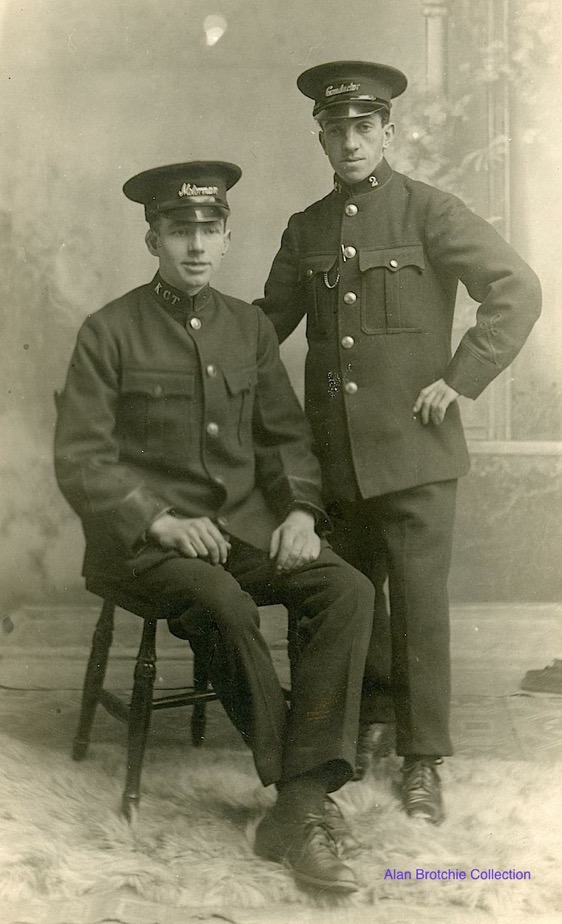
An excellent studio portrait of Motorman J. Gillies (Employee No 5) and his conductor, A. Balfour (Employee No 2) — photo undated, but given that this is a studio portrait with pristine uniforms, and with both men having very low employee numbers, it seems highly likely that it was taken around the time of opening (1903). Note the chevron braiding above Conductor Balfour's cuff, an elaborate adornment normally reserved for senior staff on other systems.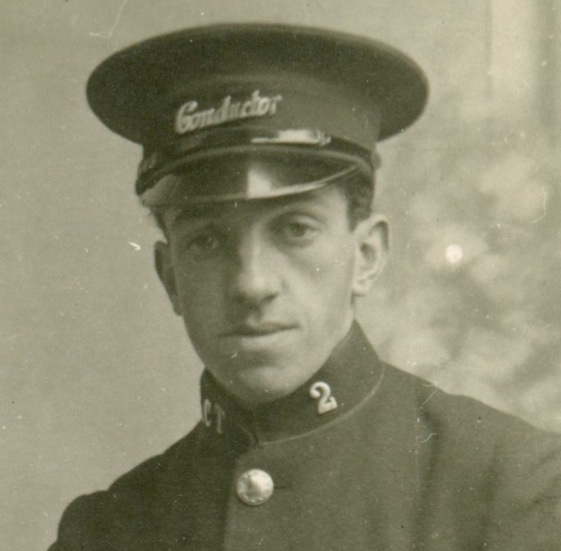
An enlargement of the above photograph showing details of the conductor's uniform, including the plain, scalloped-rim buttons (see link).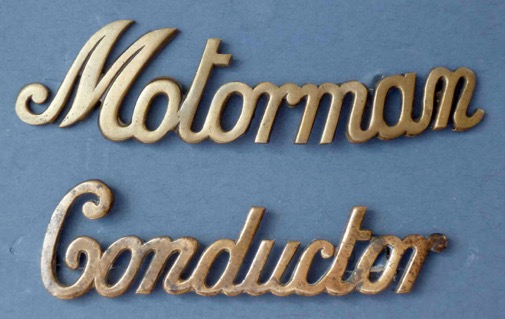
General pattern script-lettering cap badges — 'Motorman' and 'Conductor' — of the type used by Kirkcaldy Corporation Tramways. It is currently unknown whether Kirkcaldy used brass or nickel badges.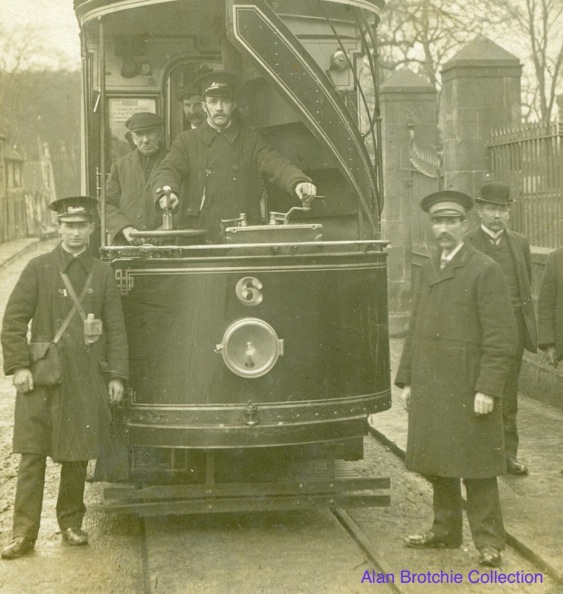
The crew of Tramcar No 6 pose at the Dysart terminus with Inspector Kidd, not long after the opening of this section (1911).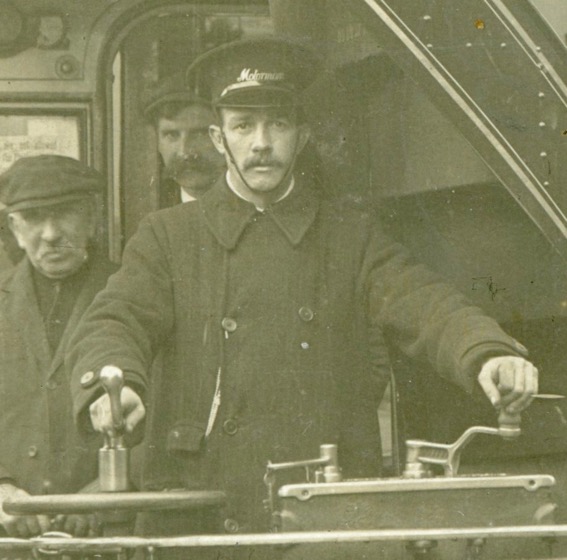
An enlargement of the above photograph showing the motorman, who most unusually has an additional chin strap, which he is using as a chin strap, the vast majority of tramwaymen being content to have just the one chin strap as a decorative adornment above the peak. The greatcoat is completely devoid of insignia, including the buttons, which appear to be black horn.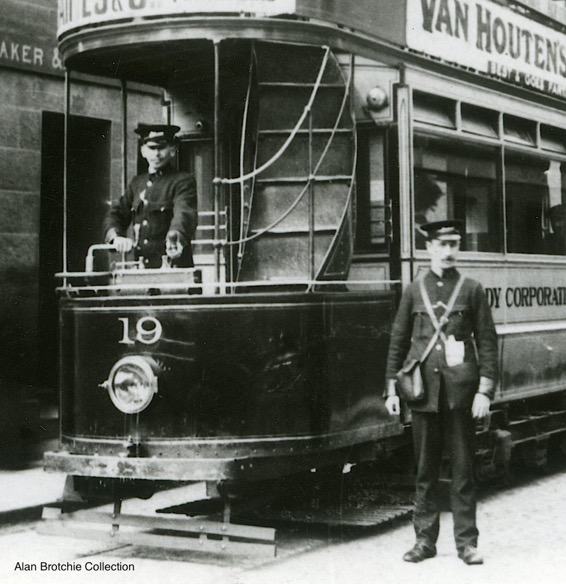
The crew of Tramcar No 19 at the Links Street terminus — photo undated, but probably taken in the years immediately before the Great War.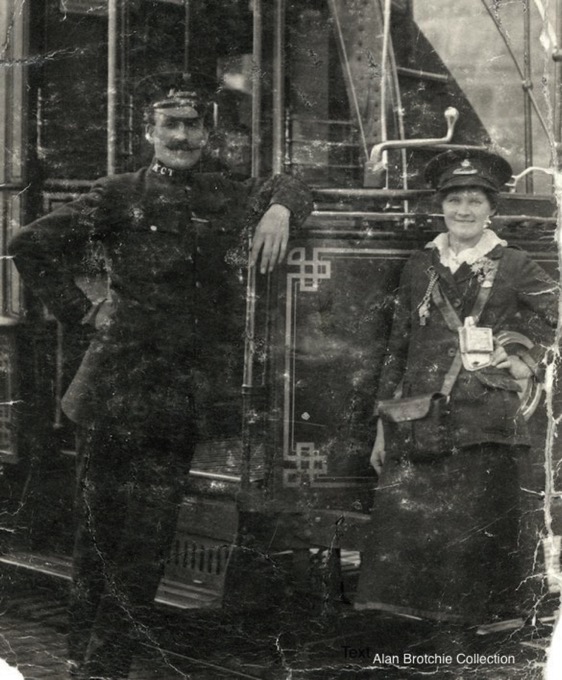
A motorman and a conductress — photo undated, but probably taken during the Great War or shortly afterwards.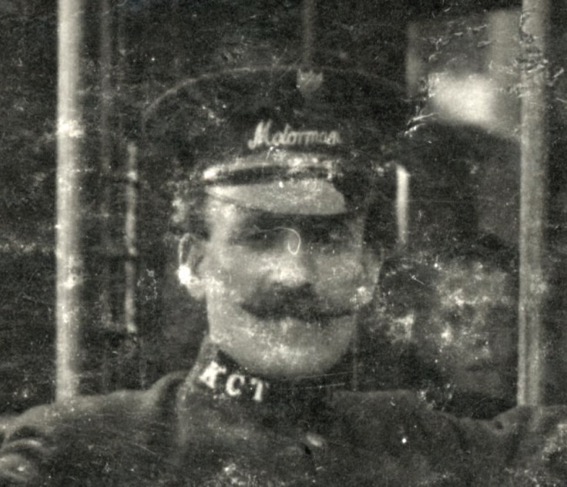
An enlargement of the above photograph, which clearly shows the motorman to be wearing a scalloped-topped, shield-shaped badge above his grade badge. This was almost certainly a military badge, possibly that illustrated below.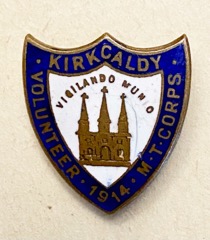
A Kirkcaldy Volunteer Motor Transport Corps badge, probably of the same pattern of badge worn by the motorman in the preceding photo.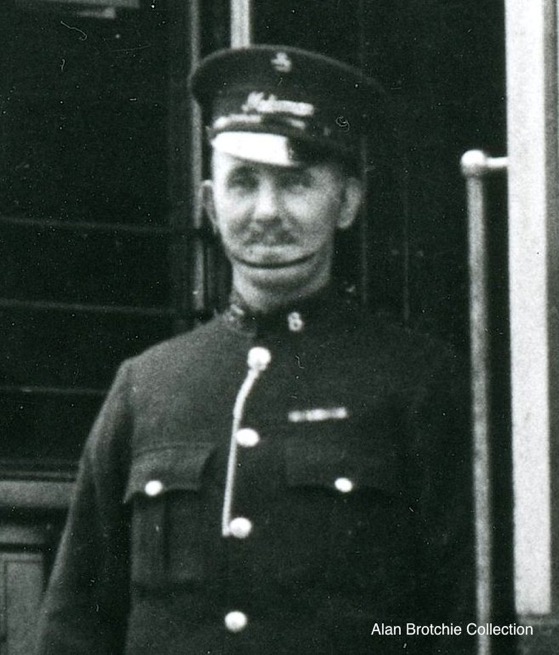
A motorman (Employee No 8) aboard the front platform steps of Tramcar No 24 — photo undated, but given the style of uniform and the medal ribbon, probably taken shortly after the Great War. Given that the subject is wearing an additional chinstrap under his chin, it is tempting to wonder whether he is the same man doing likewise in the earlier shot. He is also wearing a small badge above the standard grade badge, almost certainly military in origin, but not the same shape as the Kirkcaldy Volunteer Motor Corps badge.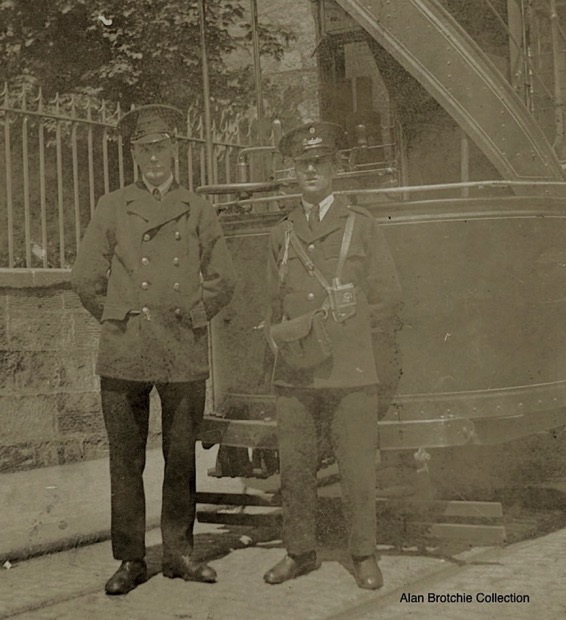
An inspector and a conductor with an unidentified tram at the Dysart terminus looking east — photo undated, but probably taken in the mid 1920s. Note the new style of uniforms with lapels.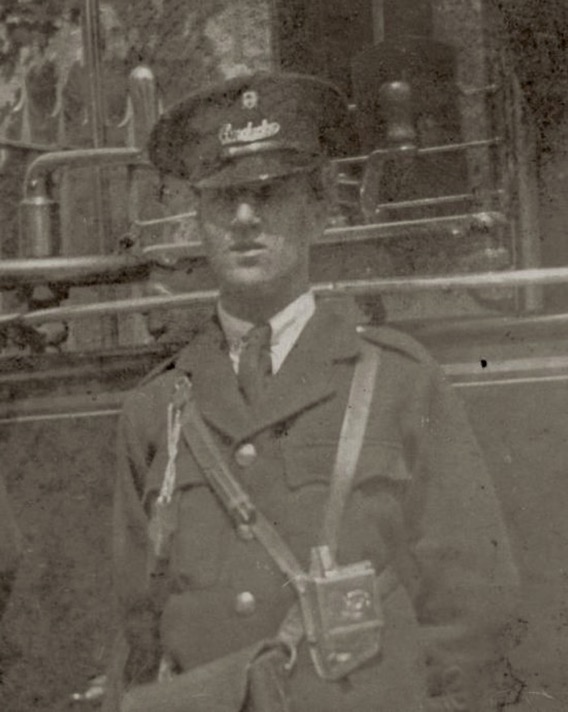
An enlargement of the above photograph showing details of the conductor's uniform, including yet another small cap badge above his grade badge; the latter is also underlined, a type not a commonly used on British tramways.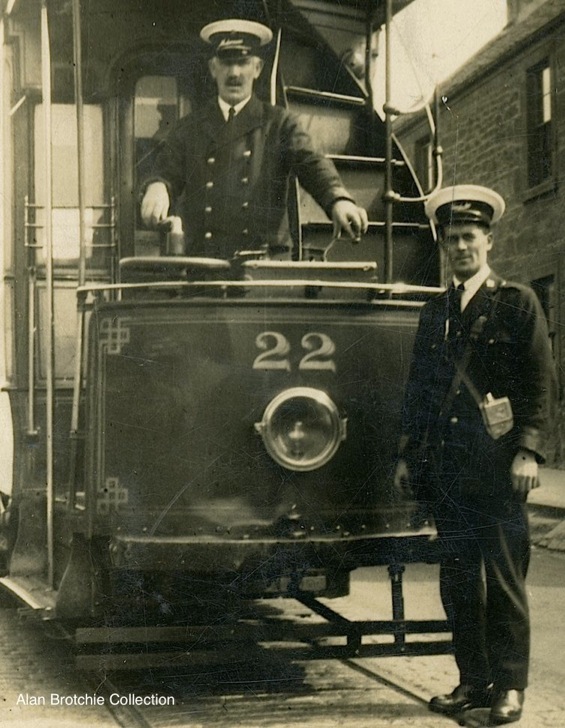
The crew of Tramcar No 22 pose for the cameraman near the Gallatown terminus — photo undated, but probably taken in the late 1920s or early 1930s.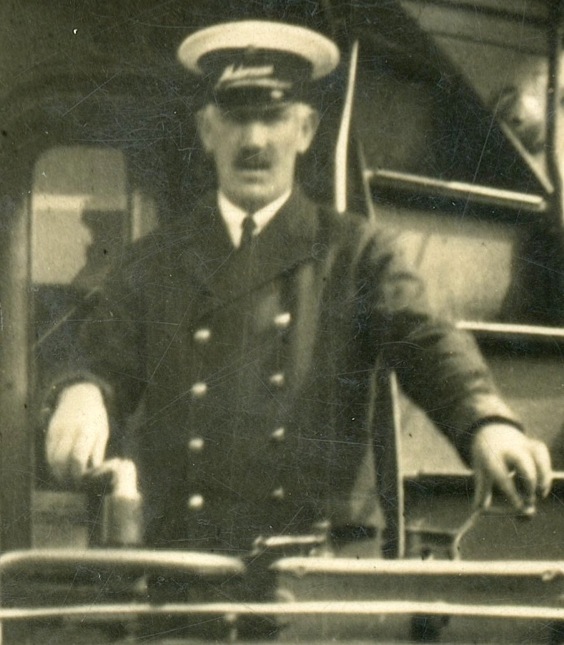
An enlargement of the above photograph showing the motorman, who is clearly wearing a small badge above his grade badge.
Senior staff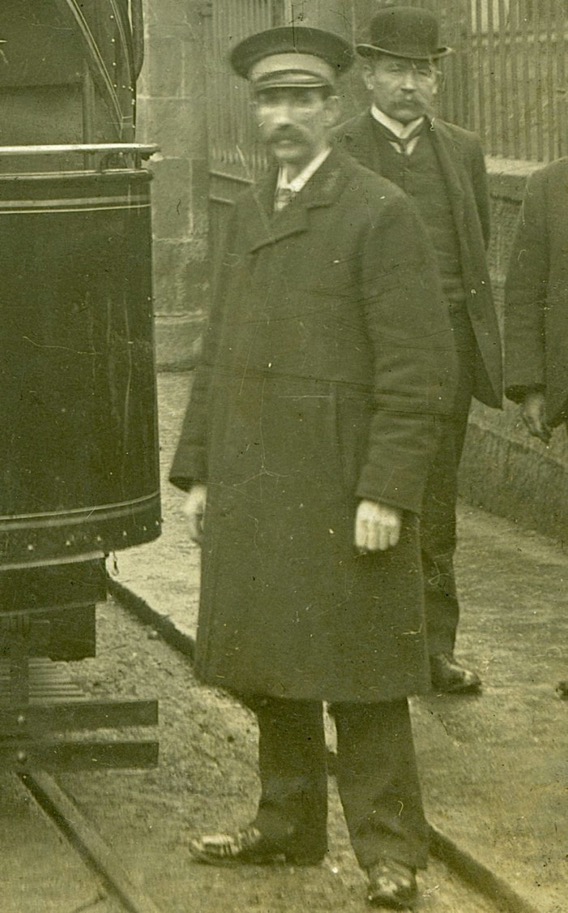
An enlargement of the Dysart photograph above showing Inspector Kidd — circa 1911. Although blurred, it does show the light-coloured hat band and the embroidered 'Inspector' badges on the collars.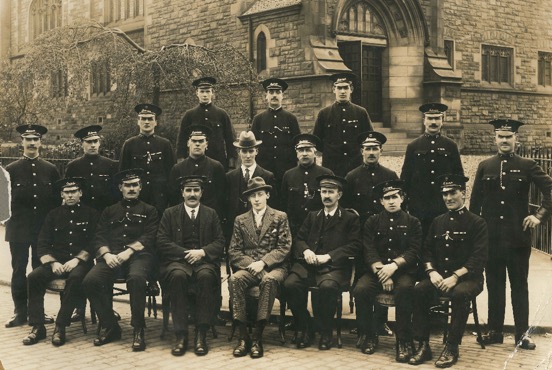
A staff photograph which, judging by the medal ribbons and the trilbies, was almost certainly taken in the early 1920s. The two inspectors — seated either side of the dapper gentleman on the front row, are wearing single-breasted jackets with the usual grade designation embroidered on the collars.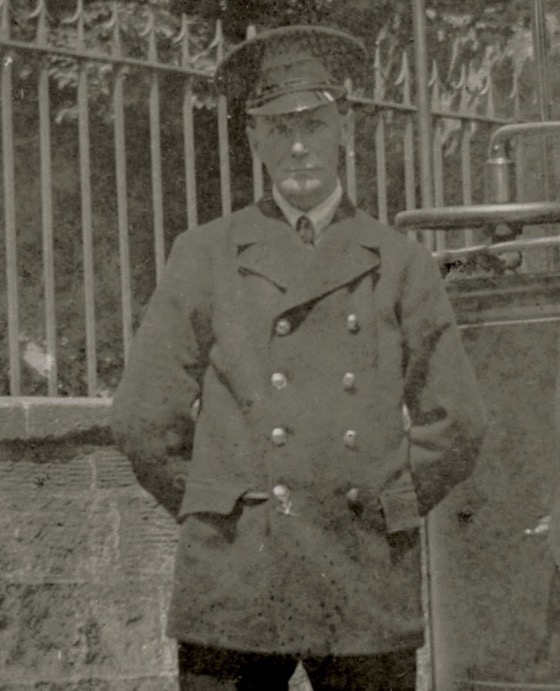
An enlargement of one of the earlier photographs above showing a 1920s inspector in double-breasted jacket with lapels. With thanks to Alan Brotchie.
Female staff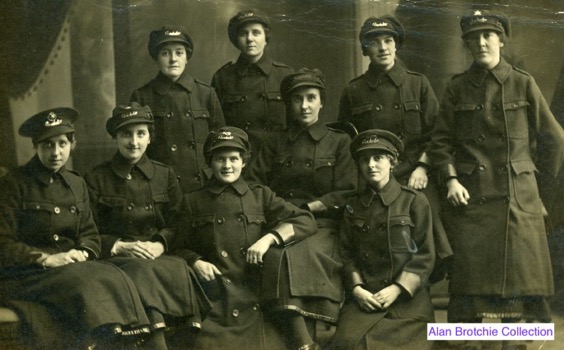
A studio portrait of eight Kirkcaldy Great War conductresses and a lady inspector.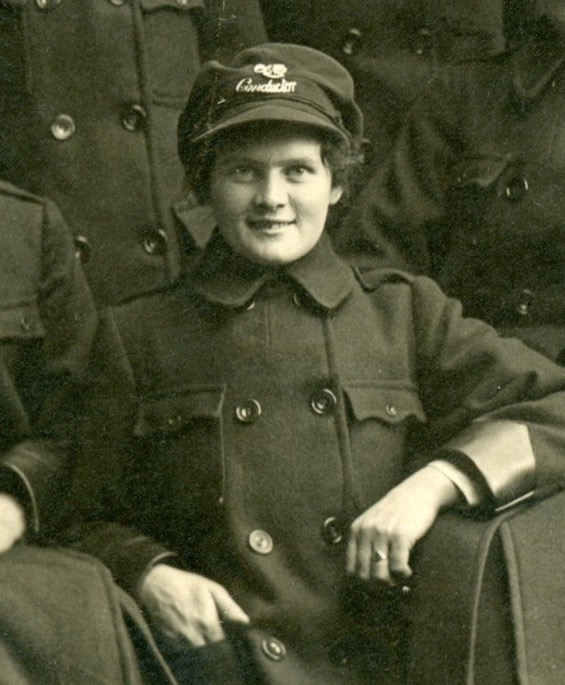
An enlargement of the above portrait showing one of the conductresses. Save for the cap, the uniform is completely devoid of insignia. The cap carries a standard script-lettering grade cap badge, above which is almost certainly a regimental sweetheart badge, a common means of showing support for a loved one away with the armed services.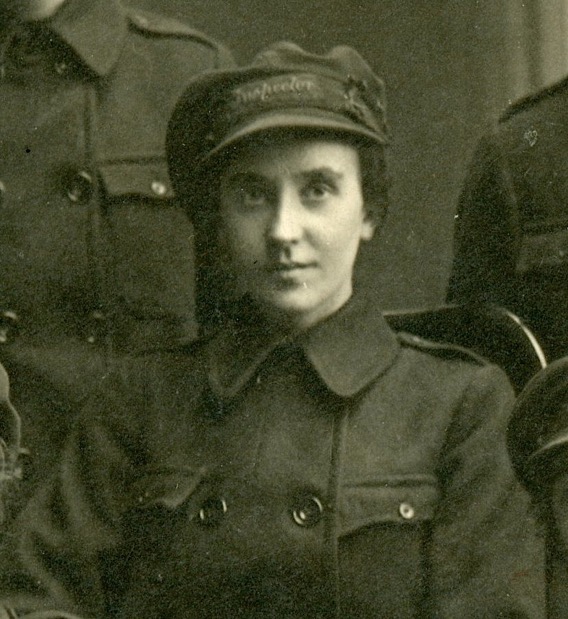
Another blow-up of the staff photograph above showing the lady inspector, almost certainly Miss Brown. The style of coat is identical to that worn by the conductresses, as is the baggy cap, though this clearly carries an embroidered 'Inspector' badge.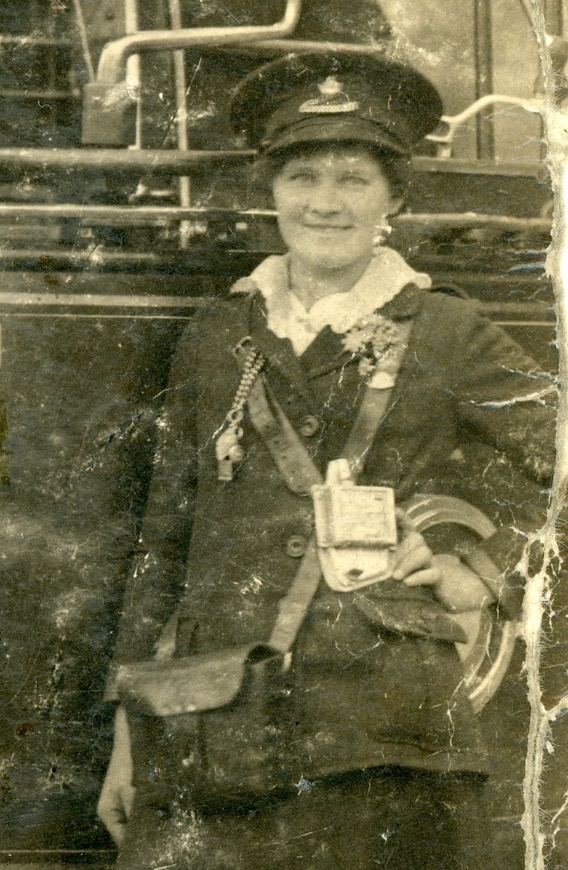
An enlargement of the earlier crew photograph showing a conductress in a uniform jacket rather than long topcoat. The cap badge is almost certainly a regimental sweetheart badge.