Keighley Tramways
History
Plans to bring a tramway to the streets of Keighley sprung from the failure of a larger scheme that had aspired to link Bradford, Saltaire, Bingley, Keighley and Utley. The new scheme was promoted by a group of Keighley luminaries, who quickly formed a company (in 1887) — the Keighley Tramways Company — to obtain the necessary powers and to finance its construction.
The tramway company was very much a local affair, with many of those involved also serving as councillors, something which no doubt smoothed the path of civic approval, the latter being secured in October 1887. This was followed by powers to build 4.13 miles of 4ft 0ins-gauge tramway, which were obtained on the 24th July 1888 via the Keighley Tramways Order 1888, which was passed into law under the umbrella of the Tramways Orders Confirmation (No.3) Act 1888. This was followed, in late November 1888, by a share issue, and the start of work on the construction of the line to Utley.
The tramway was opened in two sections, the first on the 8th of May 1889, ran southwards from Church Green in Keighley, along South Street to a terminus at Paper Mill Bridge in Ingrow; this was joined on the 18th December 1889 by a line running northwards from Church Green, via North Street and Skipton Road, to a terminus at the cemetery in Utley. Both lines were extended around 10 years later (circa 1897), but only by a very short distance, the Ingrow line to Ingrow Bridge, and the Utley line to the Roebuck Inn. Both lines were operated separately, but with a common terminus in North Street in Keighley. None of the remaining lines authorised in 1888 were ever built. At its maximum, the system totalled just 2.28 miles.
The services were operated with 7 horsecars, 2 of them large two-horse cars, the other 5 smaller one-horse vehicles.
Unfortunately, the tramway was a loss-making venture from the start, income failing to even cover the operating costs, let alone pay off the debt, or to create anything as a grand as a renewals fund. As a result, the tramway infrastructure gradually deteriorated to the point where the company could not even afford to pay Keighley Corporation for work done on maintaining the paving around the track; at this juncture, and in order to stave off bankruptcy, the company offered to sell the undertaking to the corporation, though it can hardly have been an enticing prospect. Eventually, agreement was reached (on the 25th November 1896) for the corporation to buy the track — for a nominal fee of £5 — and to then lease it back to the company, the deal being back-dated to the 1st July 1896. This represented a staggering loss for the company, the line having cost almost £10,000 to lay barely seven years earlier.
Soon afterwards, however, the corporation's thoughts turned to the new wonder of electricity, and in 1898 it obtained parliamentary powers to work the horse tramway, and to convert it to mechanical power (steam, electric or otherwise). Two years later, the corporation opened its own electricity generation plant. Despite a degree of civic opposition, a not entirely unreasonable stance given that the horse tramway had never made a profit, the corporation eventually agreed a price for the company's remaining tramway assets (e.g., horses, cars, depot, etc.), taking possession on the 15th January 1901; the company, however, continued to work the tramway, the corporation paying them an agreed price per horse per week to do so. The corporation finally took over operation itself on the 21st September 1901, following which, the KTCo was wound up.
The corporation, however, was rather slow in converting the tramway to electric traction, such that it ended up operating the horse trams for over 3 years, the last horse tram service of all running on the 28th May 1904.
Uniforms
In common with the majority of horse tramways in the British Isles, drivers and conductors simply wore informal attire — trousers, overcoats, jackets, waistcoats, shirts and ties. Headgear appears to have largely followed the fashion of the day, primarily the bowler hat, but later on the flat cap. No badges, including licence badges, were worn, either on the jackets or the hats.
Photographs of inspectors have so far yet to come to light, and in view of the small size of the system, it is entirely possible that the company never saw fit to employ them.
Further reading
For a history of the system, see: Keighley Corporation Transport by J S King; The Advertiser Press Limited (1964).
Images
Horse tram drivers and conductors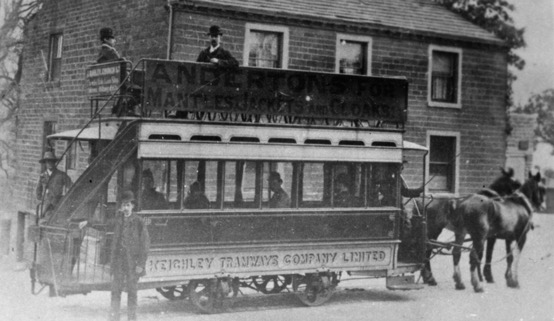
A Keighley Tramways Company horse tram captured for posterity outside the Roebuck Inn, the terminus of the Utley line — photo undated, but as the extension to this location only opened in 1897, probably taken at that time or very shortly thereafter. Photo courtesy of the Tramways and Light Railway Society, with thanks to David Voice.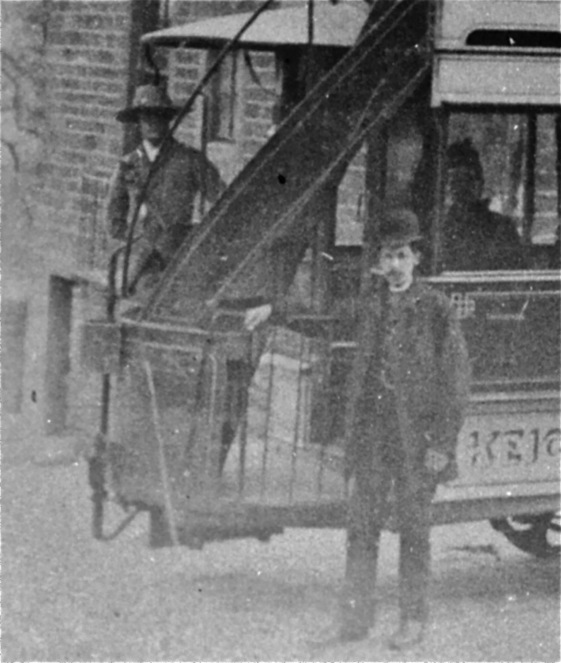
An enlargement of the above photograph showing the conductor (at the back with cash bag), who appears to be wearing rather bohemian headgear for a provincial northern town. He must have stuck out a mile in the sea of bowler hats and flat caps.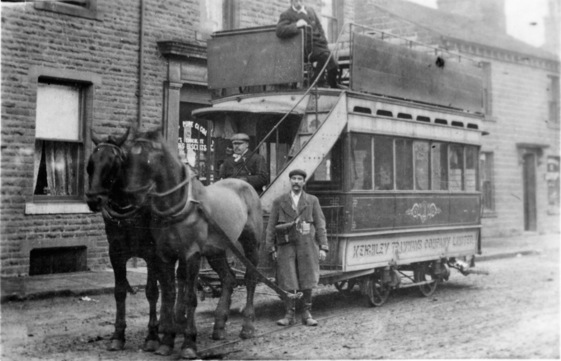
Horse Tram No 1 pictured near Corn Mill Bridge (probably) — photo undated, but given the condition of the vehicle, probably taken in the late 1890s. Photo courtesy of the Tramways and Light Railway Society, with thanks to David Voice.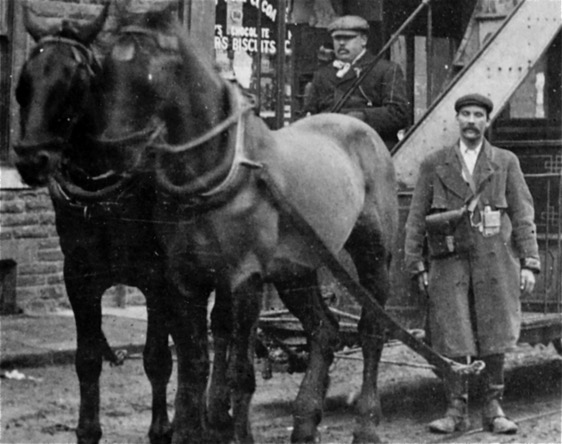
An enlargement of the above photograph showing the driver and conductor, whose workaday and slightly down-at-heel appearance no doubt reflected the financial state of the company in its latter years.