Lancaster and District Tramways
History
A scheme to build a tramway between Lancaster and Morecambe coalesced in 1888 with the formation, by a group of local worthies, of the Lancaster and District Tramways Company. Powers to build and operate 5.85 miles of tramway were granted on the 26th July 1889 via the Lancaster and District Tramways Order 1889, the order being passed into law by the Tramways Orders Confirmation (No.1) Act 1889. Surprisingly, the company were not only authorised to use animal power, but also electric traction, though subject to certain conditions and approvals.
Construction of the standard-gauge, horse-drawn tramway commenced in January 1890, with the line opening for business just over 6 months later on the 2nd August 1890. The tramway, as built, totalled 4.3 miles, but did not include the authorised line to the south from Stonewell to Scotforth, almost certainly due to insufficient capital. The tramway was built on the the single-line and passing loop principle, and ran from a terminus in Stonewell, Lancaster — at the junction of Chapel Street and North Road — northwestwards along Chapel Street and northeastwards along North Road, to Cable Street (forming a triangle), then northeastwards along Cable Street and over the River Lune via Skerton Bridge. From here, the tramway travelled broadly northwestwards, through the village of Torrisholme, to Morecambe, where it terminated in Market Street near the Royalty Theatre. Although it came close to the tracks of the Morecambe Tramways Company in Morecambe (from 1908 owned by Morecambe Corporation), and later those of Lancaster Corporation Tramways (from 1903 onwards), no connection was ever made between the systems.
The tramway was very dependent on the tourist trade, and in later years, it operated tramcars which were perhaps unique in the British Isles, with passengers carried on a raised platform, presumably to allow them to take in the views. It seems to have returned moderate profits until the late-Edwardian era, even turning down a generous offer from Lancaster Corporation in 1903, but from then on the company began to struggle. There were much quicker ways to travel between the two towns — not involving horse traction, which was increasingly viewed as an anachronism — so whilst the company managed to keep its head above water, it was never in a position to renew the track and the tramcars, let alone convert the line to electric traction. This didn't, however, stop it from applying for powers to convert the tramway to electric traction in late 1912, though they appear not to have been granted.
The services were delivered using 14 double-deck, open-topped tramcars, some of which were later cut down to the curious raised-deck single-deckers seen in the surviving photographs.
Shortly before the Great War, the L&DTCo formed a joint venture with Fahy's of Lancaster, introducing 4 motorbuses between Lancaster and Morecambe — with the fleet name Lancaster and District Tramways Company and Fahy's Limited — thereby competing directly with its own tram services. These initial services were, however, short lived, being introduced on the 9th April 1914, then falling victim to War Department requisition just 5 months later on the 18th September 1914. The joint venture nevertheless persisted, reintroducing services in January 1915 with replacement vehicles, tramway services being cut back accordingly.
Somehow the tramway managed to survive the Great War, but by 1921, it was completely run down, having withdrawn most of its tramcars, operations carrying on with just three vehicles. It must have been clear to all that the decrepit tramway had no future, so more in hope than expectation, the company offered to sell it to both Lancaster and Morecambe Corporations, who were unsurprisingly, not interested. Following this, and with motorbus competition in full swing, the company bowed to the inevitable, the last horse-tram service running on the 31st December 1921.
The L&DTCo was finally struck off the Companies Register on the 7th February 1928.
Uniforms
Considering that the L&DTCo soldiered on until relatively late for a horse tramway, and was heavily dependent upon tourist revenue — plying its leisurely trade between Lancaster and Morecambe — photographs are surprisingly uncommon. Those that have survived, however, show that drivers and conductors — in common with many horse tramways in the UK — wore informal but smart attire: trousers, jackets, waistcoats, shirts and ties. Headgear appears to have largely followed the fashion of the day, predominantly the flat cap. No badges or licences of any kind were worn on either the jackets or the hats.
It is unclear whether inspectors were employed by the company, or whether female staff were employed during the Great War. What is, however, certain is that nothing has survived photographically.
Further reading
For a history of Lancaster's tramways, see: 'The Lancaster and Morecambe Tramways' by S Shuttleworth; Oakwood Press (1976).
Images
Drivers and conductors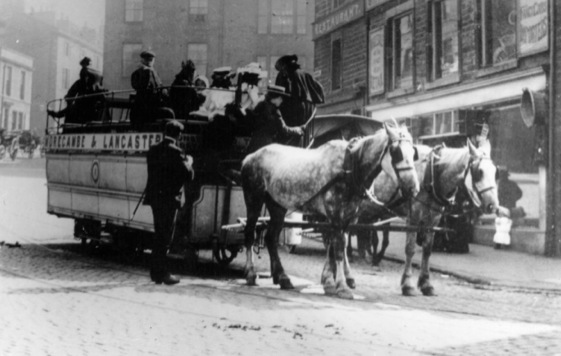
One of the rather unusual 'raised seating', open-top single-deck horse cars pictured at the Stonewell terminus in Lancaster— photo undated, but probably turn of the century. Although it is uncertain if any of those pictured are crew members, what is, however, clear is that no uniforms are in evidence. Photo courtesy of the Tramways and Light Railway Society, with thanks to David Voice.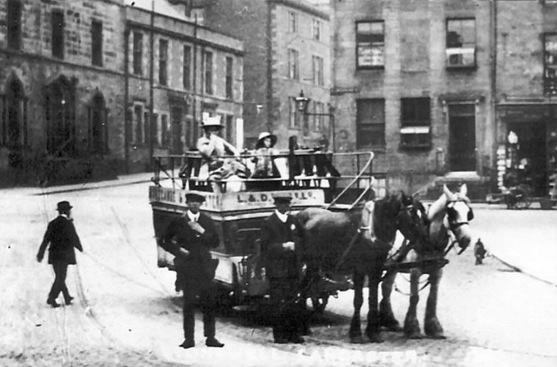
A conductor and a driver pose for the cameraman at the Stonewell Terminus in Lancaster — photo undated, but judging by the large flat caps, possibly taken just after the Great War. Both men are wearing smart but informal attire. Photo courtesy of Duncan Holden.