Inchture Tramway
History
The Dundee and Perth Railway Company obtained powers to build a railway between the two cities in its title during 1845 and 1846. Further powers were granted to the company on the 2nd July 1847 — under the Dundee and Perth Railway Act, 1847 — which included authorisation to construct a branch line from their main line to Inchture, as their new station at Inchture was around two miles south of the actual village.
The main line was opened to the public on the 24th May 1847, the branch to Inchture opening nine months later on the 1st February 1848. The branch line was approximately 1.4 miles long, running north-northwest from Inchture Station, along the eastern side of the road (Lang Cassey) rather than on it, to Crossgates, where there was a depot and waiting room; although this was the terminus, it was still a good half mile west of Inchture Village.
Services along the branch line seem to have been locomotive hauled until 1866. From then until 1895, passenger services were provided by a horse-drawn coach on rails, which was known locally as the 'bus'; it was replaced in 1895 by a tram-like vehicle, though still horse drawn.
At some point before 1859, the tramway was extended just over half a mile to the northwest to the Inchture Brick and Tile Works, plus a circa 400 yard extension to a clay pit. Although the extension (and the branch line itself) saw locomotive-hauled goods trains, passenger services never ventured further north of Crossgates.
The Dundee and Perth Railway Company was absorbed by the Scottish Central Railway Company on the 28th July 1863, under powers granted by the Scottish Central Railway (Dundee, Perth and Aberdeen Railway Purchase) Act 1863. The new owners did not, however, last for long as an independent concern, amalgamating with the Caledonian Railway just two years later — on the 1st August 1865 — under powers granted on the 5th July 1865 via the Caledonian and Scottish Central Railways Amalgamation Act 1865. The new enlarged Caledonian Railway company thereby became the owner of the Inchture Tramway, operating it right through to closure in 1917.
The brickworks closed around the turn of the century, passenger services, however, continuing as before, up until the middle of the Great War, when the War Office summarily closed the line. Although some sources state that the tramway was closed so that its rails could be re-used for the war effort, it may well have been simply to save on costs. Although there is some uncertainty over the actual closure date, the last tram is thought to have run on the 31st December 1916.
The driver of the tram for many years was Bob Speed. He purportedly drove it from the inception of services — presumably in 1866 given that he was only born in 1839, and was a 'Ploughman' in the 1861 census — through to 1907. In later returns, he described himself as a 'Railway Servant' (1871), a 'Buss Driver and Post Runner' (1881), a 'Bus Driver for the Caledonian Railway (1891) and as a 'Caledonian Railway Bus Driver' (in 1901). His son — also called Bob Speed — succeeded him, and he in turn was succeeded, around 1916, by George Imlay.
Uniforms
Photographs depicting staff working the Inchture Tramway are only available from relatively late in its life, i.e., from the Edwardian era. These show that both drivers and conductors wore robust but informal attire, comprising hard-wearing jackets and trousers, along with the working man's headgear of choice at this time, the flat cap.
Given that the tramway was really a horse-drawn railway, and was always owned by a railway company, it is perhaps somewhat surprising that conductors (at least) did not wear uniforms or carry insignia of any kind. Whether any of the companies which owned the line in the 19th Century (Dundee and Perth Railway, 1848-1863; Scottish Central Railway, 1863-1865: or the Caledonian Railway, 1865 onwards) issued the crew men with uniforms is impossible to say, thought it seems unlikely.
Further reading
For a brief history of the Inchture Tramway, see 'Tramways of the Tay Valley' by Alan W Brotchie (Dundee Museum and Art Gallery; 1965).
Images
Horse tram drivers and conductors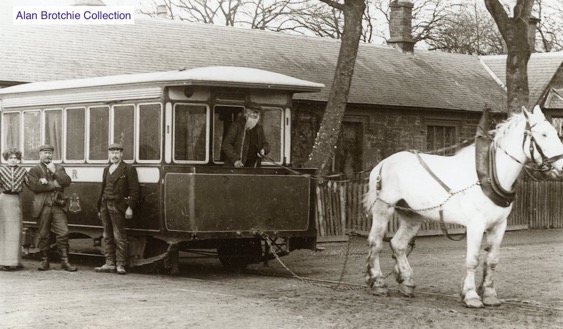
The Inchture tram (known locally as the 'bus') at Crossgates circa 1905.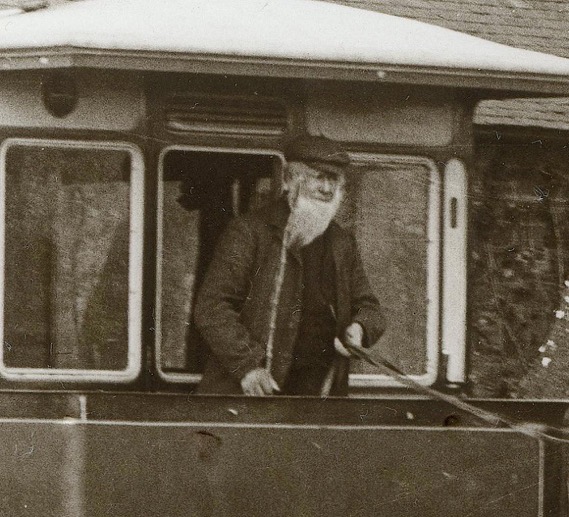
An enlargement of the above photograph showing the driver — Bob Speed — who apparently drove the tramcar (and its predecessor — a coach) from the commencement of horse-drawn services in 1866 through to 1907, when his son took over. He is wearing informal attire.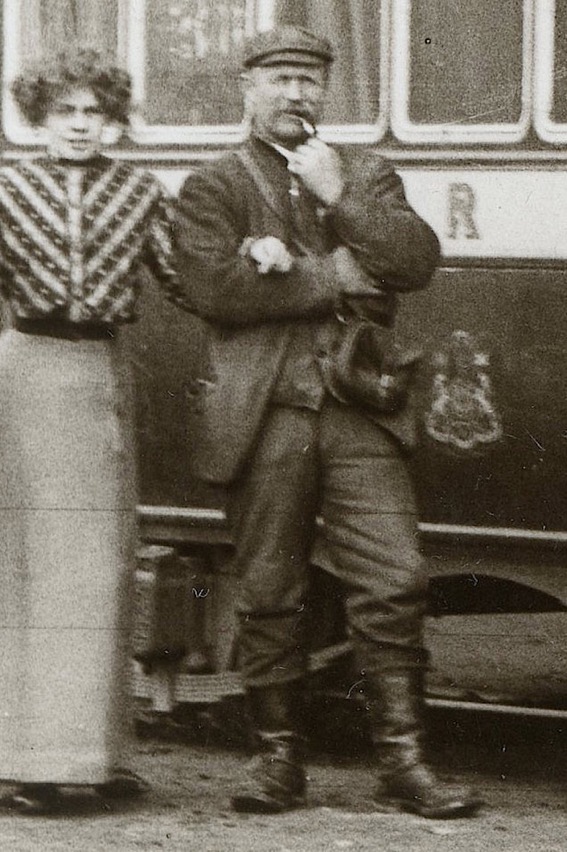
Another blow-up of the above photograph, this time showing the conductor, whose only badge of office is his cash bag.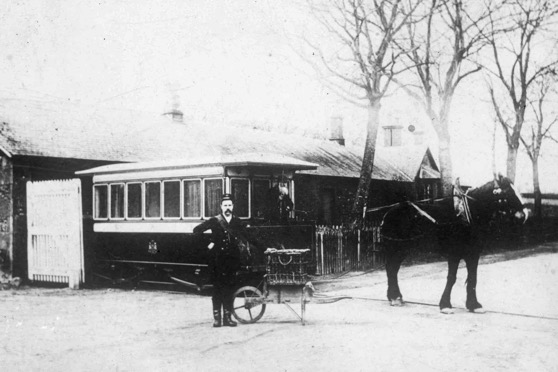
A postcard view of the 'bus' (No.1) at Crossgates, purportedly taken in 1905. Photograph courtesy of the National Tramway Museum. 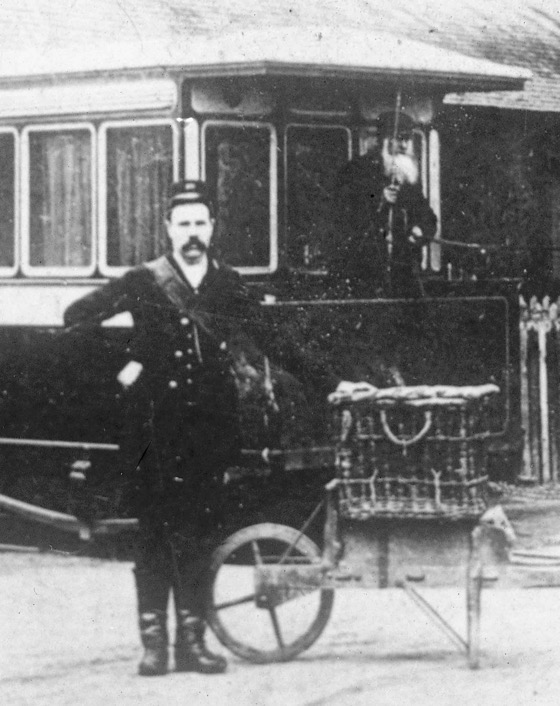
An enlargement of the above photograph showing the men in more detail. The tram driver is clearly Bob Speed, the man in the foreground more than likely the local postman.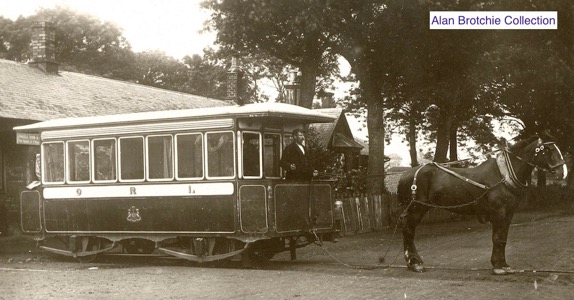
Crossgates once again, this time with Bob Speed's son at the helm — 1909.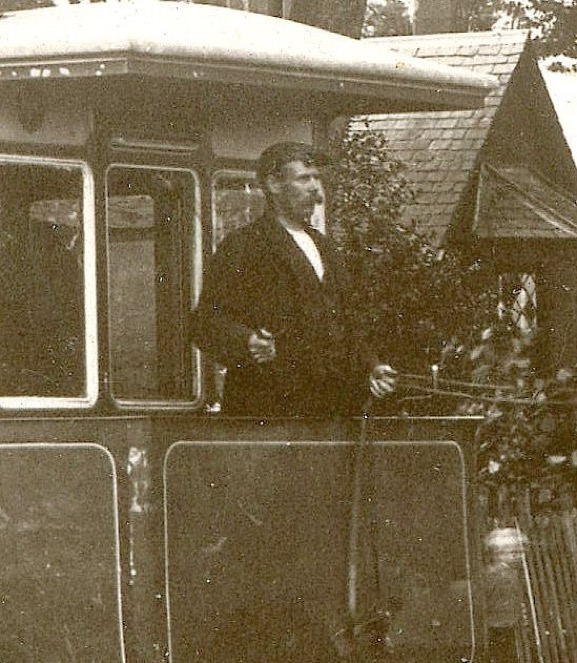
An enlargement of the above photograph showing the driver, who is once again wearing completely informal attire.