Colne and Trawden Light Railways
(Colne Corporation Light Railways)
History
The Colne and Trawden Light Railway arose from three competing tramway schemes that sought to connect Nelson, Colne and Trawden, one by Messrs Greenwood and Batley — a large, Leeds-based manufacturer of machinery — and the other two by the respective corporations of Nelson and Colne. Following an inquiry by the Light Railway Commissioners, and agreement between the various parties, Nelson and Colne Corporations withdrew their applications to operate in Colne, leaving the company to construct the tramway from the Nelson boundary through Colne to Laneshawbridge and Trawden. Powers to build the tramway were granted to Messrs Greenwood and Batley on the 24th June 1901 under the Colne and Trawden Light Railways Order, 1901. Through-running powers were subsequently obtained — on the 31st July 1902, under the Colne and Trawden Light Railways (Capital and Further Powers Amendment) Order 1902. Construction started, at least ceremonially, on the 19th May 1903, just eight days after the company had acquired yet more powers under the Colne and Trawden Light Railways (Acquisition of Lands Amendment) Order 1903. Although Messrs Greenwood and Batley set up a subsidiary — the Colne and Trawden Light Railway Company — which became the legal owner of the tramway, and whose name was emblazoned on the tramcars, the system was always operated by the parent company.
The gauge chosen was 4ft 0ins, to facilitate inter-running with the Nelson and Burnley Corporation systems to the southwest. The system was effectively centred around the junction of Keighley Road and Cotton Tree Lane in Colne, the depot being just yards away on Heifer Lane, the first section opening — on the 28th November 1903 — from here southwestwards along Keighley Road, Market Street and Albert Street, to a temporary terminus near the latter's junction with Queen Street. The remainder of the line was opened just two days later from Queen Street to the Nelson Boundary at Bott House Lane. The southern arm of the system from Colne to the Rock Hotel in Trawden, via Cotton Tree Lane, Trawden Road, Skipton Road and Church Street was opened on the 22nd June 1905. The last section to open, out eastwards along Keighley Road to a terminus at Emmott Lane in Laneshawbridge, opened in December 1905. A short extension of the Trawden line of just over a third of mile (along reserved track rather than the road) from the Rock Hotel to Lanehouse Lane was opened in December 1905, taking the system to its final size of 5.23 miles.
The initial services were operated by 6 tramcars, these being joined by a further 3 in April 1905, and 3 more in early 1906, taking the fleet to 12 vehicles.
Although the C&TLR tracks met those of Nelson Corporation at the borough boundary, and both the C&TLRCo and Nelson Corporation had mutually withdrawn applications for lines in the each other's territory, the spirit of cooperation was short-lived, would-be through passengers having to alight at the boundary and wait for a tram operated by the other concern. This can hardly have endeared either the company or Nelson Corporation to the travelling public, particularly on a cold rainy day. The fact that Burnley Corporation was allowed to operate the occasional excursion from Burnley, through Nelson to Colne and Trawden must have been especially galling. Eventually, after eight years of inconvenience, an agreement was finally reached in 1911, C&TLRCo tramcars running through to Nelson, and NCT tramcars running through to Colne from the middle of that year.
The tramway was hardly a money spinner, and this, coupled with the fact that tramway operation was not part of Greenwood and Batley's core business, eventually led to a decision to sell the undertaking, though the company doubtless also had one eye on the future, when expensive renewals would be required. After first approaching Nelson Corporation, the concern was eventually sold to Colne Corporation (including the tracks within Trawden Urban District Council's boundary), the town council having formally taken the decision to purchase the tramway on the 30th October 1912, with agreement finally being reached between the two parties on the 4th February 1913. Powers to take over and operate the tramway were acquired by the corporation on the 4th July 1913 under the Colne Corporation Act 1913, the formal handover taking place at midnight on the 24th March 1914.
Despite some top-covering of a number of tramcars, both the tramcars and the tramway were in urgent need of investment. A new manager was brought in who quickly recommended an extensive programme of tramcar refurbishment and top-covering, as well as the purchase of a new vehicle. The process had, however, hardly begun when the Great War intervened, though fortunately, the new tramcar was still delivered, entering service on the 24th December 1914, and several vehicles were still sent away for refurbishment.
Like many tramway systems, Colne Corporation's emerged from the rigours of the Great War, once again in badly run-down condition, with a significant backlog of repairs and renewals. Nevertheless, and despite high costs and inflationary pressures, in 1919 the corporation chose to invest in new tramcars, top-covering the remaining open-topped vehicles, and embarking on a programme of track replacement, two new bogie tram cars arriving in 1919.
By the early 1920s, the corporation was showing interest in extending its transport undertaking by introducing motorbus routes, initially acquiring some second-hand vehicles, which it seems to have run sporadically, as it did not possess official powers to operate them. The latter were eventually acquired on the 28th July 1921 via the Colne Corporation Act 1921, an act which also empowered the corporation to abandon tramway routes as it saw fit, and to replace them with motorbuses. The latter appears to have been an attempt to enable operational flexibility, as there is no evidence whatsoever that the corporation was thinking of closing the tramway at this time.
The corporation introduced its first regular motorbus service — to Earby — in January 1923, at a time when there was a significant trade slump in the cotton industry, and the tramway was making a large loss. Three of the trams that had not been rebuilt in 1914 were converted to single-deck, one-man operation as a cost-saving measure, the first of these entering service on the Laneshawbridge line in later 1924. Surprisingly, and despite the ageing tramcar fleet and the economic challenges, the corporation was still renewing sections of badly worn track as late as 1925. Major track renewal was, however, looming, so it was perhaps no surprise that the corporation baulked at the cost of relaying the Laneshawbridge line, as despite all its efforts, the enterprise continued to be a drain on municipal resources. The corporation duly applied to the Ministry of Transport to abandon the Laneshawbridge line, but was still intent on keeping the rest of the system, even ordering three new tramcars, which arrived in 1926.
The last tram services on the Laneshawbridge line were withdrawn on the 19th October 1926, local bus operators being licenced to extend their services into Colne to compensate for this, later joined by services jointly operated by Colne and Keighley Corporations. By 1927, however, with track renewal looming on the Trawden line, the corporation finally decided to abandon the tramway — this despite having renewed the entire fleet and a good deal of the infrastructure — the Trawden line succumbing on the 3rd June 1928. From now on, it was only a matter of time until the Nelson line was abandoned, the corporation in the meantime gradually expanding its motorbus services. In October 1932, the name of the corporation department (as well as the committee which oversaw it) was changed to 'Colne Corporation Transport' to reflect the evolving service provision.
By 1932, the corporations of Burnley, Colne and Nelson, who had been discussing joint municipal service provision since 1930, finally decided that it was the way forward, something that they perhaps ought to have considered in 1901/2. On the 1st April 1933, Colne's transport interests (including the trams) were transferred — together with those of Nelson and Burnley — to the Burnley, Colne and Nelson Joint Transport Committee. The transfer of Colne's transport interests to the new enterprise was only formalised some three months later with the passing — on the 18th July 1933 — of the Colne Corporation Act 1933.
Burnley Corporation was the major player in the BC&NJTC, and its views tended to be transposed onto the enterprise as a whole. Whilst Colne Corporation had already abandoned a significant portion of its system, Nelson Corporation were very much against abandonment, having replaced their entire tramway fleet barely 13 years beforehand. The majority view nevertheless prevailed, Nelson being out-voted, so tram replacement proceeded across the entire concern, Colne included. The last tram service over former Colne Corporation tracks — operated by the BC&NJTC — ran on the 6th January 1934.
Uniforms
Unfortunately, good-quality photographs depicting staff of the C&TLRCo or its municipal successor, Colne Corporation Light Railways, are fairly scarce, so there is little evidence to go on when relating the uniform story.
Several early photographs have survived which show staff wearing informal attire, despite the fact that their colleagues (in the same photographs) are wearing a uniform. Conductors were provided with single-breasted jackets with stand-up collars, motormen with double-breasted, lancer-style tunics (with the button pairs narrowing from top to bottom), again with stand-up collars; the latter bore insignia, very probably an employee number on the bearer's left-hand side and system or company initials on the right-hand side. Unfortunately, the surviving photographs are not of sufficient quality to allow the insignia to be discerned. Conductors' caps were of the drooping-peak type, whereas motormen wore soft-topped peaked caps; the photographic evidence is, however, far from clear, some images appearing to show that the caps did not bear badges, whilst others hint that they may have borne script-lettering grade badges. At some point, however, probably in the mid-Edwardian era, the caps were changed to a tensioned-crown peaked style (for both conductors and motormen), and these certainly bore standard, off-the-shelf, script-lettering grade badges — 'Conductor' and 'Driver' — presumably in brass to match the buttons (see link), though even this cannot be stated with certainty.
Staff were also issued with double-breasted greatcoats with five pairs of buttons and high, fold-over collars; it is unclear whether the latter bore any insignia.
It is believed that the style of uniforms did not change after the corporation take-over of 1915, and up until the absorption of the system into the Burnley, Colne and Nelson Joint Transport Committee in 1933. However, the paucity of photographic evidence does not allow this to be stated with anything like certainty.
Photographs of senior staff are extremely sparse too, with only two known so far, both from Greenwood and Batley days, i.e., pre-municipalisation. These show that senior staff wore typical 'tramway inspector' garb, namely: single-breasted jackets with hidden buttons (or perhaps more likely, hook and eye fasteners), edged in a finer material than the main body of the jacket. The stand-up collars bore embroidered insignia on both sides, though whether these were the grade, system initials, or both is unclear. Their tensioned-crown peaked caps bore a badge of some kind, possibly the grade embrodiered on a hat band.
In common with many tramway systems, it is highly likely that Colne employed female staff during the Great War to replace male staff lost to the armed services; however, photographs are yet come to light, so it is impossible to say what uniforms were worn.
Further reading
For a history of Colne's tramway system, see: 'The Light Railways of Colne' by J S King, in Tramway Review, Nos 72 (p227-233 and 239-246), 73 (p259-274) and 74 (p50-62); Light Railway Transport League (1972 and 1973).
Images
Motormen and conductors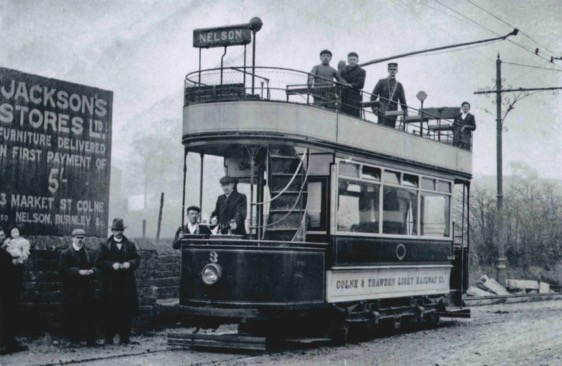
Tramcar No 3 stands outside what may be the depot on Heifer Lane in Colne — photo undated, but from the immaculate condition of the tram, probably taken shortly after its delivery in 1903. Whilst the conductor is wearing a uniform, the motorman is clearly in informal attire. Author's Collection.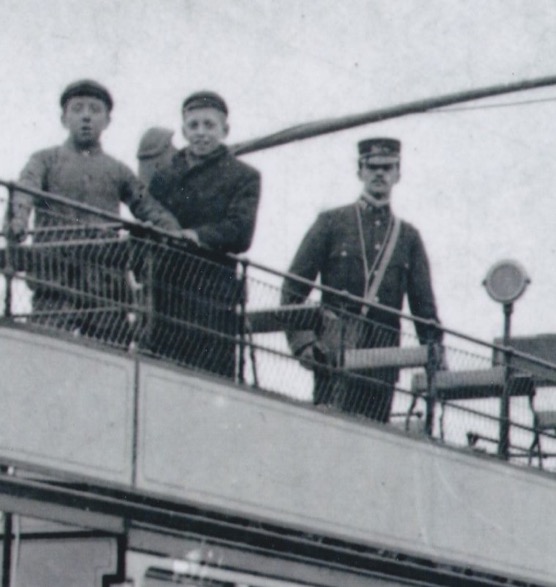
An enlargement of the above photograph showing the conductor. He is wearing a single-breasted jacket with stand-up collars and a drooping-peak cap bearing a script-lettering grade badge, probably 'Conductor'.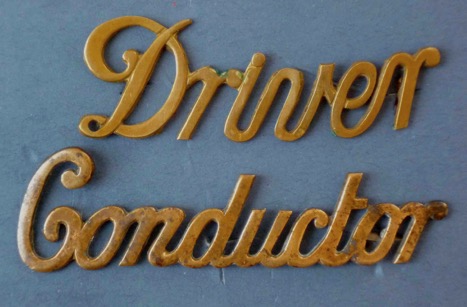
General pattern brass script-lettering cap badges of the type probably worn on tramcar crew caps. Author's Collection.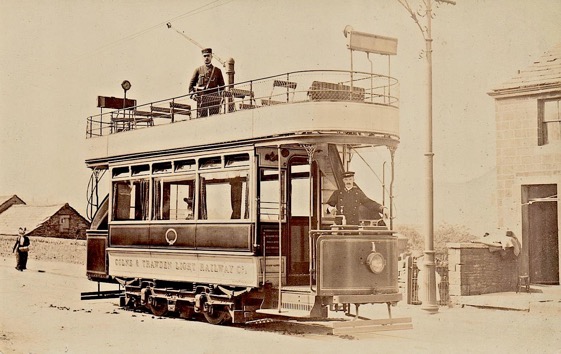
Another early photograph, this time of a pristine Tramcar No 1, dating the photograph to 1903. The conductor (on the top deck) is wearing a single-breasted jacket with a drooping-peak cap, which appears to lack a cap badge.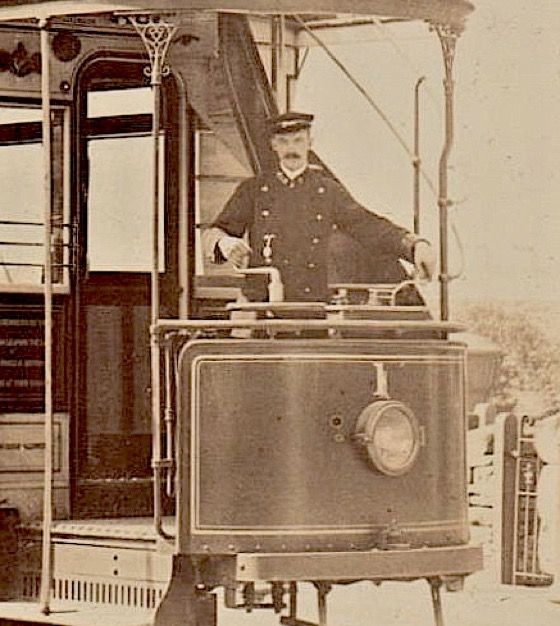
An enlargement of the above photograph showing the motorman, who is wearing a double-breasted, lancer-style tunic with stand-up collars, along with a soft-topped peaked cap; the latter does not appear to bear a cap badge.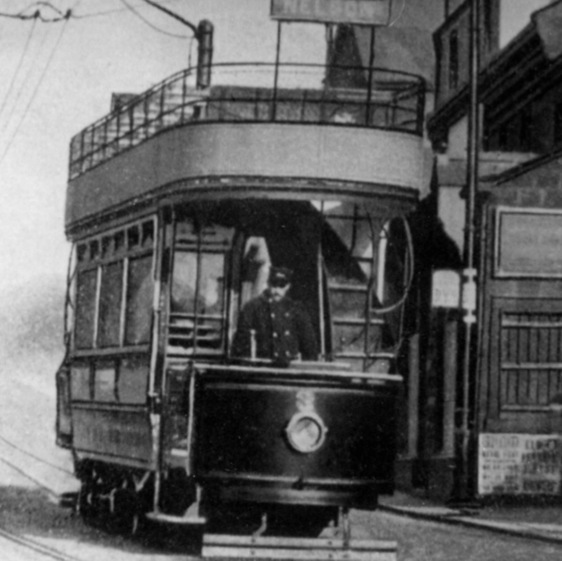
A motorman at the controls of Tramcar No 3 bound for Nelson — photo undated, but probably early-to-mid Edwardian. The motorman is wearing a double-breasted greatcoat with high, fold-over collars. Photo courtesy of the Tramways and Light Railway Society.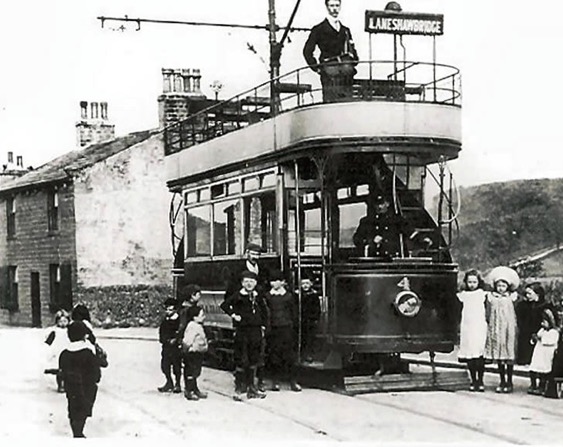
A motorman and a conductor, the latter once again in informal attire, with Tramcar No 4 at the Emmott Lane Terminus at Laneshawbridge — photo undated, but certainly mid Edwardian. Once again, the motorman, with his exposed driving position, is wearing a heavy-duty greatcoat. With thanks to Duncan Holden. 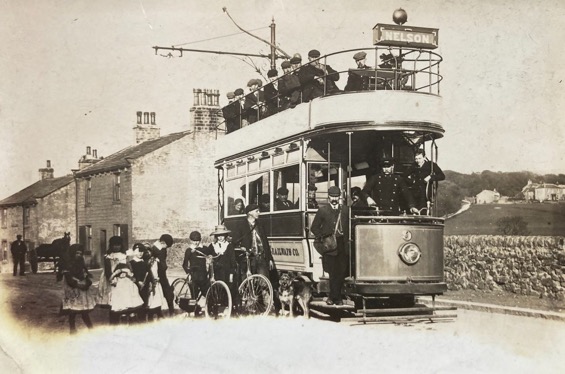
The crew of Tramcar No 9 pose for the camera at the Laneshawbridge terminus — photo undated but definitely no earlier than April 1905, when this vehicle was delivered.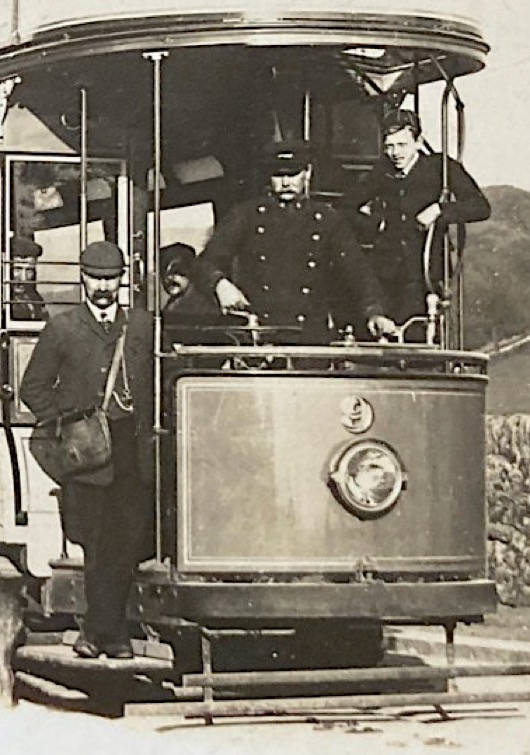
An enlargement of the above photograph showing the conductor (left) and the motorman (centre). Despite the tramway having been open for at least a year, the conductor is wearing informal attire. The motorman appears to be wearing a soft-topped peaked cap bearing a badge of some description.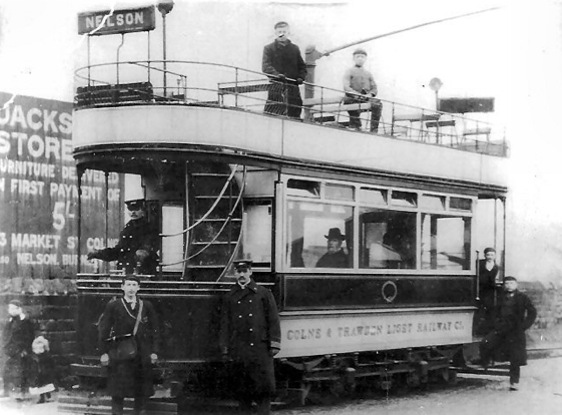
A motorman and a conductor (in informal attire) pose with Tramcar No 4, along with an individual whose grade is unclear — photo undated, but probably mid Edwardian. By this time, a switch had been made to tensioned-crown peaked caps. With thanks to Jim Halsall.