Southport Corporation Tramways
History
Southport Corporation became a tramway owner in 1896 when it bought the tracks of the Southport Tramways Company (a standard-gauge horse tramway) within the borough; although the corporation wished to control tramway development in the town, it did not want to run the trams itself at this date, so operation was leased back to the STCo.
Nothing further happened until 1899, when the British Electric Traction Company acquired a controlling interest in both the STCo, and the town's other horse tramway, the Birkdale and Southport Tramways Company. At this time, the BETCo was aggressively purchasing horse and steam-operated tramways across the British Isles, with the intention of converting them to electric traction. Although the corporation was initially favourable to the BETCo's plans (effectively a single electric tramway system in Southport and neighbouring Birkdale), it subsequently decided to build and operate its own municipal system. Matters progressed quickly, with reconstruction (including the building of new lines) commencing on the 15th January 1900, and the first corporation electric tramcar running on the 15th July.
The corporation then reached agreement with the B&STCo to purchase that company's tracks within the borough, which it did on the 1st January 1901, leasing them back to the company until the end of the year. The corporation also reached an agreement with the STCo, which required the company to convert their former lines in Southport to electric traction, in return for a 21-year operating lease (from 15th July 1901). The reason for this lease arrangement, as opposed to Southport working the lines itself, was because the STCo's main line ran across the borough boundary and into neighbouring Birkdale.
The corporation subsequently took over the working of the former B&STCo's horse services on the 15th December 1901, which it operated for just three days shy of a year, the last horse tram of all running on the 12th December 1902.
Southport became a County Borough on the 1st April 1912, absorbing Birkdale Urban District Council in the process, and thereby becoming the owner of all the tracks leased to the STCo by the former Birkdale U.D.C. Following negotiation with the STCo, the corporation acquired the company's tramway assets on the 1st March 1918, finally creating a single, unified tramway serving Southport and Birkdale.
At the end of the Great War, the tramway, like most others across the country, was badly run down, however, unlike many concerns, Southport had already made the decision to invest in its system, renewing tracks and replacing worn-out tramcars.
The corporation bought its first bus in 1924, and gradually expanded its fleet, taking the decision in 1930 to formally abandon the tramway system in favour of buses. The first route closures occurred on the 31st of March 1931, with the last tram of all running on the 31st December 1934.
The municipal transport undertaking was re-named 'Southport Corporation Transport' in 1934, in order to reflect the change to motorbus-only operation.
At its maximum, the SCT operated 17.3 miles of tramway, with lines running: northeastwards to High Park and Churchtown; southeastwards to Blowick and Kew Gardens; southwards to Bedford Park and the Crown Hotel in Birkdale; and southwestwards to the Smedley Hydro Hotel (also in Birkdale).
Uniforms
Although the corporation operated horse trams for almost one year (from December 1901 to December 1902), photographs which unequivocally date from this period have yet to come to light, so it is currently impossible to state whether the corporation issued its horsecar crews with uniforms or simply continued with the 'informal attire' policy of the horse-tramway company (see link).
The precise chronology of the uniforms issued following electrification is currently unclear, though it is likely that the initial issues were double-breasted, with five pairs of buttons (see link) — the top set buttoning through holes in the jacket lapels — with three pockets at waist/hip level, and with a slit-breast pocket on the left side. Both collars carried an employee number pre-fixed with a grade initial, 'C' for conductor and 'M' for motorman, though sometimes the badges appear to have been worn on one collar only, usually on the bearer's right-hand side. These were almost certainly in brass to match the buttons. By the end of the Great War, photographs show crews without any collar badges at all, suggesting that they had either fallen out of use, or that there were shortages during the conflict.
The uniform caps were initially of the drooping-peak type, and carried a large brass cap badge comprising a municipal device and motto, all within a wreath, below which was a ribbon containing the words 'CORPN TRAMWAYS' (see below for an example). At some point prior to the Great War, the drooping-peak caps were superseded by a more a modern soft-topped style of peaked cap, though many photographs suggest that both types continued in use simultaneously for some considerable time.
Motormen and conductors were also issued with double-breasted greatcoats with five pairs buttons, three pockets, and high, fold-over collars; the collars carried an employee number pre-fixed with a grade initial, 'C' for conductor and 'M' for motorman. These were almost certainly in brass to match the buttons.
Photographs of inspectors have yet to surface, so it is currently impossible to say what uniforms they wore.
Southport, in common with many UK tram operators, employed women during the Great War to replace male staff lost to the armed services. These ladies — seemingly referred to as either 'Lady Guards' or 'Conductorettes' in Southport — were issued with single-breasted jackets with five pairs of buttons, four pockets, lapels and epaulettes (with button closures); the lapels carried an employee number, whilst the epaulettes appear to have been left plain. A long matching skirt was also worn. Headgear comprised a baggy cap with a glossy peak, sometimes referred to as a motor cap; the caps bore the same cap badge as male employees' caps.
Further reading
For a history of Southport's tramways, see: 'Southport in the Age of the Tram' by John Dean and Cedric Greenwood; Sliver Link Publishing (2008).
Images
Motormen and conductors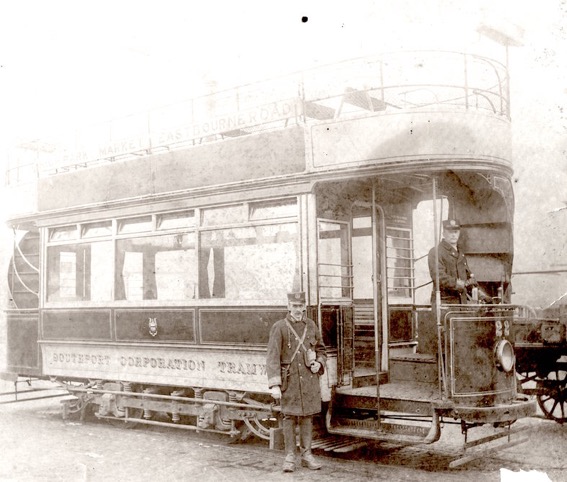
Tramcar No 22 and crew — photo undated, but judging by the excellent condition of the vehicle, probably taken shortly after its delivery in 1902; the car was top covered by 1910, so the date can be no later than this. Author's Collection.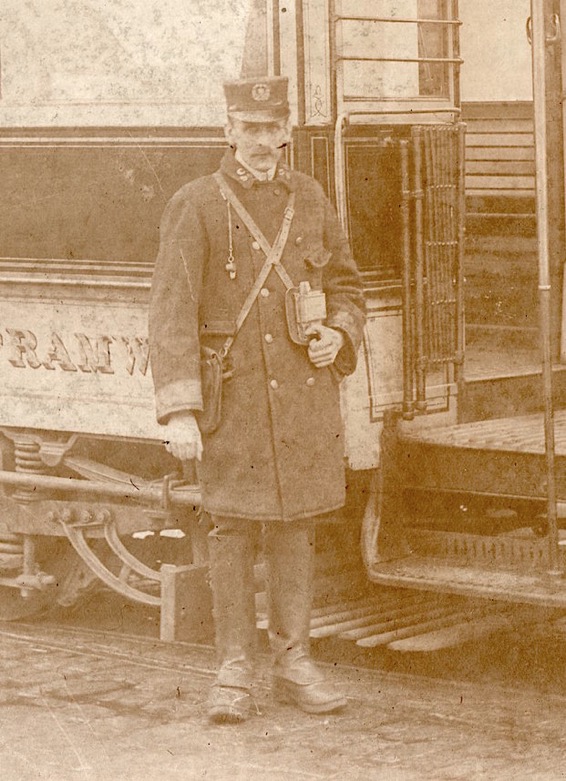
An enlargement of the above photograph showing the conductor in his clogs and gaiters. His greatcoat carries his employee number on both collars (possibly '50'), prefixed with a 'C', denoting that he was a conductor; this is in contrast to the motorman, whose collars are plain. The cap is of the drooping-peak type, carrying an elaborate 'Corporation Tramways' cap badge (see below).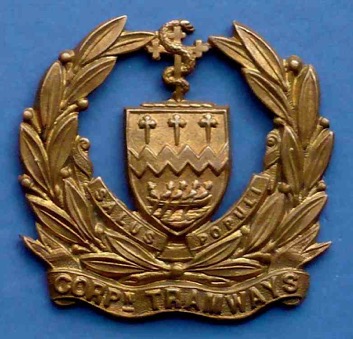
Southport Corporation Tramways cap badge — brass. Author's Collection.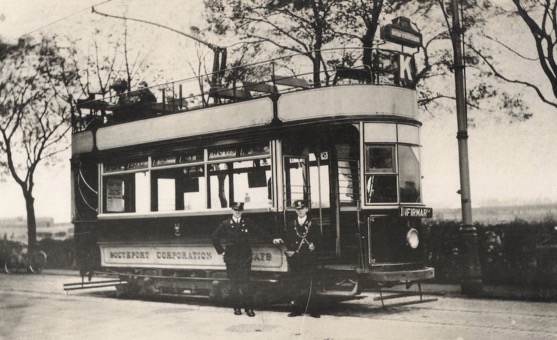
The crew of Tramcar No 14 stand with their charge at the Kew Gardens terminus around 1912, prior to reversing the trolley pole for the inward journey. Photo by W A Camwell; Author's Collection.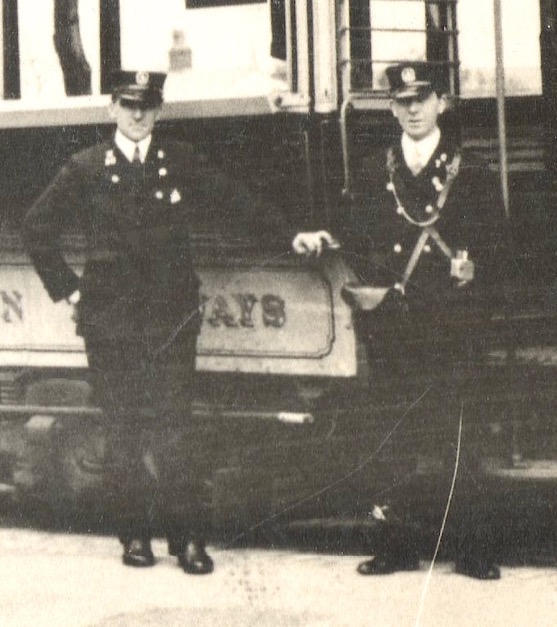
An enlargement of the above photograph showing the motorman and the conductor, both of them in drooping-peak caps, which were by this time, somewhat old fashioned. Photo courtesy of the Tramways and Light Railway Society.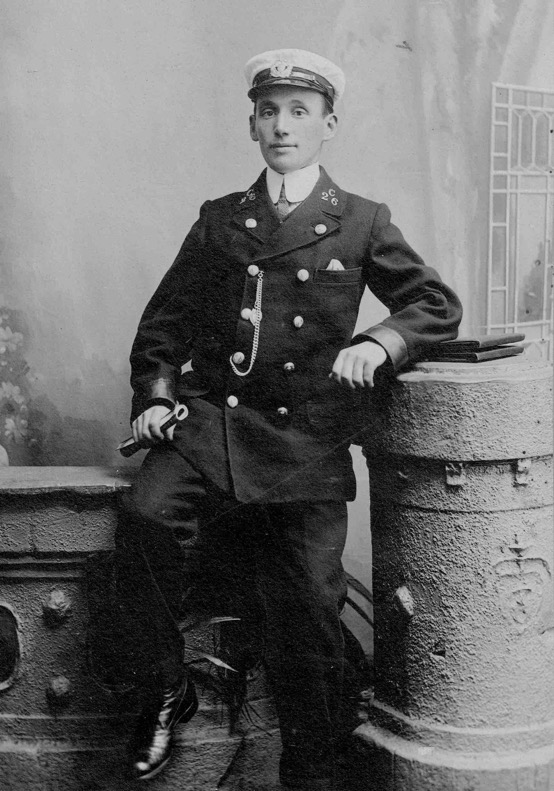
A rare studio portrait of a Southport Corporation Tramways conductor (Employee No 26) — photo undated, but very probably taken several years prior to the Great War. Photo taken in the studios of Taylor Limited, 262, Upper Parliament Street, Liverpool. Author's Collection.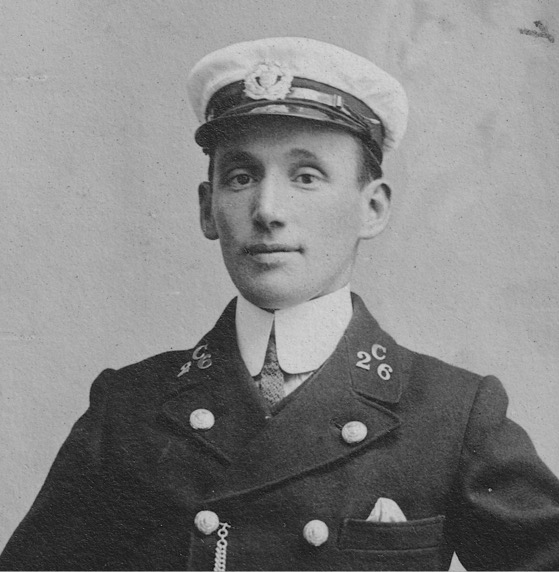
An enlargement of the above photograph showing details of the uniform and cap insignia. The photograph shows the unusual positioning of the top pair of buttons, and a slit-breast pocket, which on later photographs is absent. Curiously, he is wearing a soft-topped cap rather than the drooping-peak type seen in other pre-Great War photographs..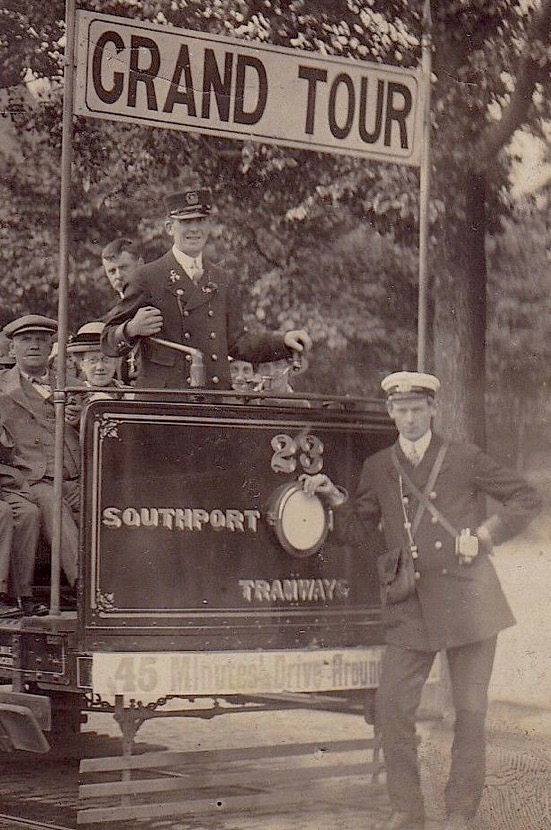
The crew of what would appear to be a brand-new No 23 (a 'toastrack') pose for the cameraman on a 'Grand Tour' service. The service was inaugurated in 1914 using Tramcar No 21, and this car, No 23, was delivered the following year, so the photo was probably taken in that year, though it is difficult to say with certainty as Southport seems to have kept these vehicles in immaculate condition. The motorman is wearing a drooping-peak cap, in contrast to the conductor, who has a soft-topped cap with a white rain cover. The motorman's lapel badge seems to be 'C74', which suggests that he may only recently have passed out as a motorman, having previously served as a conductor. Author's Collection.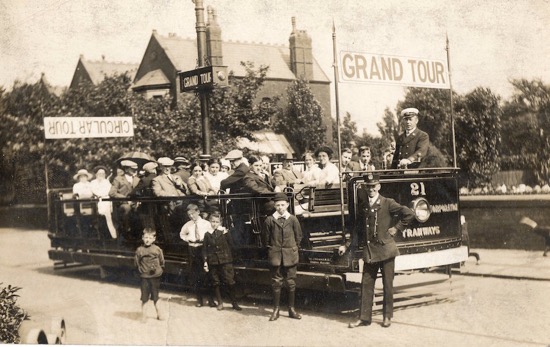
Another toastrack shot, this time of No 21, again seemingly in pristine condition, but from the plethora of large flat caps, possibly taken after the Great War rather than during it. Author's Collection.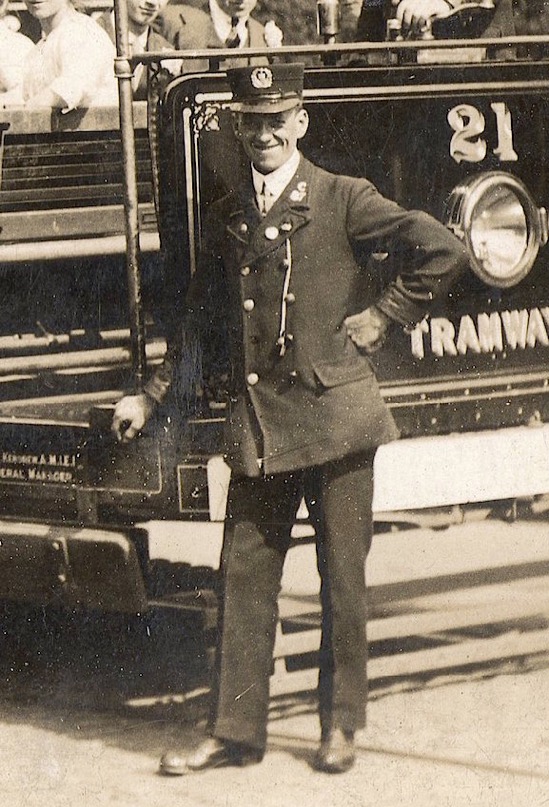
An enlargement of the above photograph showing the conductor in his smart uniform and drooping-peak cap with prominent cap badge. He appears to be Employee '87', the 'C' prefix correctly denoting him as a conductor.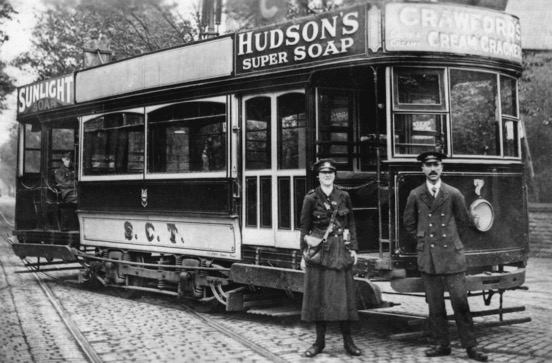
A conductress and a motorman with 'California-type' Tramcar No 7 — photo undated, but almost certainly taken during the Great War. Author's Collection.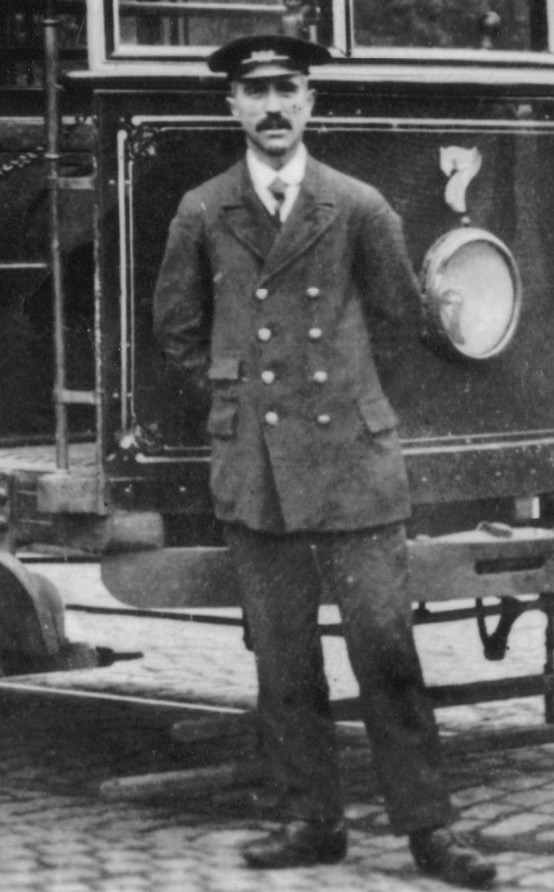
An enlargement of the above photograph showing the motorman. By this time staff were clearly wearing rather squat peaked caps, the top of which, in this photo, obscures the bearer's cap badge. The lapels and collars are plain, i.e., devoid of badges.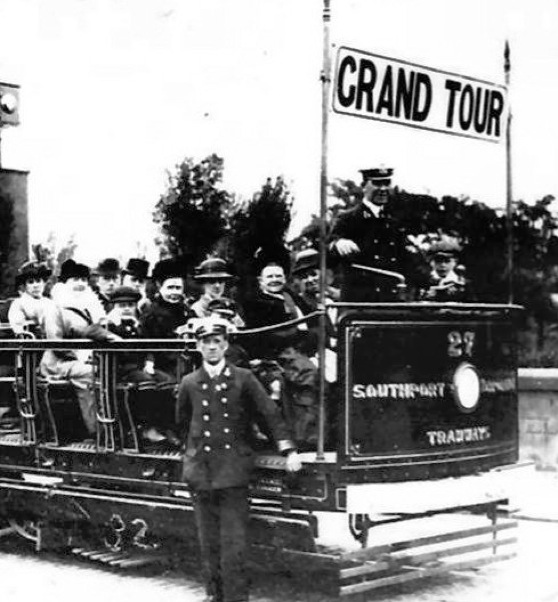
A conductor and motorman, both in soft-topped peaked caps, with another immaculately turned-out toastrack, Tramcar No 27 — photo undated, but probably taken after the Great War. Photo courtesy of Duncan Holden.
Female staff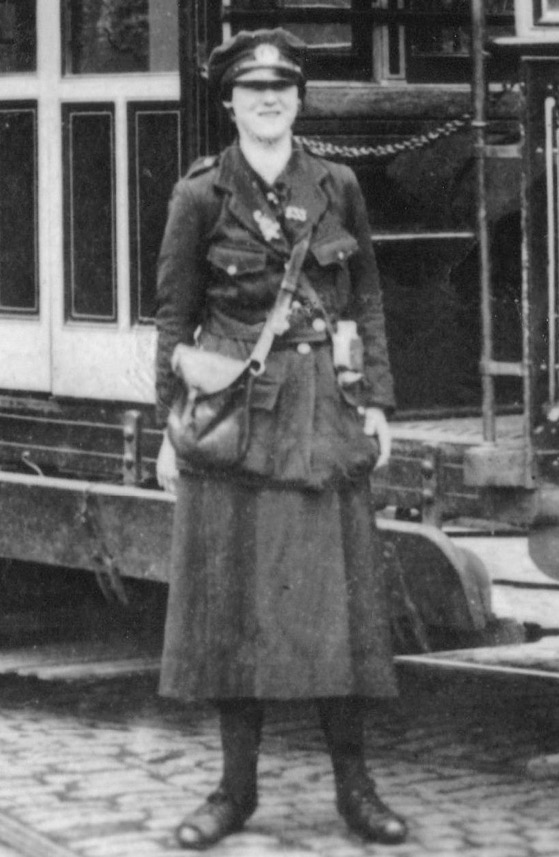
An enlargement of the Great War photograph of Tramcar No 7 above, showing the conductress, who would appear to be Employee No C33.