Scarborough Tramways Company
History
Powers to build an electric tramway system in Scarborough were granted on the 23rd June 1902 under the Scarborough Tramways Act (1902); the act also incorporated a company — the Scarborough Tramways Company — to build and operate the tramway. The STCo quickly passed into the hands of Edmundson's Electricity Corporation, which controlled numerous electricity supply companies across the country, including that in Scarborough; the EEC also owned two other tramways — via its subsidiary, the Urban Electric Supply Company Limited — the small, provincial tramways in Glossop (Derbyshire) and Camborne/Redruth (in Cornwall). It is likely, though by no means certain, that the named promoters in the enabling act were acting on behalf of the EEC.
Construction of the 3ft 6ins-gauge, overhead electric tramway began on the 12th October 1903, the system opening for business on the 6th May 1904. Other than a very short extension opened in 1906, the tramway remained as built throughout its life, 4.78 miles in total. The system itself was a compressed 'figure of eight' lying on its side, with three branches and a short connecting line. From the depot in Scalby Road at the western apex of the 'figure of eight', the line ran southwards to Falsgrave Road then northeastwards along Westborough, Newborough and Eastborough to the eastern apex of the 'figure of eight' at West Pier. Here the line turned southwards along the Foreshore to the Aquarium, then northeastwards along Falconers Road to cross itself on Newborough Road (by means of a staggered junction from Vernon Road to Aberdeen Walk), before returning to Scalby Road via Horton Road, Prospect Road and Manor Road. One long branch ran from Aberdeen Walk along Castle Street and North Marine Road to North Sands, whilst the other two branches, which were very short, ran southwards from the Aquarium to the Spa, and eastwards from West Pier to South Sands. The connecting line ran between the western loop of the 'figure of eight', from opposite the station on Newborough, northwestwards along Hanover Road, Barwick Street and Trafalgar Street, to rejoin the 'figure of eight' at Prospect Road.
The STCo struggled from the off, making losses that were presumably only sustained courtesy of its parent company, the EEC. In short, the town was fundamentally unsuited to a tramway, being rather compact, so it was never far to walk to your destination, and with narrow and often very steep streets that forced single line and loop working, as well as the use of low-capacity, narrow-gauge tramcars. On top of this came the bane of all seaside tramways, large numbers of passengers in the summer (assuming the weather was good) and hardly any outside that season. Although the company ran a restricted service in winter, this was not enough to stem the losses, so after a poor summer season in 1910, the company announced that it would close the system during the winter. This move incurred the wrath of the council, who successfully prosecuted the company for failing to fulfil its statutory requirement to run services; the company, however, seemed to be more than happy to pay a daily fine right through into April 1911, rather than to run loss-making services.
Shortly before the Great War, the company was considering abandoning the tramway in favour of trolleybuses or buses, but nothing came of it. Like most systems during the Great War, Scarborough's suffered from a shortage of staff and skills, and an inability to source spares or carry out anything other than minimal maintenance; unlike many systems, however, which were heavily loaded due to war work, Scarborough had no war industries to speak of, and being on the east coast, the shoreline was fortified and access restricted, leading to a dramatic fall-off in passengers and revenue. As a result, the system emerged from the conflict in badly run-down condition, and there was simply no money to renew the tramcars or track, the company resorting to lifting tracks from little-used sections to replace worn-out track on the main routes.
The losses continued unabated, and by the close of 1921, the EEC had clearly had enough; although they considered closing the system, rather surprisingly, it was purchased — in January 1922 — by a business syndicate with connections to Seaton's Yellow Motor Buses. Unsurprisingly, this led to the introduction of motor buses, which ran along Marine Drive, a long-held aspiration of the tramway, but one which, given the financial situation, was never fulfilled. This led to a fall-out with the council, who for some reason refused to grant the company a licence for the new services, even though they seemed happy to grant them to many of the company's competitors. The new dawn ended barely one year after it had begun with a provisional winding-up order, a liquidator being appointed on the 1st October 1923. The liquidator was a Mr Herbert Walker Pulleyn, who evidentally saw some potential in the tramway, given that it was subsequently sold to another business syndicate, with whom he was presumably connected (a Yorkshire family of the same name, i.e., Pulleyn).
The new company overhauled the system, purchasing second-hand cars from Ipswich Corporation Tramways, and generally tried to make the concern pay in the face of bus competition and council opposition, the latter clearly wanting the tramcars gone from its streets. The corporation, who had passed up the right to buy the tramway in 1926, eventually decided to do so, acquiring powers to that end on the 31st July 1931 under the Scarborough Corporation Act (1931). The act also authorised the abandonment of the tramway, subject to the approval of the Minister of Transport, and the replacement of the tram services with either trolleybuses or motorbuses. The tramway was duly purchased on the 30th September 1931, the last tram running that day, following which, the services were taken over by the motorbuses of United Automobile Services Limited.
Uniforms
Despite operating a system in one of the north of England's premier tourist resorts, images of Scarborough Tramways Company staff are surprisingly rare, especially those taken prior to the Great War. Surviving photographs from the early years of the tramway's existence seem to have been largely intended to show the new electric wonder within its wider environment, so close-up shots of crewmen are rare. Those that have survived reveal that both motormen and conductors wore double-breasted, lancer-style tunics with five pairs of buttons (narrowing from top to bottom), epaulettes and stand-up collars; the latter carried an employee number on the bearer's left-hand side and company initials — 'S T C' — on the right-hand side, both in individual numerals/letters. The material used is currently unknown, but would have been either nickel or brass. The tensioned-crown peaked caps bore standard, off-the-shelf, script-lettering grade badges, either 'Driver' or 'Conductor', with the former being relatively quickly displaced by 'Motorman'.
Around the time of the Great War, though possibly considerably before this, the double-breasted lancer-style tunics were replaced by single-breasted jackets with five buttons, two breast pockets, epaulettes and stand-up collars; whilst the collars probably bore the same insignia as the earlier uniforms, photographs occasionally show them without badges. In the mid 1920s, the uniform jackets were changed yet again, and though still single breasted, they now bore seven buttons (the STCo was probably unique among British tramway systems in having such a high number of buttons; the usual was five), two breast pockets (with button closures), and stand-up collars, but no epaulettes; the collars carried the same insignia as described above. It would appear that this style of jacket was worn right through until closure in 1931. Tramcar staff were also issued with long, double-breasted greatcoats, which somewhat unusually, bore pairs of lancer-style buttons, six or seven, narrowing slightly from top to bottom, and high, fold-over collars. The greatcoats do not appear to have carried badges of any kind.
Only two photographs of STCo inspectors are known to have survived, one taken in the first few years of operation, and the other much later, probably in the 1920s. Inspectors' jackets were initially double-breasted with four pairs of buttons and lapels; the collars bore insignia of some description, almost certainly the bearer's grade — 'Inspector' — in embroidered script-lettering. Caps were in the same style as those worn by tramcar crews, but whether or not they bore a badge is currently unclear. At some point, a switch was made to a more traditional style of tramway inspector uniform, single-breasted with hook and eye fastenings, a slit breast pocket, epaulettes and stand-up collars; the slit pocket and the jacket were all edged in a finer material than the main body. The collars very probably carried the bearer's grade — 'Inspector' — though this cannot unfortunately be made out on the surviving photograph. At some point, the tensioned-crown peaked caps acquired a hat band of a lighter colour, which again probably bore the grade, and above which a tall, oval cap badge was worn. Details of the badge remain unknown, as no examples are known to have survived.
The Chief Inspector was provided with an elaborate single-breasted jacket with stand-up collars, which was heavily embellished with material of a finer quality than the main body to give a bandmaster-like effect. The stand-up collars carried the grade in embroidered script-lettering on one side, and company initials — 'S T C' — on the other; the tensioned-crown peaked cap also carried the grade, but on a hat band.
In common with the vast majority of UK tramway systems, the STCo employed women during the Great War to replace male staff lost to the armed services. The first ladies were taken on in spring 1915 and served as conductresses (some later as motorwomen), and were issued with rather shapeless single-breasted jackets with five buttons, two flap-closed breast pockets, epaulettes and high, fold-over collars; the collars and the pocket flaps were of a much lighter colour than the main body of the jacket. The jacket, which was completely devoid of insignia, was complemented by a long matching skirt with a short slit at the bottom closed by three plain composite buttons. The tensioned-crown peaked caps look to have been the standard type issued to male employees; they bore a standard, off-the-shelf script-lettering grade badge, 'Conductor'. At some point, the early style of jacket was superseded by a new style, still single breasted and with high, fold-over collars, but tailored, with a waist belt with button fastening. Around the same time, the tensioned-crown peaked caps were replaced by more stylish baggy peaked caps, often referred to as motor caps; they carred the same grade badge as the earlier caps.
Further reading
For a short history of Scarborough's tramways, see: 'Trams by the Sea: a History of Trams and Early Buses in Scarborough' by Chris Goode and Ross Hamilton; United Automobile Services Ltd (1981). For a more detailed history, see: 'The Scarborough Tramways' by H V Jinks, in the Tramway Review, Nos 82 (p35-44), 83 (p79-95), 84 (p126-128), 88 (p247-249) and 89 (p21-24); Light Railway Transport League (1975 to 1977).
Images
Motormen and conductors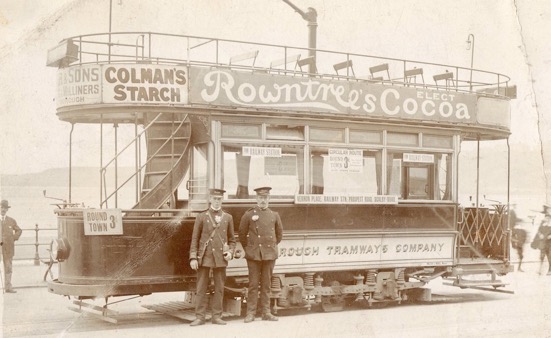
The crew of Tramcar No 1 (on a circular tour service) pose for the camera on the sea front — photo undated, but judging by the relatively good condition of the tram, probably mid-to late Edwardian. Author's Collection.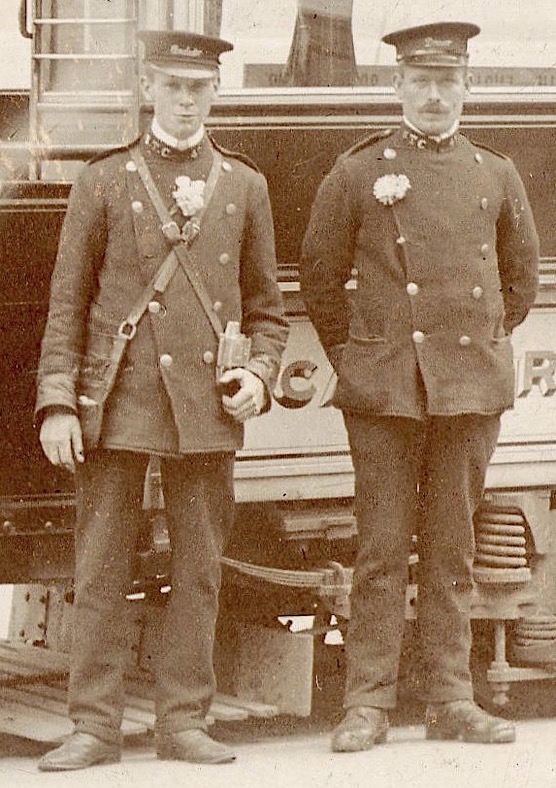
An enlargement of the above photograph showing the conductor and the motorman (Employees Nos 40 and 41). Both men are wearing lancer-style, double-breasted tunics with stand-up collars and epaulettes.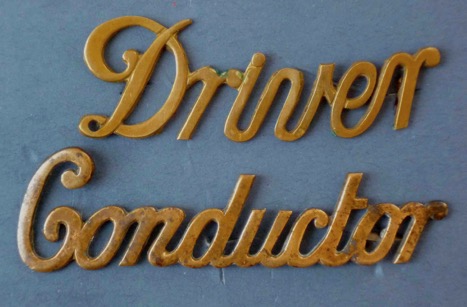
General pattern brass script-lettering cap badges of the type used by the Scarborough Tramways Company. It is currently unclear whether the STCo issued these in brass or nickel. Author's Collection.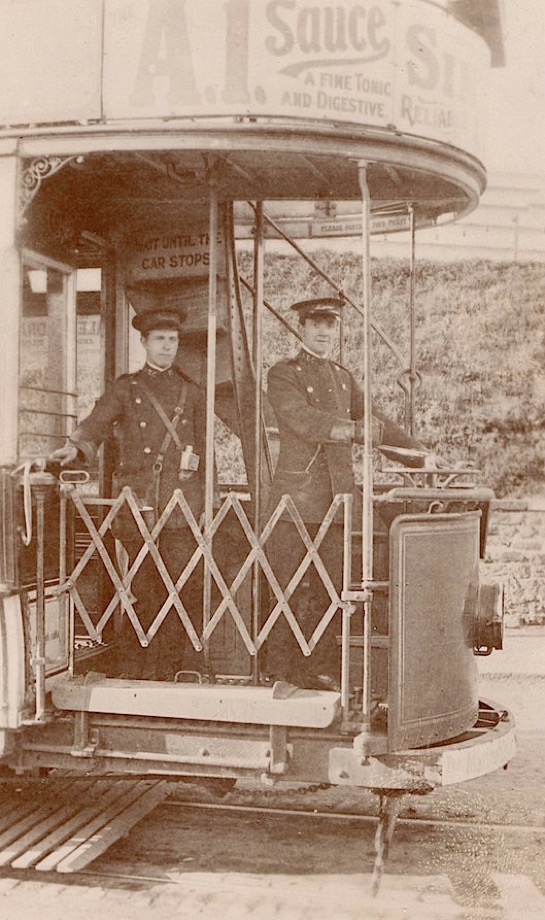
The crew of an unidentified STCo tramcar pose for the cameraman — photo undated, but probably Edwardian. Author's Collection.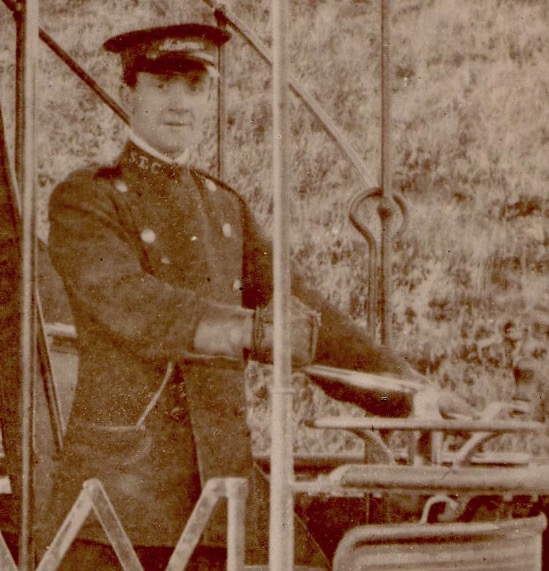
An enlargement of the above photograph showing the motorman — his collar initials are clearly seen, as well as his script-lettering grade badge, 'Motorman'.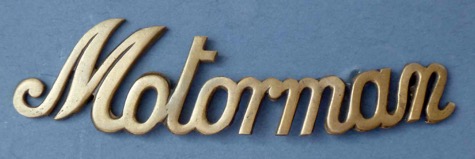
Script-lettering 'Motorman' cap badge, seemingly issued to STCo motormen in place of the earlier 'Driver' badges — brass. Author's Collection.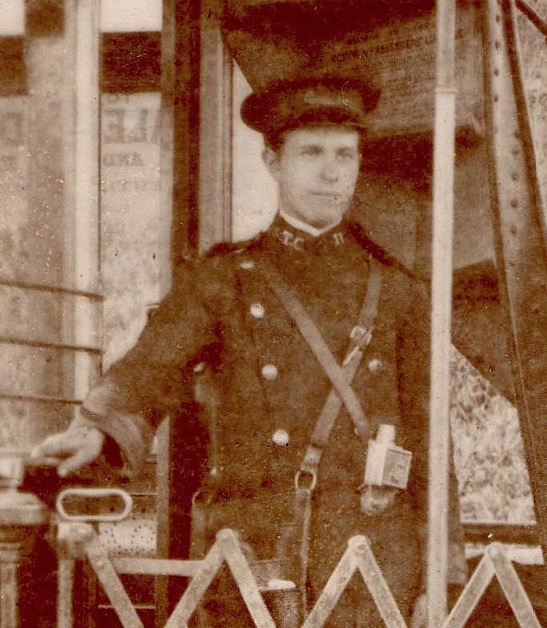
Another blow-up of the photograph above, this time showing the conductor, Employee No 11.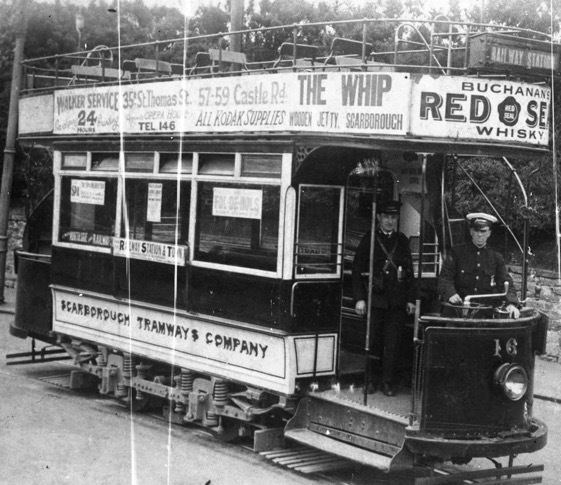
Tramcar No 16 and it's crew on North Side — photograph undated, but given that the motorman is wearing his military medals, probably taken in the years immediately after the Great War. Photo courtesy of the National Tramway Museum.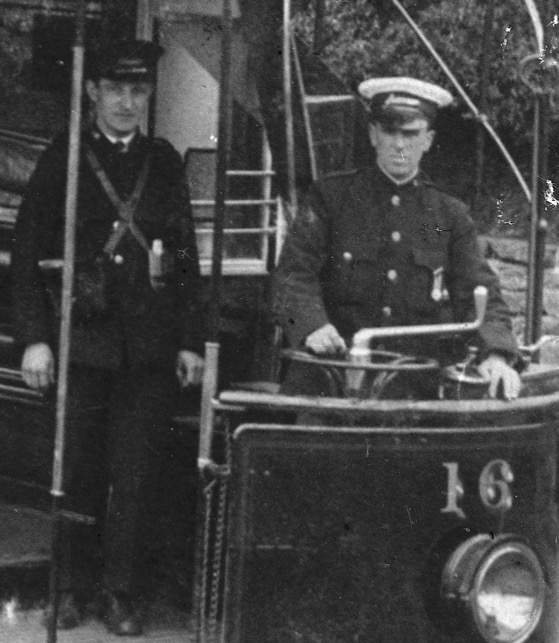
An enlargement of the above photograph showing the new single-breasted jackets, which appear to have been worn from sometime shortly before the Great War through to the mid 1920s.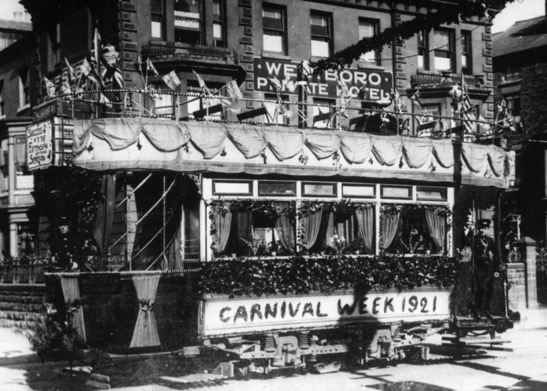
A rather dark photograph, but one which is clearly dated, and which shows a motorman (on the front platform) and a conductor (on the rear platform) in single-breasted jackets. Photo courtesy of the Tramways and Light Railway Society, with thanks to David Voice.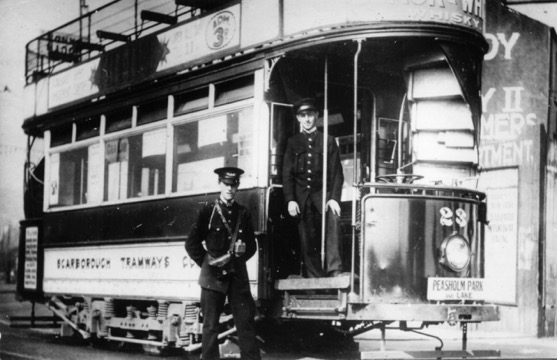
The crew of Tramcar No 23 — photo undated, but definitely taken no earlier than 1926, when this vehicle was purchased from Ipswich Corporation Tramways. Photo courtesy of the Tramways and Light Railway Society, with thanks to David Voice.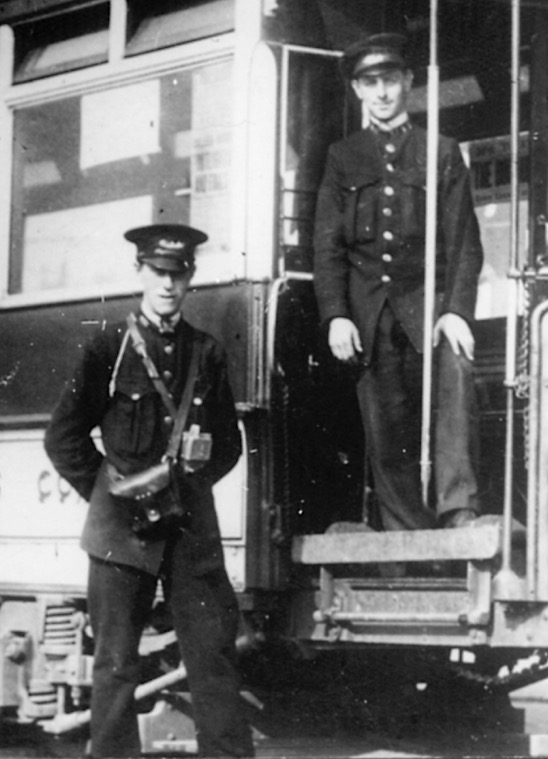
An enargement of the above photograph showing the conductor and motorman, both in single-breasted tunics.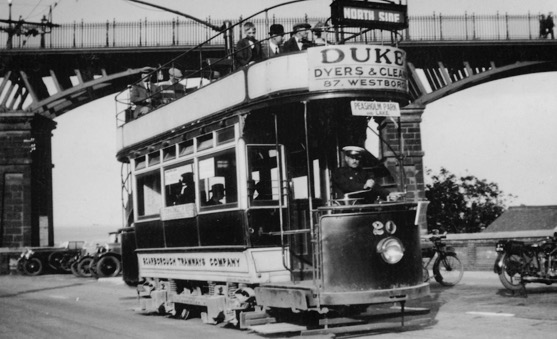
Tramcar No 20 waits at the Aquarium — photo undated, but probably taken in the late 1920s. Photo courtesy of the Tramways and Light Railway Society, with thanks to David Voice.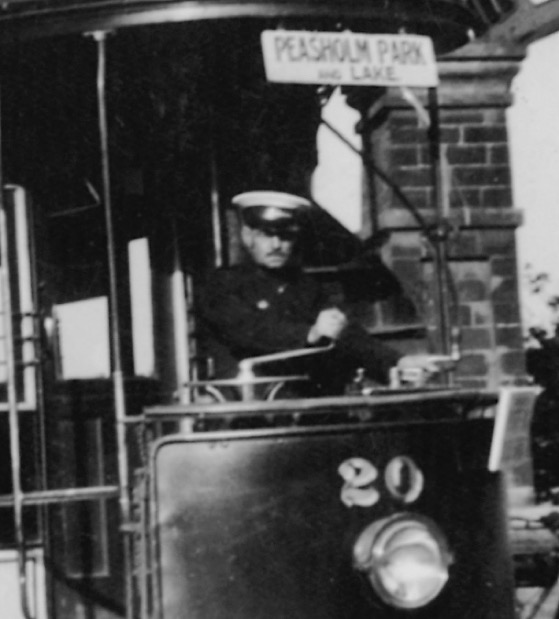
An enlargement of the above photograph showing the motorman.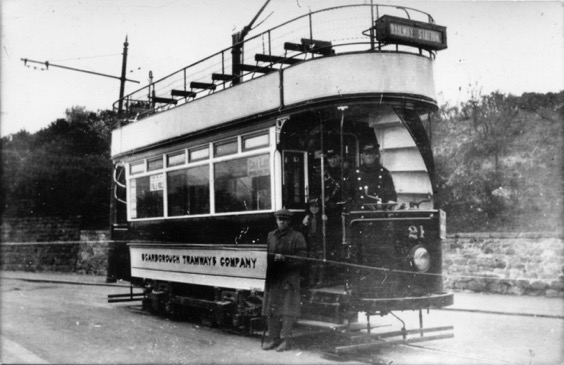
A rather smart-looking Tramcar No 21, almost certainly taken in 1926 or 1927 after rebuilding using the body of an Ipswich tram (on the trucks of the old No 21, which had been written off in an accident in 1925). The precise location is uncertain, but is possibly at the Northern terminus (thanks to Brian Mulvana for this information). Photo courtesy of the Tramways and Light Railway Society, with thanks to David Voice.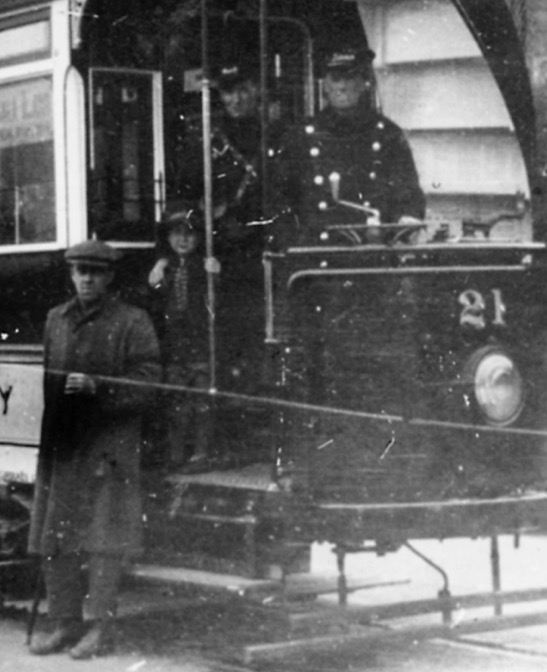
An enlargement of the above photograph showing the motorman, who appears to be wearing a lancer-style greatcoat, and a cap bearing a 'Motorman' script-lettering grade badge.
Senior staff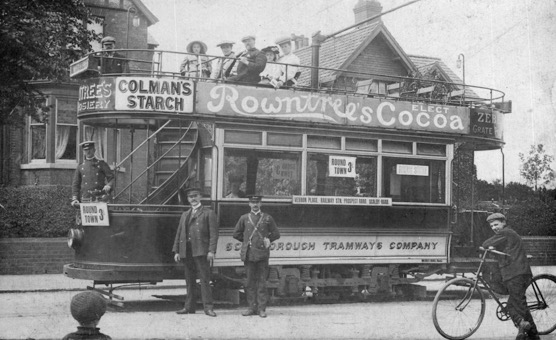
The crew of a fairly new Tramcar No 5 standing in what is possibly Manor Road, along with an inspector — photo undated, but probably mid-Edwardian. Source unknown.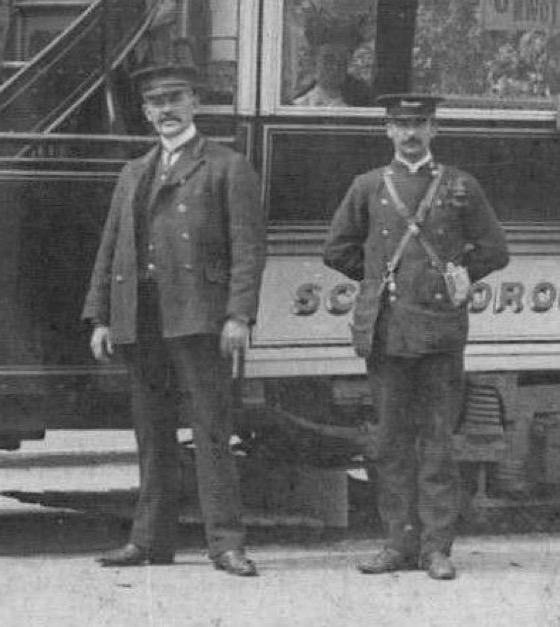
An enlargement of the above photograph showing the inspector (left); he is wearing an open, double-breasted jacket with lapels, the collars of which very probably bear his grade — 'Inspector' — in embroidered script-lettering.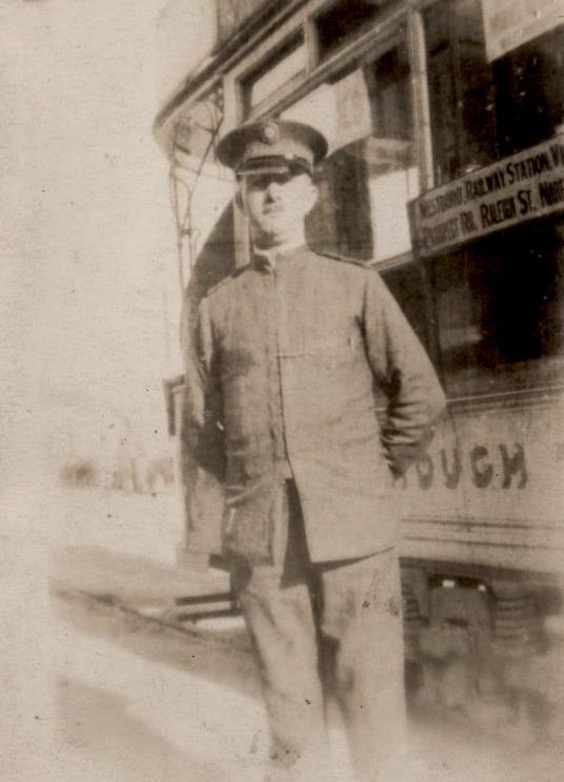
Inspector James Birley of Scarborough Tramways — photo undated, but possibly taken in the 1920s. The subject is wearing traditional tramway inspector's garb, namely, a single-breasted jacket with hook and eye fastenings, along with a tall, tensioned-crown peaked cap; the latter bears a large oval cap badge of unknown pattern. A staff photograph has also survived showing James Birley as a motorman on the Dewsbury, Ossett and Soothill Nether Tramways (see link). Source unknown.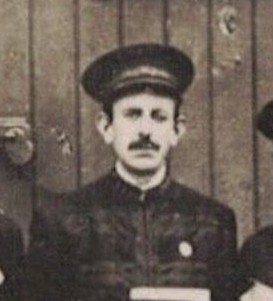
An enlargement of the Great War conductresses photograph (see below) showing the Chief Inspector, who is believed to have been a Mr Gubbins. He is wearing a heavily embellished jacket in the style of a bandmaster, along with a tensioned-crown peaked cap.
Female staff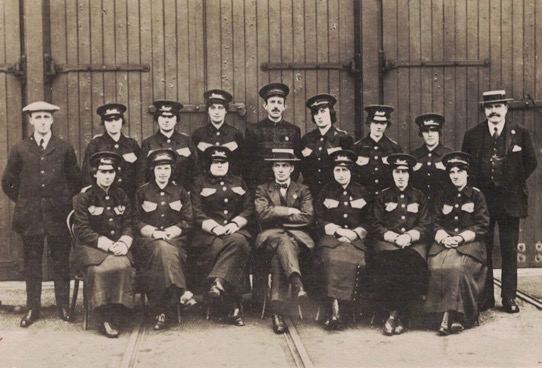
A rare photograph of STCo Great War conductresses taken at the tram depot on Scalby Road.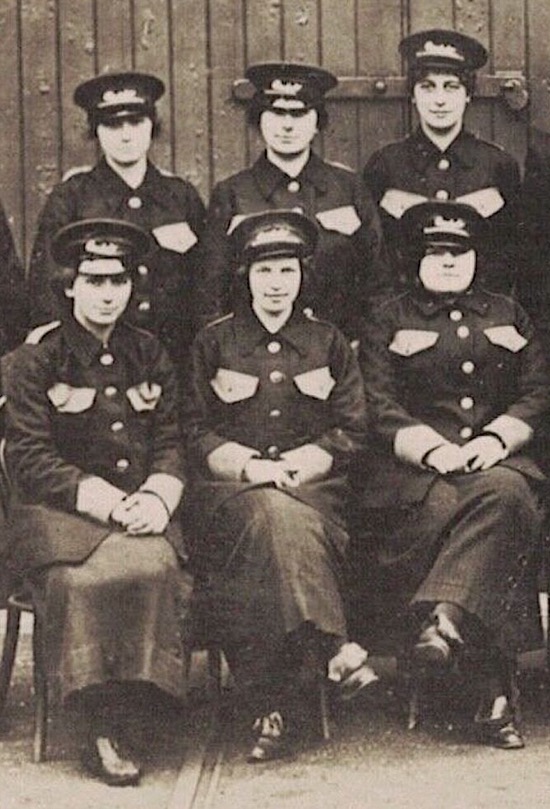
An enlargement of the above photograph showing six of the conductresses. Their single-breasted jackets have epaulettes of a lighter colour, but bear no badges; their tensioned-crown peaked caps bear standard off-the-shelf grade — 'Conductor' — badges.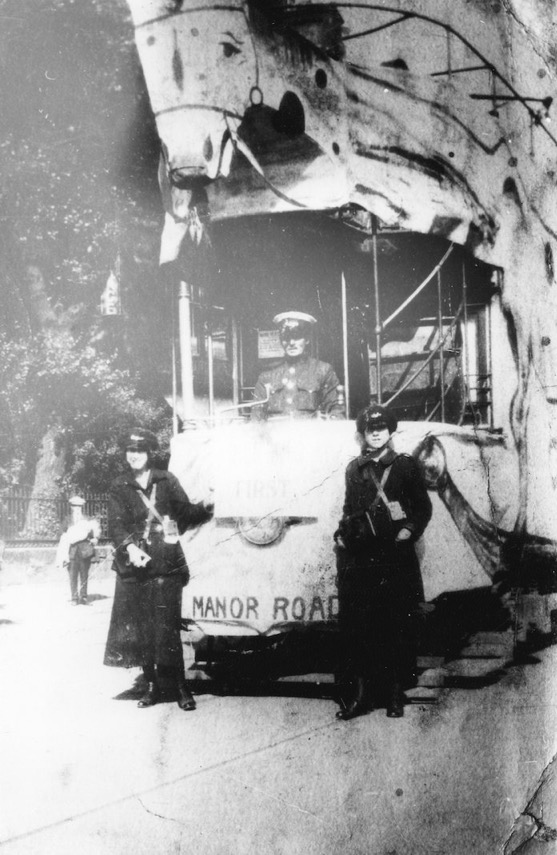
A motorman and two conductresses pose for the cameraman with a tram decorated as a horse, almost certainly for Carnival Week — photo undated, but probably taken during or shortly after the Great War. The motorman is wearing a single-breasted jacket. Author's Collection.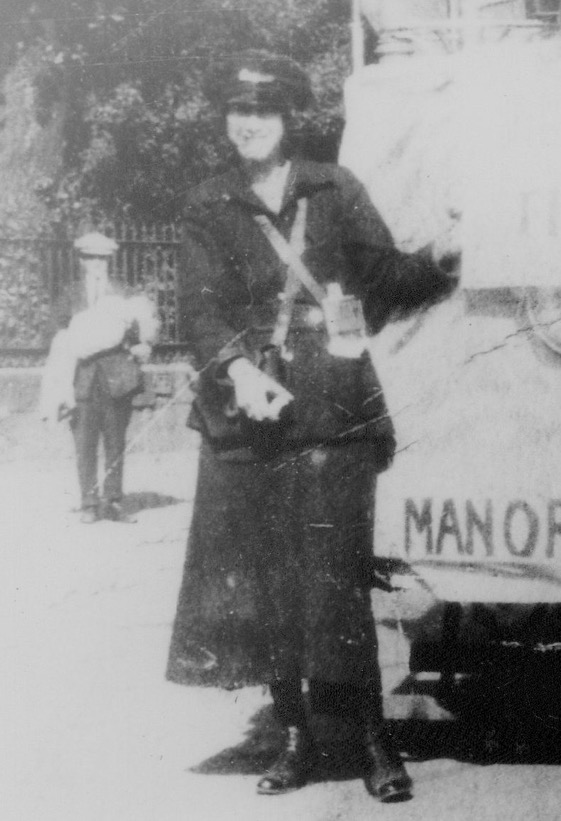
An enlargement of the above photograph, which though of very poor quality, does show the uniform and cap in reasonable detail. The latter, a baggy peaked motor cap, presumably superseded the earlier tensioned-crown peaked caps.