Sheerness and District Tramways
History
Sheerness and District Tramways were owned and operated by the Sheerness and District Electric Traction and Power Company, which was a subsidiary of the much larger British Electric Traction Company (BETCo), a concern which at its zenith either owned, part-owned or leased almost 50 tramway concerns across the British Isles.
In the late 1890s, the BETCo began aggressively purchasing horse and steam-operated tramways across the British Isles with the intention of converting them to electric traction, as well as promoting schemes for completely new electric tramways. Its Sheerness plans fell into the latter category, commencing with the setting up of a subsidiary company — the County of Kent Electrical Power Distribution Company — on the 24th April 1900, which would not only provide electricity generation and distribution for the Isle of Sheppey, but would also build an electric tramway. The latter was done by means of a Light Railway Order, in the name of the BETCo, which was submitted in May 1900. Although the LRO initially met no opposition, it soon ran into objections from the Sheppey Light Railway, with whose services two of the proposed tramway lines would compete. As a result, the lines to Queensborough and to Minster were struck out, in part based on the need for crossings (on the level) over the railway, such that when the LRO — the Sheerness and District Light Railway Order (1901) — was approved on the 12th February 1901, all that remained were 2.5 miles of electric tramway, a system size that was always going to be a challenge to operate profitably. Given that the tramway would not now extend beyond the Isle of Sheppey, the company name was changed — on the 25th March 1902 — to the more geographically accurate Sheerness and District Electric Traction and Power Company.
Construction of the 3ft 6ins-gauge overhead electric tramway appears to have started in early-to-mid 1902, the tramway opening for business on the 9th April 1903. Although 12 cars had been ordered, the failure to obtain permission to construct the lines out to Queensborough and Minster, meant that only 8 cars were needed, the four surplus cars soon being sold off to another BETCo subsidiary, the City of Birmingham Tramways Company. The 8 open-top tramcars were unique in the British Isles in being provided with Siemens bow collectors. As built, the system comprised just 2.47 miles of single line and loop tramway, which was never extended. The western terminus was opposite the pier in West Street, from where it ran northwards, before turning eastwards along High Street, then over the Moat and southeastwards along High Street (now Bridge Road) to the Clock Tower. Here a line branched off eastwards along Edward Street and Broadway to the Cheney Rock terminus on Marine Parade. The main line meanwhile, continued southeastwards from the Clock Tower along High Street, across the Canal, and along Halfway House Road to a terminus just short of Sheerness East Station. The power station and tramcar depot were also located here, just a few yards along Power Station Road to the east.
The tramway always struggled to make ends meet, and was never in a position to pay off the initial capital. The financial situation turned from poor to dire in 1913, with the appearance of two double-deck motorbuses — operated by T Standen and Sons — which ran a circular service out past the tram terminus at Sheerness East Station to Queensborough, abstracting significant numbers of passengers from the tramway. The S&DETCo fought back by introducing motorbuses of its own, drawing on experience of their deployment in other BETCo subsidiaries. Whilst this undoubtedly helped return passengers to the BETCo, it did little to help the tramway.
Although its days were clearly numbered, the final straw was the outbreak of the Great War, which rendered spare electrical equipment impossible to procure, due to the manufacturer — Siemens — being German. The company soon decided to make no provision whatsoever for renewals, the thinking clearly being to run the system down until circumstances, e.g., infrastructure renewal, necessitated its closure. After struggling on for a further two years, the company finally threw in the towel on the 14th June 1917 when it informed the two local authorities — Sheerness Urban District Council and Sheppey Rural District Council — that the tramway would have to close, unless they were willing to step in. The latter were not unnaturally reluctant to do so, the tramway closing for good just three weeks later on the 7th July 1917.
The tramcars were sold to Darlington Corporation LIght Railways, with the tramway now being chiefly remembered for its early demise, as the first electric tramway system to close in the British Isles.
Summary
Photographs clearly show S&DWT&PCo staff wearing the familiar and largely regulation BETCo uniform. Although jackets appeared to vary somewhat between BETCo systems, as well as across the decades, the cap badges, collar designations and buttons invariably followed a standard pattern.
Photographs of the early years of the system are scarce, but those that have survived show that conductors and motormen were issued with single-breasted jackets with five buttons (of the standard BETCo pattern — see link) and stand-up collars; by analogy with other BETCo systems, the latter probably bore an employee number on the bearer's left hand side (in individual numerals) and system initials — most likely 'S D T' or 'S E T — on the right-hand side (in individual letters). The tensioned-crown peaked caps bore the standard BETCo 'Magnet & Wheel' cap badge, worn above an employee number (in individual numerals). The badges and buttons were almost certainly brass. At some point, probably in the late-Edwardian era, a change was made to double-breasted, lancer-style tunics with five pairs of buttons (narrowing from top to bottom) and stand-up collars; the latter carried the same insignia as the earlier jackets. Photographs clearly show that both styles of jacket co-existed, suggesting that the transition from one to the other was gradual.
Although photographs of senior staff are rare, the one staff photo that has survived indicates that inspectors wore single-breasted jackets with hidden buttons (or more likely a hook and eye affair) and stand-up collars, with the pockets and jacket edged in a finer material than the main body; the collars probably bore the grade — 'Inspector' — in embroidered script lettering. The standard ‘Magnet & Wheel’ cap badge was worn on the cap, but with an embroidered script-lettering grade badge — 'Inspector' — on a hat band rather than an employee number.
The S&DET&PCo employed the services of female staff during the Great War to replace male employees lost to the armed services; the conductresses were definitely working on the trams by April 1916, and possibly from considerably earlier. A studio portrait of a conductress has survived, which was clearly taken in a Sheerness studio, with a uniform bearing BETCo buttons. Although there is a possibility that she was a bus conductress, it seems highly likely that conductresses, irrespective of whether they were working on the trams or on the buses would have worn the same uniforms.
For a history of Sheerness and District Tramways, see: 'The Tramways of Kent' by Invicta - Volume 1, West Kent; The Light Railway Transport League (1971).
Images
Motormen and conductors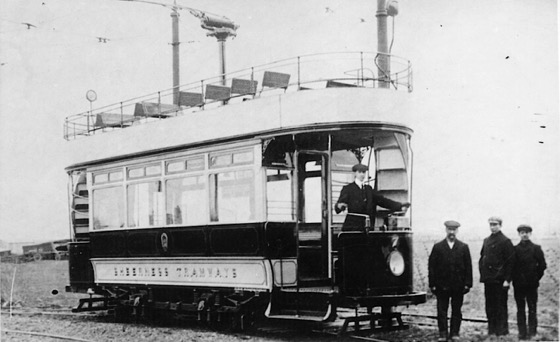
A photograph that almost certainly depicts a brand-new Tramcar No 7 during test running, prior to the opening of the sytem in April 1903. The man at the controls is wearing informal attire, and is possibly an employee of the tramcar electrical contractors, Siemens. Photo courtesy of the Tramways and Light Railway Society, with thanks to David Voice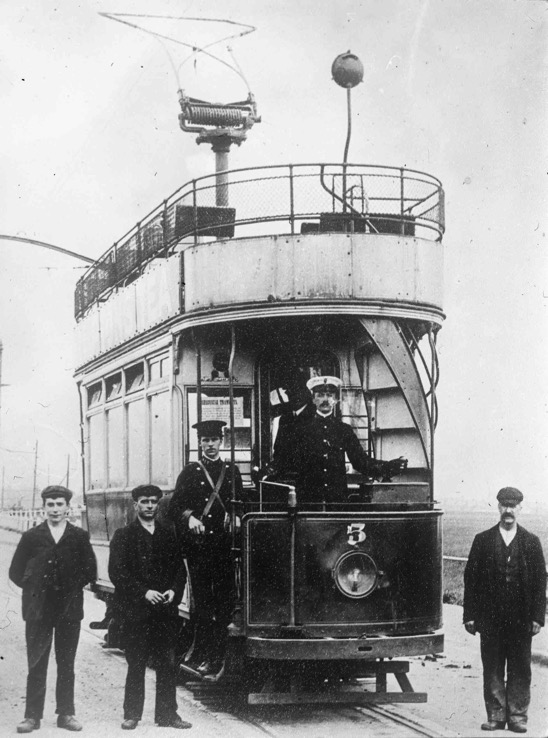
Tramcar No 5 and its crew, probably pictured near the racecourse — photograph undated, but given the slightly care-worn condition of the vehicle, probably taken around 1910. Photo courtesy of the National Tramway Museum.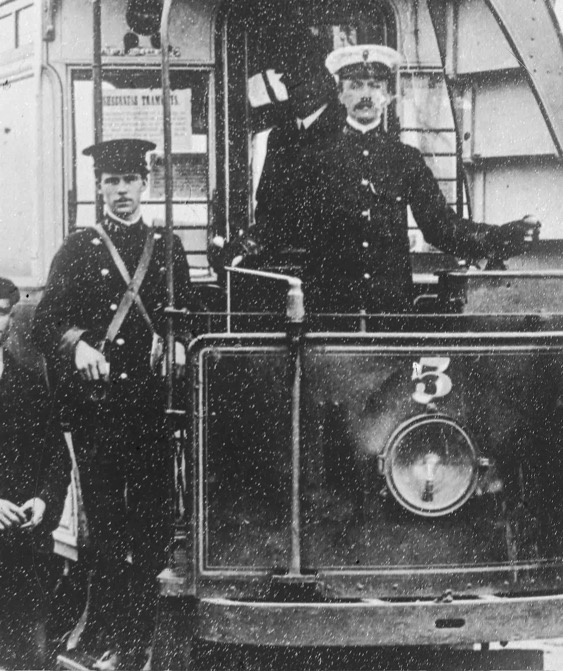
An enlargement of the above photograph showing the conductor in his double-breasted lancer-style tunic, and the motorman in his single-breasted jacket; both types of jacket bear stand-up collars. Further enlargement indicates that the system initials on the collars were either 'S D T' or possibly 'S E T'. The motorman's cap bears the standard BETCo 'Magnet & Wheel' cap badge, worn above an employee number.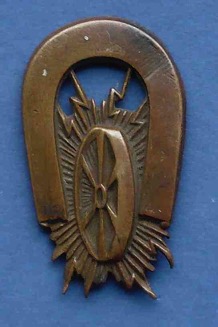
Standard British Electric Traction Company ‘Magnet & Wheel’ cap badge — brass. Author's Collection.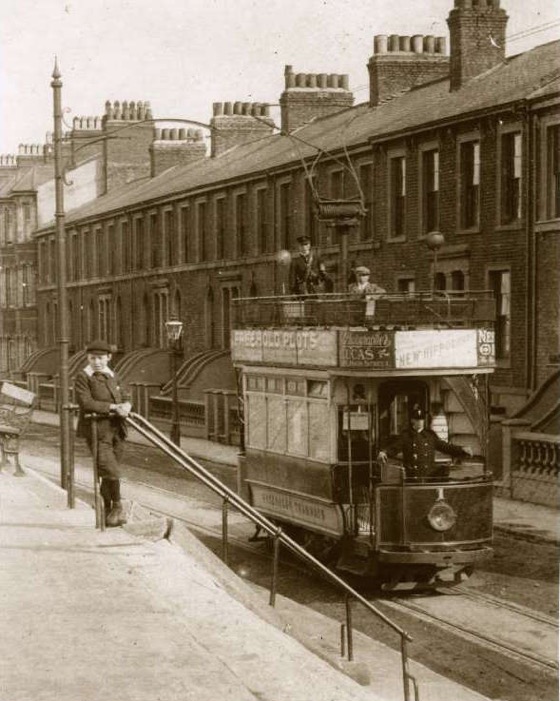
Tramcar No 1 trundles along Marine Parade — photo undated, but probably taken in the late-Edwardian era, given that the vehicle bears advertising enamels. The conductor (on the top deck) is wearing a single-breasted jacket, whilst the motorman (at the controls) is wearing a double-breasted greatcoat. Photo courtesy of the Tramways and Light Railway Society, with thanks to David Voice.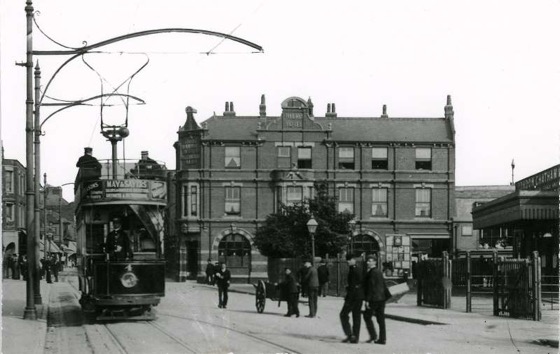
Tramcar No 4 stands at the entrance to Sheerness Town Station loop, its unusual bow collector clearly in evidence — photograph undated, but probably taken in the late-Edwardian era. The motorman is wearing a single-breasted tunic with stand-up collars. Photo courtesy of the Tramways and Light Railway Society, with thanks to David Voice.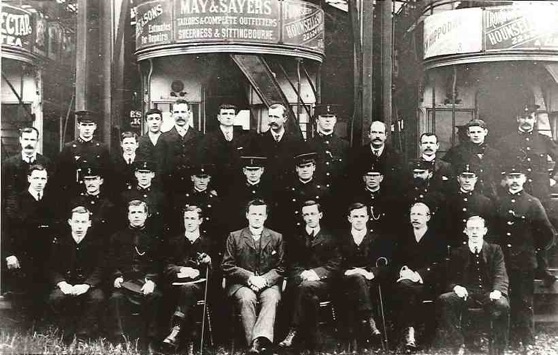
Probably the entire staff of the SD&TCo assembled at the depot — photo undated, but possibly taken shortly before the Great War. A mixture of single-breasted jackets and double-breasted, lancer-style tunics are on show. Other photographs s clearly show motormen and conductors wearing both styles of jacket, suggesting that they overlapped, rather than each being used for a specific grade. Caps bear the standard BETCo 'Magnet & Wheel' cap badge (see below), worn above an employee number. The insignia were in all probability brass.
Female staff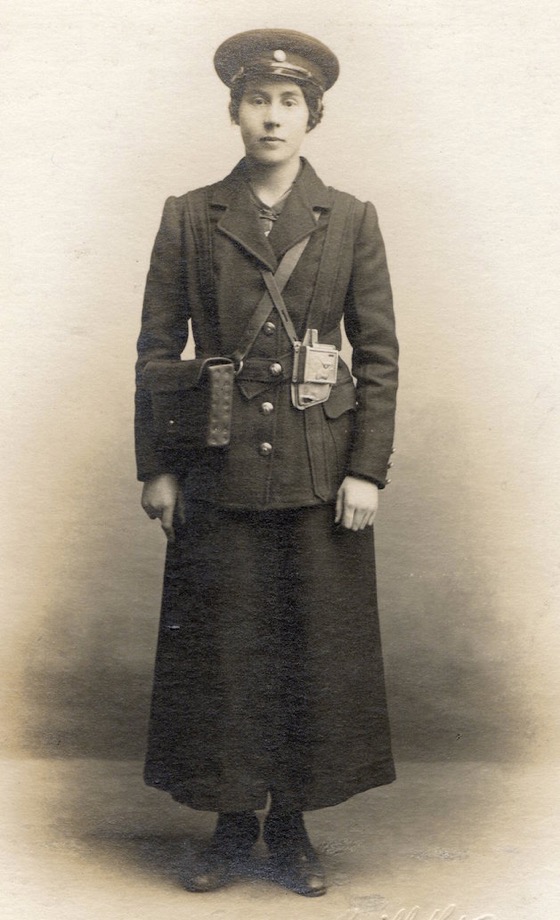
A studio portrait of a BETCo Great War conductress, clearly embossed: 'J Griffiths, Sheerness-on-Sea'. It is currently unclear whether female staff were employed on the trams, which closed for good on 7th July 1917, or whether she worked on the bus services which the Sheerness and District Traction Company also ran, both as a supplement to the tram services, and eventually to replace them. Author's Collection.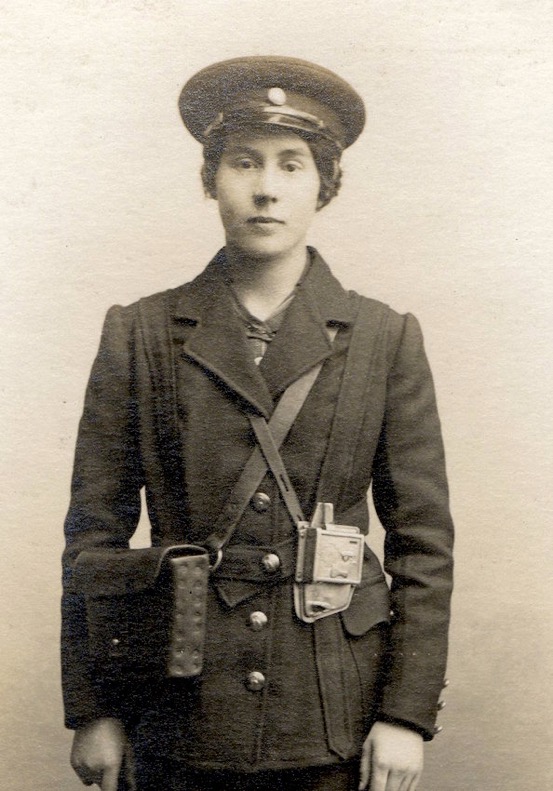
An enlargement of the above photograph. Although the subject is not wearing a BETCo cap badge, her buttons are certainly the standard BETCo 'Magnet & Wheel' pattern.