South Shields Corporation Tramways
History
South Shields Corporation obtained powers to construct 5.8-miles of standard-gauge horse tramway within the town under the South Shields Corporation Tramways Order, which was passed into law on the 18th July 1881 via the Tramways Orders Confirmation (No.1) Act (1881). However, as local authorities were prevented from operating tramways by the Tramways Act of 1870, the corporation needed to find a lessee to operate it for them, eventually reaching agreement with a Mr Winby, who was based in London.
Unfortunately, and before construction had even begun, the corporation inadvisedly changed the gauge of the tramway from that stated in the provisional order (4ft 8½ins) to 3ft 6ins, a move that was to put it on a collision course with the Board of Trade. Whilst this perhaps made sense given the town's narrow streets, it seems that the corporation officials failed to seek approval for the change, so despite a positive Board of Trade inspection of the newly laid tramway in November 1882, approval was not forthcoming, the tramway contravening the order under which it had been constructed.
The corporation was now left with a brand-new tramway that it was unable to open, the local press repeatedly claiming that the Board of Trade knew of the change and had not rejected it (they had not approved it either), and that all their woes were due to a cabal of neighbouring local authorities and tramway promoters who had lobbied against the change. Whilst the corporation continued trying to blame everyone but themselves, including the lessee, Mr Winby, who they claimed had advised them to change the gauge, perhaps the most damning evidence comes from the mouth of Mr Chamberlain — the President of the Board of Trade — who stated in a meeting with corporation officials on the 24th April 1883: "…that the difficulty he had to contend with was that the corporation had chosen to fly in the face of an order of the Board of Trade and the decision of Parliament, and without authority and, after repeated warnings, had proceeded to lay down this 3ft 6ins tramway, trusting in their power to get from the Board a provisional order or an Act of Parliament condoning the course they had taken.".
At the same meeting, however, Mr Chamberlain did suggest a way out of the impasse, namely, that he would be prepared to provisionally sanction the line as built — which was only a portion of that authorised — provided that the neighbouring authorities agreed, and presumably, that any attempt to build the remainder would require the corporation to obtain new powers. The corporation delegation accepted this, and a provisional order was granted; this was confirmed on the 16th July 1883 by the South Shields Corporation Tramways (Amendment) Order (1883), which was passed into law under the Tramways Orders Confirmation (No. 4) Act (1883).
Whilst much of the mess that the corporation found itself in could simply be attributed to municipal incompetence, there does seem to have been more than a hint of parochialism in the decision to opt for the narrower gauge, as it would inevitably have made it harder for other contemporary tramway proposals, which were all standard gauge, to encroach upon the corporation's territory.
The tramway finally opened for business on the 1st August 1883, around nine months later than it otherwise would have done had the gauge not been changed. The line ran from Slake Terrace at Tyne Dock in the west, snaking eastwards and northwards through High Shields and Milldam to the Market Place, before turning eastwards along King Street and Ocean Road to the eastern terminus at the Pier Head; although various extensions were planned, none were ever built, the system's final size being 2.53 miles. It was operated with a fleet of ten horsecars.
Meanwhile, Winby had, on the 5th March 1883, registered a company — the South Shields Tramways Company — to take over his interests, and to operate the horse tramway, which it did for over two years of a 7-year lease. The corporation's woes were, however, not yet over as Winby had agreed an unrealistically high rental with the corporation, such that the SSTCo could not make the concern pay, the company eventually being pursued for non-payment of interest and loans by its debenture holders, one of whom was Winby.
It is unclear exactly what happened next, but by March 1886 at the latest, the company was in the hands of a receiver. Despite this turn of events, the corporation was hopeful that the assets could be transferred to a new lessee, so was initially persuaded to hold off taking legal action; it was, however, taken completely by surprise on the 30th April 1886, when the tramway services abruptly ceased, the tramcars and horses being removed in the dead of night, leaving the corporation with the tramway tracks and depot (which it of course owned) but no means of operating the concern. The SSTCo's entire tramway assets (i.e., the horses, tramcars, and fittings) were auctioned off on the 15th May 1886, the sale raising £1,000. This was in fact the second attempt to auction off the assets, so it is possible that the first attempt was subject to a legal challenge by the corporation.
Eventually, Daniel Busby and William Turton came to the rescue, two well-known tramway entrepreneurs, who either separately or together, had interests in several horse tramways in the north of England, most notably, those of Newcastle, Manchester, Leeds, Liverpool and Salford. On the 11th January 1887, they registered a new company — the South Shields Tramways and Carriage Company — to acquire the South Shields lease and to work the tramway; services duly recommenced on the 28th March 1887 — under a 14-year lease (running from the 1st February 1887) — after almost a year lying dormant. Happily for the corporation, Busby and Turton knew what they were doing, and with a more realistic rental, turned the tramway into a profitable concern, which they expanded through the introduction of horse omnibuses.
In the mid 1890s, the corporation's thoughts turned to converting its small horse tramway to electric traction, as well as to a significant expansion of the system. Although powers to build 4.18 miles of 3ft 6ins-gauge tramway were acquired on the 2nd July 1896 — under the South Shields Corporation Act of 1896 — the corporation then chose not to act on these.
In the late 1890s, the success of the horse tramway attracted the attention of the British Electric Traction Company, which had, since the mid 1890s, been aggressively purchasing horse and steam-operated tramways across the British Isles with the intention of converting them to electric traction, as well as promoting schemes for completely new tramways. The BETCo had grand plans to build a tramway network south of the Tyne, stretching from Gateshead eastwards, through Hebburn and Jarrow to South Shields, then south to Sunderland, and as part of this, it acquired the SST&CCo (in June 1899), followed a few months later by the Gateshead and District Tramways Company (a steam tramway). Powers were also acquired — on the 17th December 1901 — to construct tramways in Jarrow, which was immediately to the west of South Shields.
Unfortunately for the BETCo, their plans to construct tramways southwards to Sunderland ran into significant opposition from Sunderland Corporation, the North Eastern Railway Company and most importantly, South Shields Corporation, the latter having of course held powers to convert their horse tramway to mechanical traction since 1896. Although the company did not give up, trying a second time to obtain approval, the objections once again resulted in the application for a Light Railway Order being rejected. South Shields Corporation was, however, still undecided about pressing forward with electrification and expansion of its system, granting the company a new 7-year lease of the horse tramway from the 1st February 1901.
Whilst the company evidently still hoped to persuade South Shields Corporation to lease them whatever system it eventually decided to build, they must have realised that their chances were slim when the corporation gained additional powers in 1903, not only for 7.07 miles of standard-gauge electric tramway, but also to operate the system itself; these powers were granted on the 11th August 1903 under the South Shields Corporation Act (1903).
Construction of the corporation's standard-gauge, overhead electric tramway commenced on the 6th June 1905, the SST&CCo's lease being terminated on the 1st February 1906; all tramway and omnibus services ceased the day before, with the first electric service commencing two months later on the 30th March 1906. The SST&CCo subsequently entered voluntarily liquidation on the 25th April 1906.
The system was opened in stages over the next 12 months, after which there was only one major extension (of circa 1.25 miles in 1922), which took the system to its final size of 7.51 miles. The core of the system was a figure of eight, with the northern apex at the junction of King Street, Mile End Road, Ocean Road and Fowler Street, and the south-western apex at Tyne Dock. From the northern apex, a line ran southwards to Westoe, where it turned south-westwards along Dean Road and Stanhope Road to Bolden Lane, then north-westwards along Hudson Street to Tyne Dock. The return route ran northwards along South Eldon Street, Frederick Street and Station Road to the Market Place, where it turned north-eastwards along King Street to the northern apex. The middle of the figure of eight ran along Laygate. The remainder of the system comprised three branches, two running from the northern apex — one northwards for a short distance along Mile End Road, and the other north-westwards along Ocean Road to the South Pier — and the last line, built in 1922, running southwards from Westoe along King George Road to Cleadon, terminating just beyond its junction with the Ridgeway. The latter was just over two miles from the nearest Sunderland Corporation Tramways line, but the two systems were never joined up, in no small part due to the intransigence of the South Shields councillors, who refused to entertain any connecting route other than the one they proposed.
The system was initially operated with 25 tramcars, these being joined by a further 10 new cars in 1907, and 5 just before the outbreak of the Great War.
At Tyne Dock, the tracks and overhead were connected to those of the Jarrow and District Electric Traction Company, which was a subsidiary of the BETCo. Although through-running was eventually agreed in 1908, it was terminated three years later after the corporation demanded more money for J&DETCo cars working over its lines, and though the company offered to meet them half way, the corporation refused. Whatever the corporation said publicly about making a loss on the service, it was fairly clear that many within the council were ideologically opposed to a company making money in their area, even if it were mutually beneficial; it was of course the travelling public who paid the price for the council's dogma. In the 1920s, after years of public complaint, through-running was restored, but only for around 5 years, before the corporation once again pulled the plug; during this period, cars of the J&DETCo travelled through to the Pier Head, whilst those of the corporation ran through to Jarrow.
The corporation looked at building various extensions shortly before the Great War, finally obtaining powers for just 0.94 miles of tramway on the 29th July 1915 under the South Shields Corporation Act (1915). The corporation was, however, unsure whether the extensions could be made to pay, so instead opted for a small number of battery-electric buses, the use of which the Act of 1915 had also authorised. This decision was in part driven by the activities of a new bus company — the Northern General Transport Company — which began encroaching into what the corporation saw as its territory. To add insult to injury, the NGTCo was a subsidiary of the BETCo, the root of all evil as far as the corporation were concerned. These buses appear to have served the corporation well during the war years, being immune to War Department requisition and independent of restrictions on imported fuel.
Like most tramway systems nationally, the SSCT was placed under immense strain during the Great War, with greatly increased passenger loadings, severe shortages of staff, and restrictions on spares and new material. As a result, the tramway emerged from the conflict in badly run-down condition, with a significant maintenance backlog and an ageing tramcar fleet. The corporation, however, still viewed the tramway as the core of its transport services, quickly obtaining powers to build a tramway out to a large new housing estate in Cleadon, these being conferred in 1920 by the South Shields Corporation Light Railway Order. The corporation also sought an extension to the time allowed to construct the unbuilt tramways in the 1915 Act, this being granted on the 19th August 1921 under the South Shields Corporation Act (1921). The act also granted the corporation powers to run further omnibus services.
The new double-track, reserved-formation tramway out to Cleadon opened in November 1922, ensuring that the tramway could continue to serve the needs of the populace as it migrated outwards from the centre of the town. The corporation's enlightened approach to its tramway also saw it invest in 5 new tramcars in 1921, and a series of second-hand vehicles — between 1929 and 1930 — from tramways that were closing; it also undertook a sizeable rebuilding programme that saw some cars emerge as virtually new vehicles. The last new tramcar of all was purchased in 1936, and though thoroughly modern, the corporation had by the time of its arrival, already made the decision to switch to trolleybuses.
Up until the 1920s, the tramway was very profitable, often making substantial contributions to the rates, despite paying an exorbitant price for current and thus subsidising the struggling corporation electricity department. By the early 1920s, the post-war boom was over, economic recession and higher costs had turned the profits into small losses, matters being made worse by the handful of corporation buses — which it had been operating since 1919 — which were being subjected to intense competition from pirate operators, and were making a substantial loss; the buses did not in fact turn a profit until 1935. The economic situation worsened significantly in the second half of the 1920s, and with passenger numbers dropping, by the early 1930s, the whole undertaking was making an annual loss. This was a prelude to an extraordinary period in 1933/1934, when the council effectively declared war on its own tramways department; the latter was accused of all kinds of misdemeanours, the council setting up a Special Committee to investigate, one which had no independent tramway expert. The process was conducted quite publicly, so it is fairly clear that those holding the reins of power had an axe to grind, a view supported by the outcome, which basically found some minor shortcomings, but then saw fit to censure several individuals, either forcing their retirement or demoting them. Whatever the rights or wrongs of this, it resulted in a series of new managers and a change in direction.
Although a new manager was appointed in April 1934, the council clearly thought it knew how to run a tramway better than the manager and the Tramways Committee, forcing the latter (against its recommendations) to replace the entire track on the Ocean Road line, a significant outlay for a branch line that only made money on summer weekends. The new manager, who was eventually to become the General Manager of Glasgow Corporation Transport Department, only stayed for a short time, but left his mark by persuading the council to order new buses, and to seek powers to operate trolleybuses and to abandon the tramway system. At the same meeting, in June 1934, it was decided to change the name of the undertaking to South Shields Corporation Transport Department. Powers to operate trolleybuses and to abandon the tramway were granted on the 2nd August 1935 under the South Shields Corporation Act (1935).
The first trolleybus entered service on the 12th October 1936, being initially deployed on new routes rather than as a tramway replacement service. The first tramway replacement came on the 3rd May 1937 (Market Place to Stanhope Road), by which time the SSCT had managed to lose yet another manager. In a quite bizarre spectacle, the council chose to celebrate the conversion of the town routes — essentially the figure of eight — to trolleybus operation (in 1938) by burning a tram, an act which perfectly sums up the council's attitude to its tramway.
This left just one tramway route operating — Moon Street to Ridgeway — which was given a reprieve by the outbreak of the Second World War, but which finally closed on the 31st March 1946.
Uniforms
Although South Shields' horse tramway system was built and owned by the corporation, it never actually operated the services itself, instead leasing them to operating companies. The first of these was the South Shields Tramways Company (1883-1886), about which very little is known, with not even a single photograph having survived for posterity. It does, however, seem likely that the company followed the general practice of most horse-tramway companies in not issuing uniforms, so in probability, staff would simply have worn informal attire, such as heavy jackets and overcoats, along with the fashionable head gear of the day (during this period, almost certainly the bowler hat).
In contrast to the above, photographs of the subsequent South Shields Tramways and Carriage Company era (1887-1889) have survived in significant numbers, and clearly show that staff wore a variety of informal attire such as jackets, shirts and ties, heavy overcoats (particularly drivers), along with top hats, bowlers hats and tight fitting flat caps. No insignia of any kind, badges or licences, were worn.
Following the British Electric Traction Company takeover of 1899, staff were issued with uniforms: conductors wore single-breasted jackets with five buttons and stand-up collars, whilst drivers appear to have worn double-breasted jackets with lapels. Neither style of jacket appears to have borne insignia of any kind. Caps were initially in a kepi style with a glossy peak, but did not at first carry a cap badge. At some point, it isn't exactly clear when, the kepis were superseded by soft-topped peaked caps; these now bore a cap badge, possibly an employee number, though there remains a possibility that it was the standard BETCo 'magnet & wheel' badge (see below). The BETCo usually reserved its 'magnet & wheel' branding for its new electric tramways, though it definitely issued 'magnet & wheel' cap badges for a time on at least two if its other horse tramways (the Brighton and Shoreham Tramway, and Yarmouth and Gorleston Tramways).
Horse tram drivers and conductors were also issued with double-breasted greatcoats with five pairs of buttons and high fold-over collars; the latter appear to have been left plain.
Early photographs of the corporation-operated electric era show that crews were issued with double-breasted, lancer-style tunics with five pairs of buttons (narrowing from top to bottom, and presumably brass — see link) and stand-up collars; the latter probably bore an employee number on the left-hand side, and individual metal initials — 'S S C T' — on the right-hand side. The tensioned-crown peaked caps bore script-lettering grade badges, either 'Conductor' or 'Motorman'; these were very probably manufactured in brass to match the buttons. In the late-Edwardian era, the script-lettering grade badges were supplemented with a broadly circular cap badge with a protrusion at the top and a curved border at the bottom; this was very probably a municipal-device badge, the border carrying the town's name, i.e., 'SOUTH SHIELDS'. The script-lettering grade badges appear to have been dispensed with around the time of the Great War, the municipal-device badge following suit in the late 1920s when it was superseded by a large, circular cap badge containing the municipal coat of arms (see below for an example).
In later years, conductors were issued with single-breasted tunics with five buttons, breast pockets, epaulettes and stand-up collars, whilst motormen continued to wear lancer-style tunics right through to closure. It is possible, but by no means certain, that the buttons and badges were changed to nickel at this time.
The tunics were also augmented with epaulettes at some point (these were fastened with a button at the neck end, but were otherwise devoid of insignia).
Perhaps unsurprisingly, given South Shields location on the North Sea, many photographs show staff wearing double-breasted greatcoats with five pairs of buttons and high fold-over collars; like the tunics worn underneath, the collars bore an employee number on the left-hand side and individual metal initials — 'S S C T' — on the right-hand side. In later years, the greatcoats bore epaulettes.
As far as senior staff are concerned, numerous photographs of the SST&CCo have survived, but none show inspectors, so it could well be that the company did not see fit to employ them.
In the early electric era, inspectors wore single-breasted jackets with hidden buttons (or more likely a hook and eye affair), four slit pockets and stand-up collars (see below); the pockets and the jacket were edged in a finer material than the main body. The collars probably carried the grade — 'Inspector' on the bearer's right-hand side and system initials, 'S S C T', on the left-hand side, both in embroidered script lettering, though these cannot be made out with certainty on the surviving photographs. Caps were initially in a kepi style with a pom pom on top, and carried bearer's grade — 'Inspector' — probably in embroidered script lettering (on a hatband). At some point, a switch was made to tensioned-crown peaked caps; these simply bore the standard, round municipal-device badge, seemingly worn without a grade badge. The jackets were also subtly changed in later years, bearing breast pockets with flap closures rather than slit pockets.
The chief inspector (see below) wore a very similar uniform to the inspectors, but with braided epaulettes. His collar insignia almost certainly reflected his grade, though this cannot be made out on the surviving photograph. Like the inspectors, his cap simply bore the standard, round municipal-device badge.
In common with many tramway systems, conductresses were employed during the Great War to replace men lost to the armed services. Only a single photograph of these ladies has so far come to light; all the subjects are wearing long, double-breasted topcoats (with four pairs of buttons) with epaulettes and high fold-over collars, along with shiny, waterproof bonnets, the latter possibly for winter wear. The only badges worn appear to have been on the collars, possibly employee numbers, though this is far from clear. The conductresses were presumably also issued with uniform jackets and some form of cloth cap/hat for summer wear. Contemporary comment suggests that the jackets were three-quarter length, and that gaiters were also worn.
In 1914, South Shields Corporation Tramways Traffic Department employed 1 chief inspector, 4 inspectors, 39 motormen, 51 conductors and 9 points boys.
Further reading
For a history of South Shields tramways, see: 'The Tramways of Jarrow and South Shields' by George S Hearse; published by the author (1971).
Images
Horse tram drivers and conductors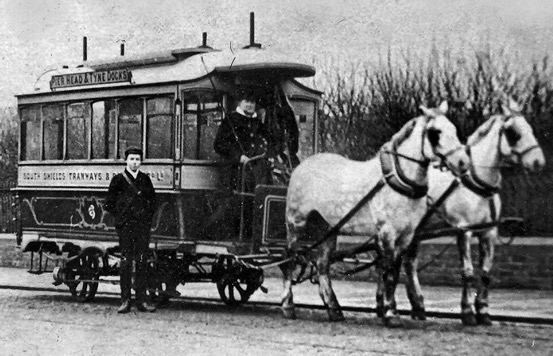
A rather new-looking Horsecar No 6 at Bents Park — photo undated, but possibly taken around 1890 when these Ashburys-built vehicles were first put into service. The driver is wearing typical coaching gear, i.e., a coachman's coat and a top hat; the conductor on the other hand is wearing an informal single-breasted jacket and a tight-fitting flat cap. With thanks to Malcolm Fraser.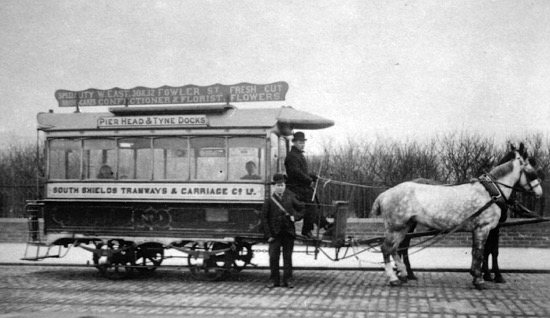
Horsecar No 1, another Ashburys-built single decker, and again captured at Bents Park — photo undated, but probably taken around 1890. Both men are wearing the tall bowlers typical of the period. Photo courtesy of the Tramways and Light Railway Society, with thanks to David Voice. 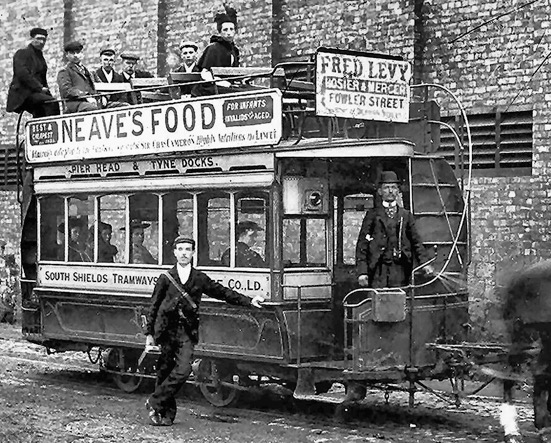
Horsecar No 10 (a product of G F Milnes) stands at Tyne Dock — photo undated, but probably taken around 1894. Both the driver and the conductor are wearing informal attire, the former in a bowler hat and the latter in a flat cap. The conductor is holding a Kayes Patent fare collection box in his right hand. With thanks to Malcolm Fraser.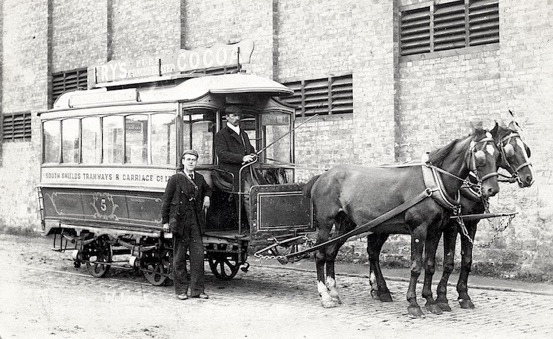
Another shot taken at Tyne Dock, this time of Horsecar No 5 — photo undated, but probably taken in the mid-1890s. Both men are wearing informal attire and flat caps. Photo courtesy of the Tramways and Light Railway Society, with thanks to David Voice. 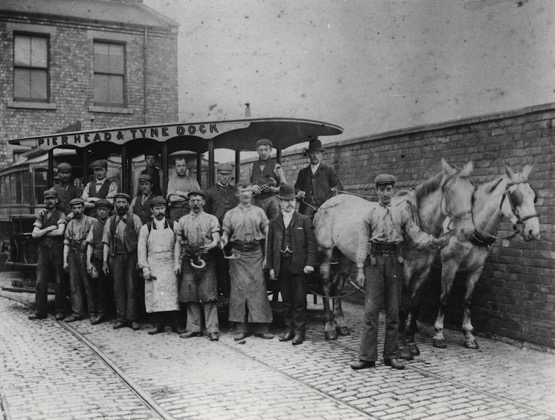
A superb shot taken in Victoria Road depot with a toastrack horse car, showing fitters, farriers, stablehands and presumably, the odd driver and conductor — photo undated, but probably taken in the early-to-mid 1890s. No-one present is wearing a uniform. The SST&CCo had a number of toastracks, and you have to admire the optimism of the company given South Shields exposed position on the North Sea coast. Photo courtesy of the Tramways and Light Railway Society, with thanks to David Voice.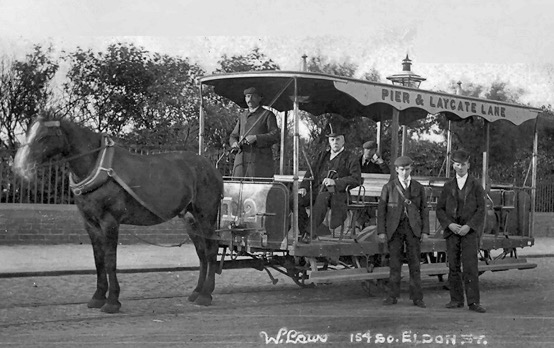
Horsecar No 12, a toastrack, stands at Bents Park with a Pier to Laygate Lane service — photo undated, but probably taken in the mid 1890s. Both the driver and the conductor are wearing informal attire, and there is no sign of insignia, either badges or licences. Photo by W Laws, with thanks to Malcolm Fraser.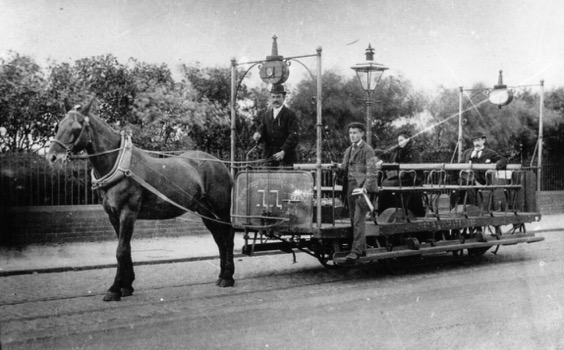
Another shot of a toastrack at Bents Lane, this time No 11, which though quite elaborate, could clearly do with a lick of paint, suggesting that the photograph was taken in the late 1890s. Photo courtesy of the Tramways and Light Railway Society, with thanks to David Voice.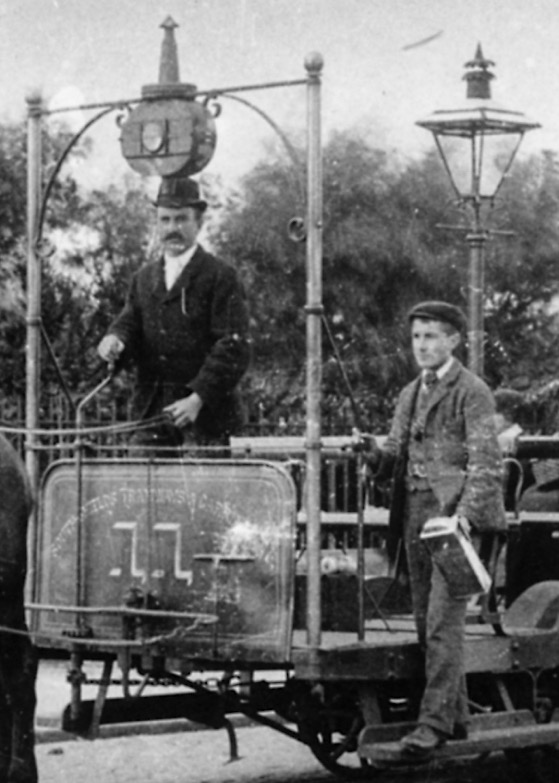
An enlargement of the above photograph showing the driver and the conductor, the latter with a Kayes Patent fare collection box.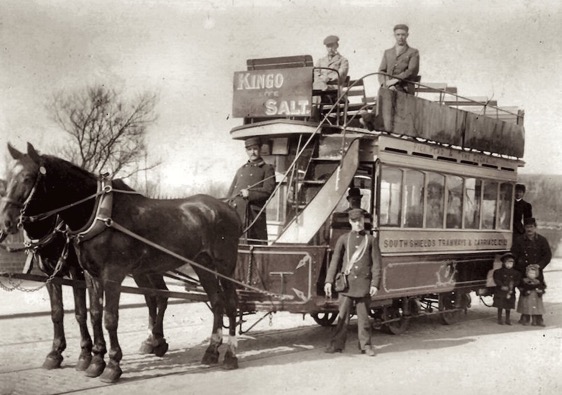
Horsecar No 9 captured at Bents Park — photo undated, but probably taken shortly after the British Electric Traction Company takeover of 1899. With thanks to Malcolm Fraser.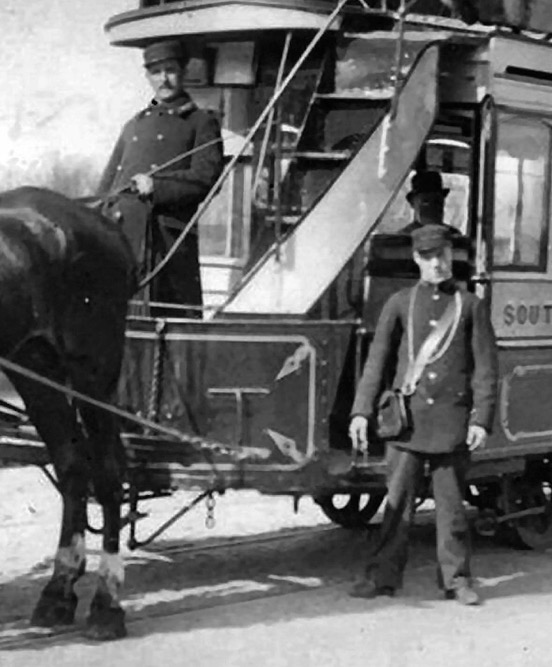
An enlargement of the above photograph showing the driver and the conductor, both of whom are wearing uniforms and kepi-style caps. Neither the collars nor the caps would appear to carry insignia.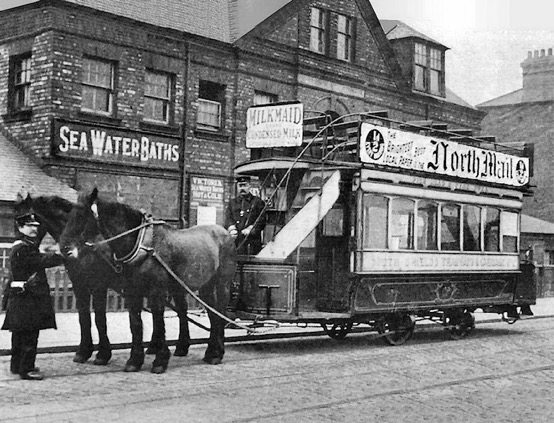
Horsecar No 8 standing in front of the Sea Water Baths at Pier Parade — photo undated, but possibly taken in 1905. With thanks to Malcolm Fraser.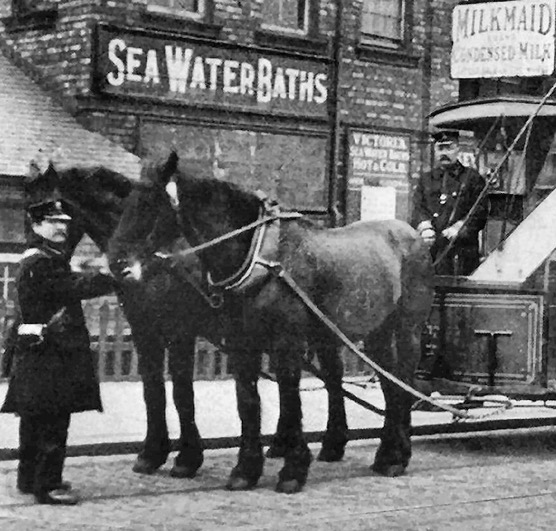
An enlargement of the above photograph showing the conductor and the driver, both of whom are wearing greatcoats — photo undated, but possibly taken in 1905. Both men are soft-topped peaked caps, which carry a metal cap badge, possibly an employee number, though it may be the standard BETCo 'Magnet & Wheel' cap badge.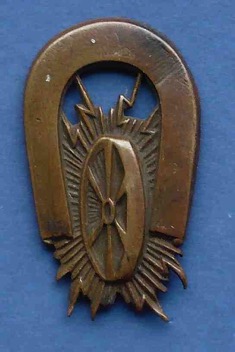
Standard British Electric Traction Company ‘Magnet & Wheel’ cap badge — brass. Although it is possible that tramcar crews were issued with this badge, it cannot be stated conclusively.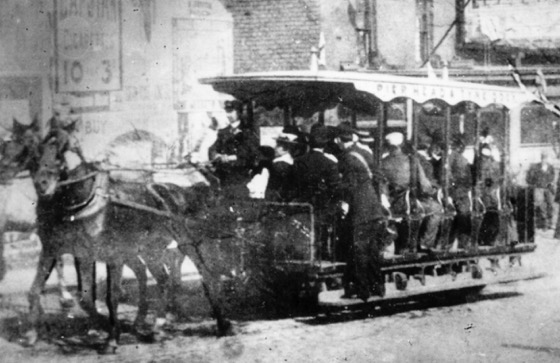
A poor quality photograph of a South Shields toastrack, but one which does show a driver in double-breasted uniform jacket with lapels — photo undated, but certainly taken between 1899 and 1906. Photo courtesy of the Tramways and Light Railway Society, with thanks to David Voice.
Motormen and conductors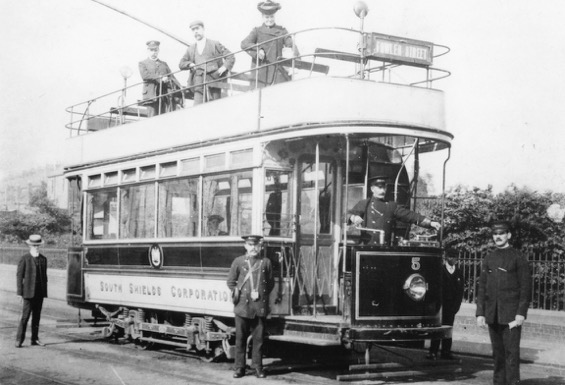
A conductor, a motorman and an inspector pose with Tramcar No 5 (very probably brand new) at West Park in Stanhope Road, with a service bound for Fowler Street — photo taken in the summer of 1906. With thanks to Malcolm Fraser.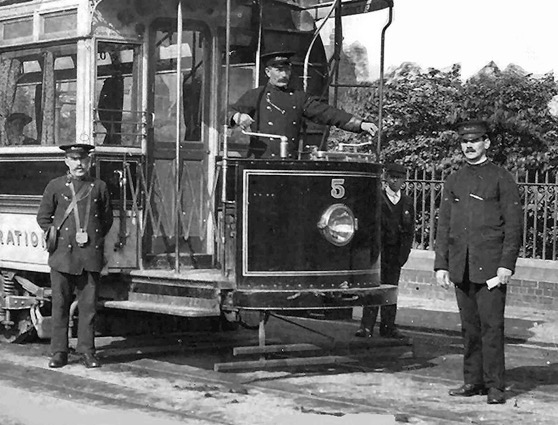
An enlargement of the above photograph showing the crew in their lancer-style tunics and tensioned-crown peaked caps, and the inspector, who is wearing a single-breasted jacket with a kepi-style cap topped by a pom pom. The conductor's and motorman's caps bear script-lettering grade badges.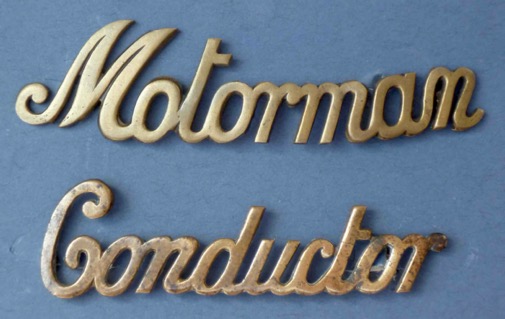
Standard script-lettering cap badges of the type used by South Shields Corporation Tramways from the start of electric services in 1906 up until around the time of the Great War — brass. Author's Collection.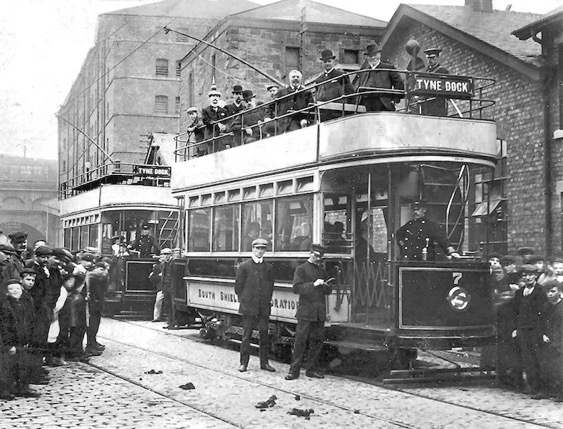
Tramcar No 7 captured at Slake Terrace, Tyne Dock on the opening day of that route — the 23rd June 1906. With thanks to Malcolm Fraser.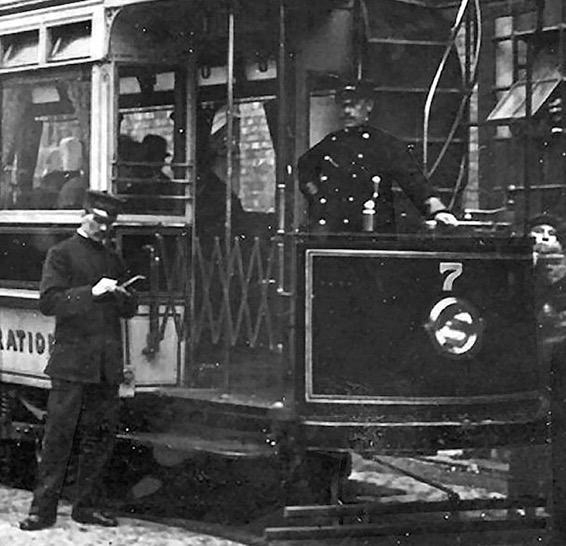
An enlargement of the above photograph showing the inspector, who is wearing kepi-style cap with a pom pom on top, in contrast to the motorman, who has a tensioned-crown peaked cap.
The crew of Tramcar No 23 pose for the cameraman, whose flash has been reflected by the dash — although the photograph is undated, the name of the manager on the tramcar rocker panel — L E Harvey — dates it to between 1908 and 1912. Photo courtesy of the Stephen Howarth Collection.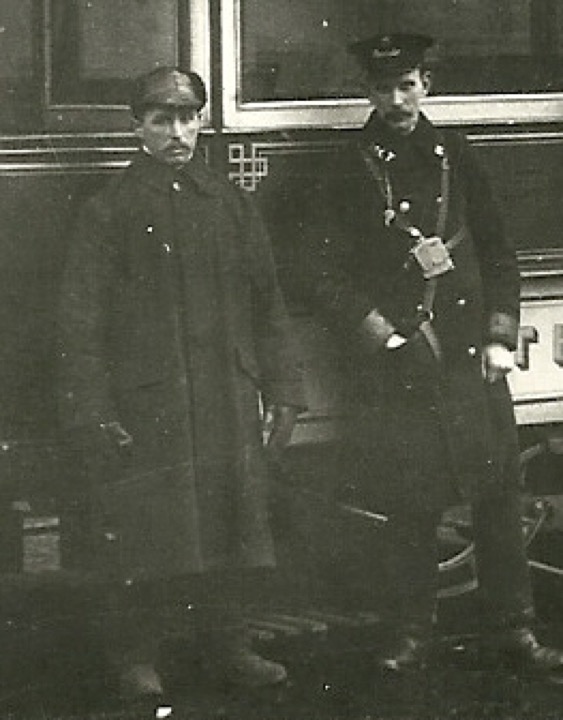
An enlargement of the above photograph showing the motorman, who is clearly prepared for Arctic conditions, and his conductor. The latter is wearing a broadly round badge above his script-lettering grade badge, probably a municipal-device badge, though of unknown pattern. 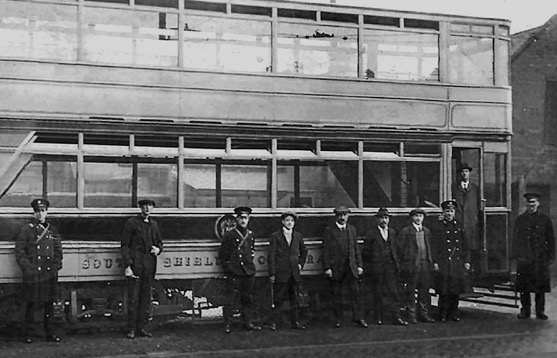
Members of staff photographed with one of the new Brush front exit tramcars (Nos 41 to 45) at Dean Road Depot in 1921. At least two of the individuals are wearing round cap badges, but without script-lettering grade badges, which appear to have been dispensed with by the end of the Great War. With thanks to Malcolm Fraser.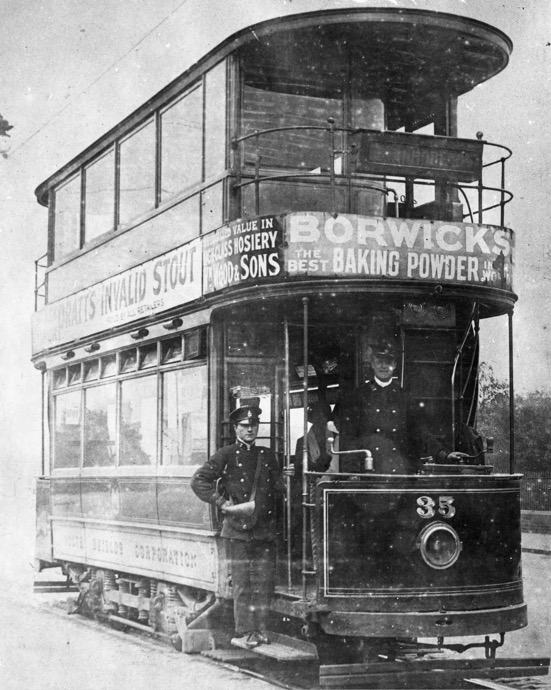
South Shields Corporation Tramways Tramcar No 35 and crew, possibly at the Pier Head — photograph dated 1922. Photo courtesy of the National Tramway Museum.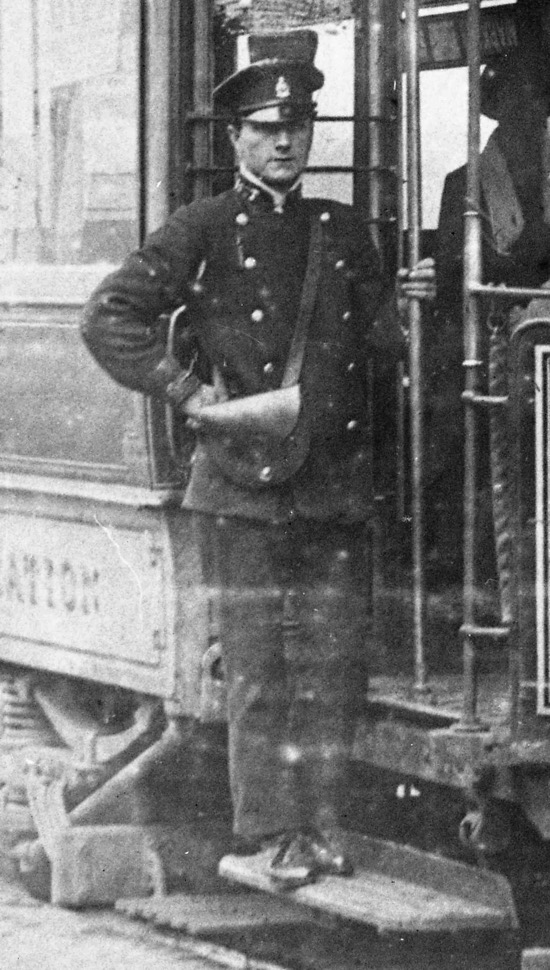
An enlargement of the above photograph showing the conductor. His right-hand collar bears system initials — 'S S C T' — whilst his cap has a broadly circular badge with a protrusion on top and a curved border underneath, very probably a municipal-device badge.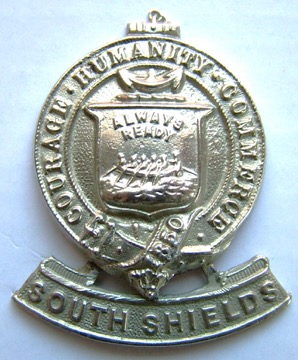
An example of a South Shields municipal-device cap badge, which is possibly the same pattern as that used on tramway uniform caps. Photo courtesy of Dave Wilkinson.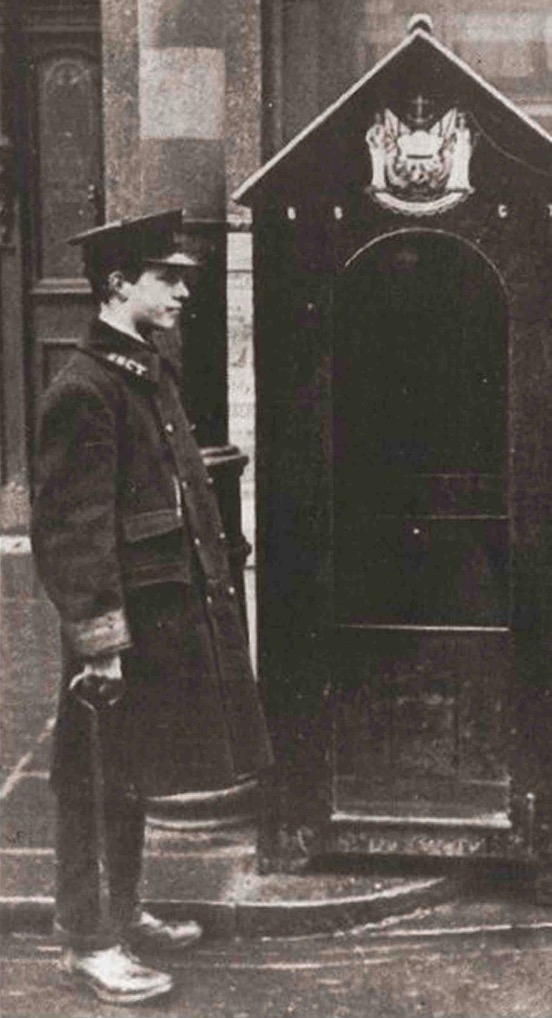
A South Shields Corporation Tramways points boy, points iron in hand — photo undated, but probably taken around 1930. The 'S S C T' collar insignia are easily made out. With thanks to Malcolm Fraser.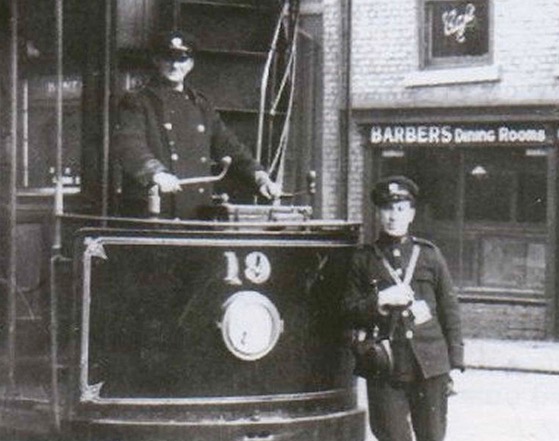
Motorman Jimmy Edwardson and Conductor Frederick Boad pose with Tramcar No 19 at Slake Terrace in 1931, the latter in single-breasted jacket with stand-up collars and epaulettes. Both men are wearing a noticeably larger circular cap badge than the one seen in earlier photographs, and with no protrusion at the top, nor with a circular border at the bottom. With thanks to Malcolm Fraser.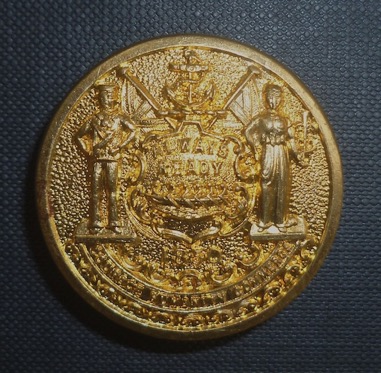
South Shields Corporation Tramways cap badge — gilt/brass. This badge appears to have been worn from the late 1920s onwards. Author's Collection.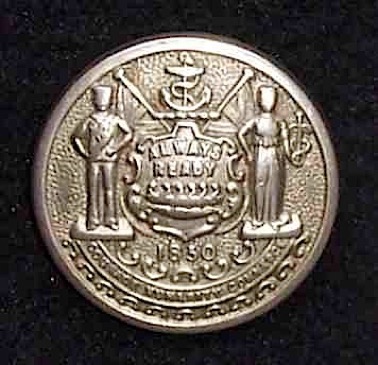
South Shields Corporation Tramways cap badge — nickel. This pattern of badge appears to have been worn from the late 1920s, right through to the closure of the system in 1946. Author's Collection.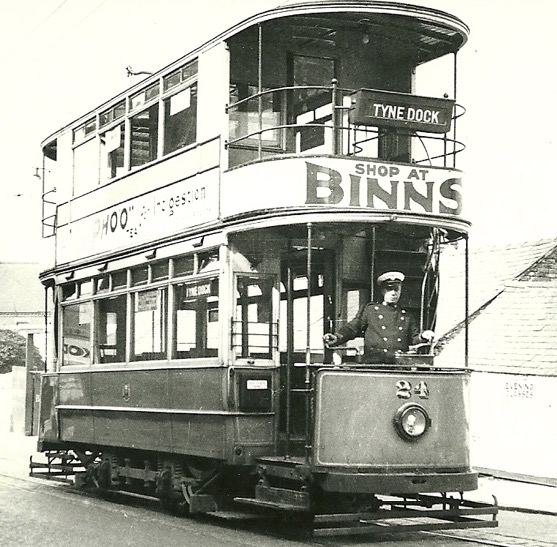
Tramcar No 24 and motorman — photo undated, but probably taken in the 1930s. Photo courtesy of the Stephen Howarth Collection.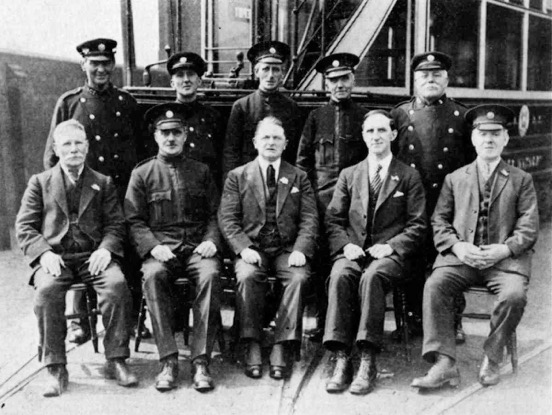
The South Shields General Manager, pictured with nine long-service employees in front of Tramcar No 13 at Dean Road Depot in 1931. From left to right, back row: P. McCardle (Motorman), W. Allen (Motorman), R. Burford (Inspector), H. Wilson (Inspector), Atkinson (Motorman); seated, W. Hails (Storekeeper), W. A. Huntley (Chief Inspector), J. Austin Baker (General Manager), J. Wilson (Cashier), J. Bovill (Office Caretaker). Seven of the ten individuals depicted are wearing the circular municipal cap badge introduced in the late 1920s. With thanks to Malcolm Fraser.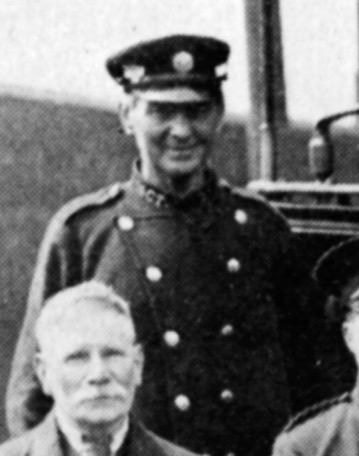
An enlargement of the above photograph showing Motorman P. McCardle.
Senior staff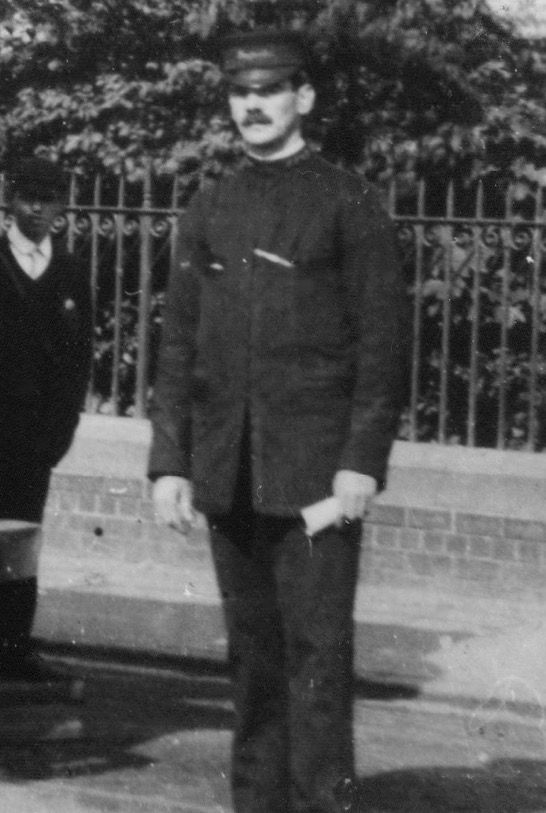
An enlargement of the photograph of Tramcar No 5 above taken in 1906, showing the inspector in his smart kepi-style cap topped off with a pom pom; the latter carries a script-lettering grade badge — 'Inspector' — on a hat band. His left-hand collar would appear to bear embroidered 'S S C T' initials, and the right-hand side 'Inspector'. With thanks to Malcolm Fraser.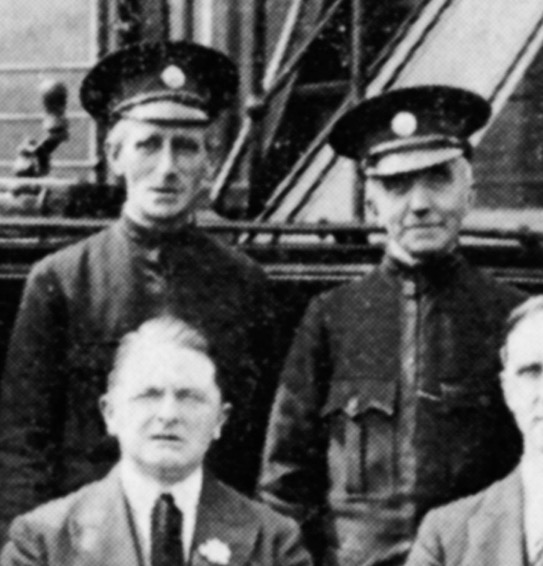
An enlargement of the 1931 long-service photograph above showing Inspectors Burford and Wilson. The caps do not appear to carry their grade, bearing only the standard circular municipal-device cap badge.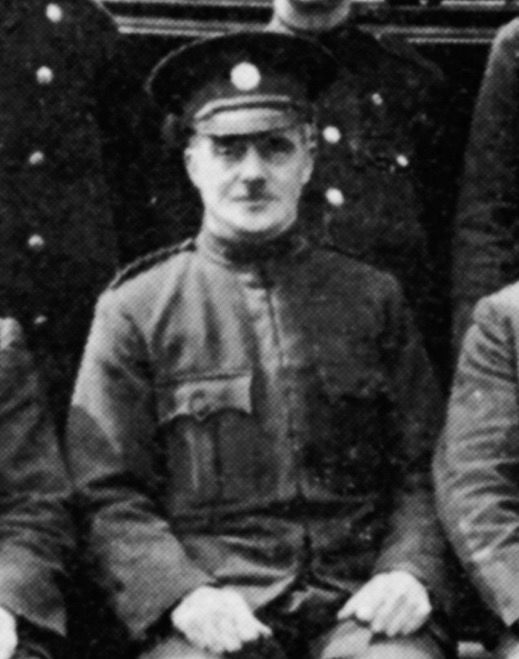
Another blow-up of the 1931 long-service photo above, this time showing Chief Inspector W. A .Huntley. Like the inspectors above, his cap only bears the circular municipal-device cap badge. The jacket epaulettes are clearly braided.
Female staff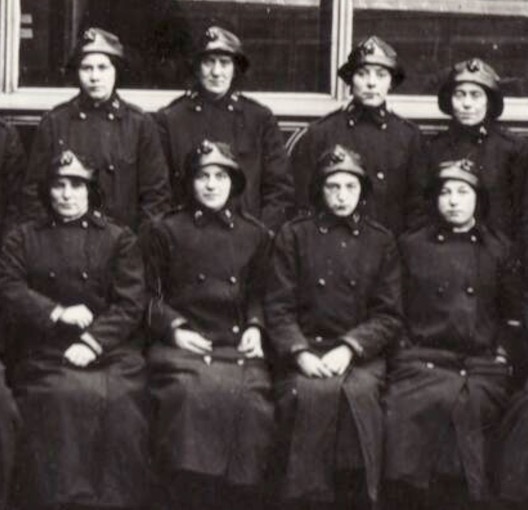
A poor photograph, but the only one that I am aware of that shows SSCT Great War conductresses. The subjects are all wearing long, double-breasted topcoats and waterproof bonnets. The only insignia appears to be on the topcoat collars, possibly employee numbers.