Southampton Corporation Tramways
Summary
Southampton took over the local horse tramway (owned by the Southampton Tramways Company) on the 1st July 1898, and continued to operate horse trams until 3rd August 1901. It would appear that the corporation was happy to let its newly acquired horsecar staff continue to be attired as they had been under the auspices of the Tramway Company (see link), so they were possibly never issued with uniforms.
The first of the new electric services was inaugurated on 22nd June 1900. Motormen and conductors were issued with double-breasted jackets bearing four pairs of buttons, presumably brass (see link), and lapels; the jacket collars bore 'S C T' in embroidered block capitals on the right-hand collar, and probably on the left-hand collar too. Caps were in a kepi style similar to that used by the erstwhile tramway company. The caps appear initially to have been devoid of insignia, but quickly acquired badges, though curiously, they differed completely between motormen and conductors: whilst the latter bore an employee number on a hat band (in individual metal numerals, probably brass), the former had a very unusually shaped embroidered cloth badge (akin to the cross-section through a loaf of bread) that bore the grade — 'MOTOR MAN' — in block capitals over two lines, all within a border.
At some point in the mid-Edwardian era, the cut of the jackets was altered, but still remained double-breasted with slit pockets (one on the left and two on the right) and lapels; the collars bore 'S C T' in embroidered block capitals. The kepi-style caps were superseded around the same time by peaked caps with wide, tensioned crowns (tops). Once again, a distinction was made between motormen and conductors in respect of the cap badges: the latter's caps continued to bear metal employee numbers (probably brass), whilst the former's caps now bore a new, elaborate cap badge comprising a municipal-device above a ribbon containing the full system title: 'SOUTHAMPTON CORPORATION TRAMWAYS'. The distinction did, however, not last long, conductors soon being issued with the more elaborate cap badges too.
Tramcar crews were also issued with long, double-breasted greatcoats with five pairs of buttons and high, fold-over collars; the latter carried embroidered block-capital system initials — 'S C T' — on both sides.
The uniforms were changed again around the time of the Great War; although the overall style remained the same, the right-hand collars now bore a one-piece nickel system-initials badge — 'SCT' — with the left-hand collar carrying a nickel employee number. The cap badge was also changed, to a round voided design comprising a municipal device within a garter containing the full system title; these were worn above a standard script-lettering grade badge, either 'Motorman' or 'Conductor'. At some point, and certainly by 1927, a switch was made to single-breasted jackets for conductors and double-breasted lancer-style tunics for motormen; both had stand-up collars, which continued to bear the same insignia as the earlier jackets. The single-breasted jackets had two flap breast pockets closed by buttons.
During the 1930s — or possibly as late as the 1940s — the jackets were changed one last time to a single-breasted design with four pairs of buttons, two waist pockets, two breast pockets (with button closures), epaulettes and lapels. It is highly likely that new uniform issues from the mid-1930s onwards would have borne 'Corporation Transport' insignia (badges and buttons), as the name of the department (and the fleet name) was changed to 'Southampton Corporation Transport' around this time (and certainly by 1936). These were initially nickel, but at some point the material was changed to chrome.
Tramcar staff were also issued with lightweight coats for summer use, as well as waterproof capes.
In the early Edwardian era, Southampton employed ticket examiners, a grade which appears to have been junior to an inspector. Ticket examiners wore long, double-breasted, frock-style coats with four pairs of closely spaced buttons, and lapels; the latter, as well as the collars, were edged in a finer material than the main body of the garment. The collars bore a large oval badge bearing the grade in block capitals ('TICKET' above and 'EXAMINER' below) with a number in the middle. It is unclear if the number denoted a class of ticket examiner (the photo below shows a '1') or if this was the examiner's employee number. Caps were of the drooping-peak type and bore a large oval badge similar to the collar badge, but presented vertically rather than horizontally.
In the early years, inspectors wore identical topcoats to ticket examiners, but with a lozenge-shaped cloth badge on each collar bearing the grade — 'Inspector' — in embroidered script lettering, within a border. The caps were of the drooping-peak type; they carried an oval cloth cap badge with block capitals (over three lines) within a wreath, probably stating the grade. These caps were eventually displaced by tensioned-crown peaked caps that bore the grade — 'Inspector ' — in embroidered script lettering (on a hatband). Probably at the same time that the drooping-peak caps were superseded by tensioned-crown peaked caps, the frock-style coats were displaced by jackets identical to those issued to tramcar staff, but with embroidered, script-lettering grade badges — 'Inspector ' — on both collars.
By 1927 at the latest, and probably from much earlier, inspectors were being issued with single-breasted jackets with hidden buttons (or more likely hook and eye fasteners) a slit-breast pocket (on the bearer's left breast) and stand-up collars; the pocket and the jacket were edged in a finer material than the main body. The stand-up collars bore the grade — 'Inspector' — in embroidered script lettering, as did the tensioned-crown peaked caps. By the late 1940s, another change had been made, senior staff now wearing double-breasted lounge suits with two pairs of plain buttons and wide lapels, all devoid of insignia.
Southampton Corporation Tramways also used the grade of Traffic Regulator, at least in the tramway's latter years. In the 1930s, regulators wore the same uniform jacket as tramcar crews — single-breasted with stand-up collars — both collars carrying one-piece system-initials badges; the caps bore a metal script-lettering grade badge — 'Regulator' — presumably in nickel, above which the standard circular cap badge was worn.
As with many tramway systems, Southampton employed female staff during the Great War — as both conductresses and motorwomen — to replace male staff lost to the armed services. Uniforms were of a dark grey gabardine material with red piping, and comprised single-breasted jackets with four buttons, three open pockets (two waist and one breast), high fold-over collars, a waist belt (with button fastening), a knee-length skirt and high lace-up boots. The left-hand jacket collar bore an employee number (probably in nickel numerals), the right-hand system initials ('S C T'), initially embroidered but soon superseded by the same one-piece nickel 'SCT' system-initials badge used on the mens' jackets. Headgear came in three varieties: baggy pleated cloth bonnets (with brims), baggy peaked motor caps (with cloth peaks) and wide-brimmed sou'wester-style waterproof bonnets; the baggy motor caps superseded the baggy pleated bonnets, whilst the sou'westers were for use in summer (or bad weather). Both cloth hats bore the standard round cap badge, but without the usual script-lettering grade badge, whilst the sou'westers were badgeless.
Conductresses were also issued with long, single-breasted topcoats, of which there were two types. The first issues bore four buttons, a waist belt (with button fastening), lapels and epaulettes; they do not appear to have carried any insignia. The later type was also single-breasted, but bore five buttons, along with high fold-over collars and epaulettes; the collars carried the same nickel insignia as the jackets worn underneath. A single studio portrait has survived of a motorwoman; she is wearing a long, heavy-duty, double-breasted, lancer-style topcoat with five pairs of buttons (narrowing from top to bottom), epaulettes and high fold-over collars. The latter bore the standard one-piece system-initials badge on the left-hand side and a script-lettering grade badge ('Driver') on the right-hand side.
Southampton also employed the services of a lady inspector. The sole surviving photo (see below) indicates that this lady was issued with an overcoat very similar in style to those issued to conductresses, but with embroidered collar insignia, presumably 'Inspector'. The style of uniform that was presumably worn underneath is currently unknown. Headgear took the form of a standard tensioned-crown peaked cap carrying the standard cap badge.
Female staff were also employed during the Second World War, both as conductresses and motorwomen. These ladies were issued with single-breasted jackets with four pairs of buttons, breast pockets (with button closures), epaulettes and lapels; the collars were either left plain or bore a standard one-piece SCT initials badge. Headwear took the form of a baggy motor cap with an upturned back and sides (see below), and with a glossy peak; it carried the standard cap badge, sometimes augmented with a grade badge.
For a history of Southampton's tramways, see '100 Years of Southampton Transport'; Southampton City Transport and Southampton City Museums (1979).
Images
Motormen and conductors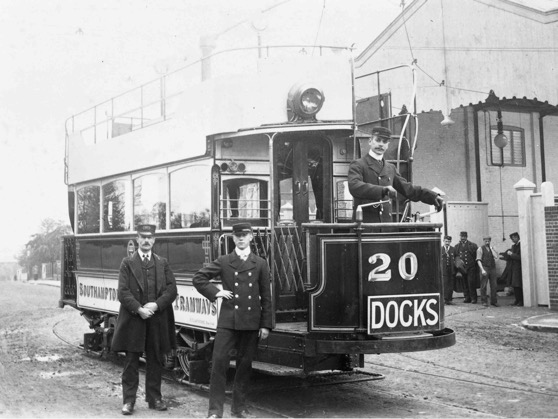
A conductor and a motorman with Tramcar No 20 outside Portswood Depot with a service bound for the Docks — photo taken in October 1900. Both the tram and the crew's uniforms appear to be in pristine condition. The man on the left, in the frock-style coat with the large oval cap badge, is very probably an inspector. Photo courtesy of the National Tramway Museum.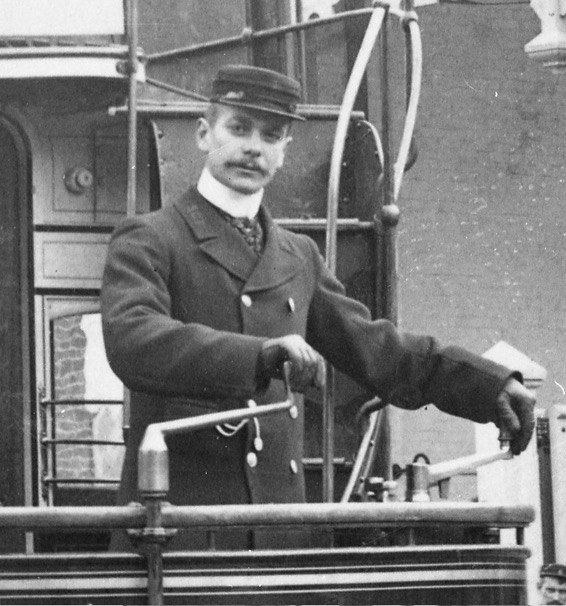
An enlargement of the above photograph showing the motorman. Whilst his right-hand greatcoat collar bears embroidered system initials — 'S C T' — his kepi-style cap appears to be without a badge of any kind.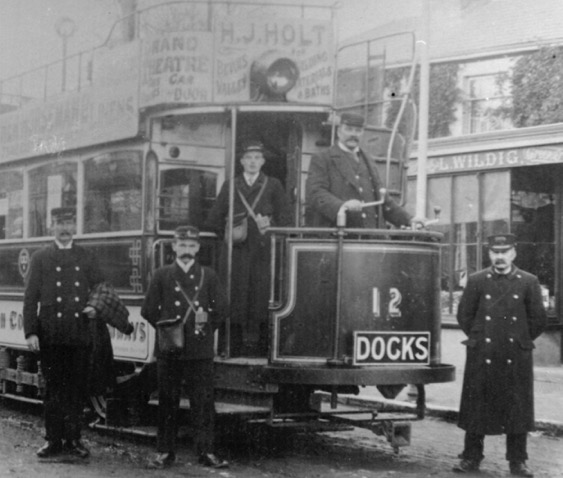
Two motormen, two conductors and an inspector posing with Tramcar No 12 outside L Wildig’s greengrocers — photo undated, but probably taken in 1902 or 1903. Whilst one conductor and the two motormen appear to be wearing kepi-style caps without insignia, the conductor at the front appears to have a small cap badge, probably a single-digit employee number. Photo courtesy of the Tramways and Light Railway Society, with thanks to David Voice.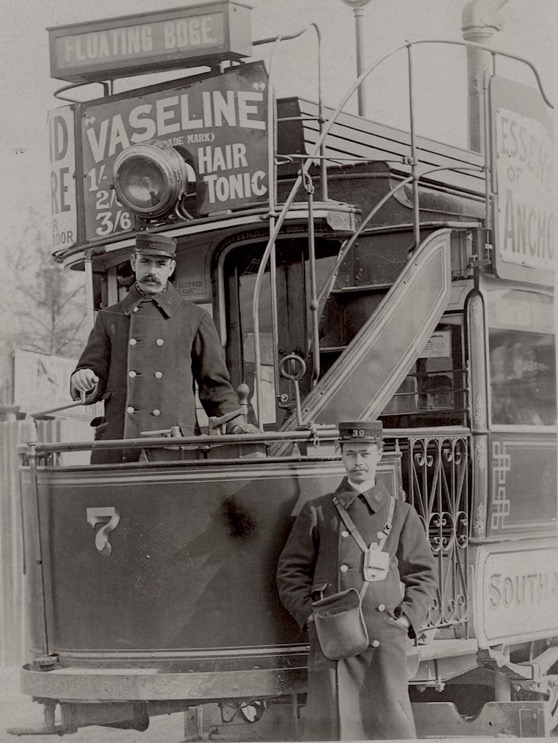
A nice study of the crew of Tramcar No 7, on a service to Floating Bridge — photo undated, but probably taken in late 1901 or 1902. Author's Collection.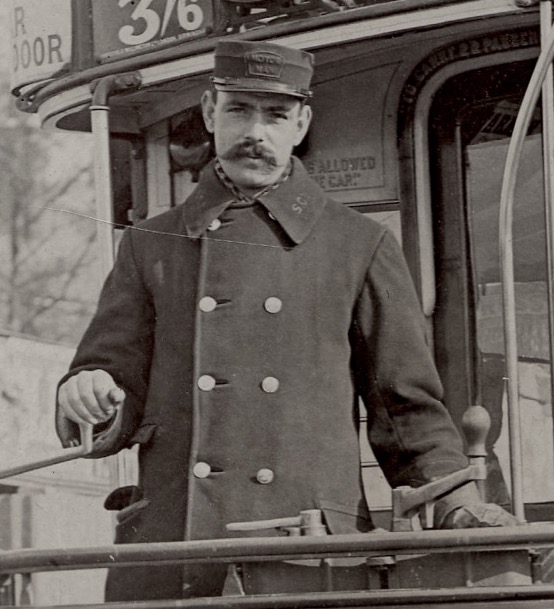
An enlargement of the above photograph showing the motorman. The collars of his greatcoat bear embroidered 'S C T' system initials, whilst his kepi-style cap bears an unusually shaped cloth badge bearing his grade — 'MOTOR MAN' — on two lines in block capitals.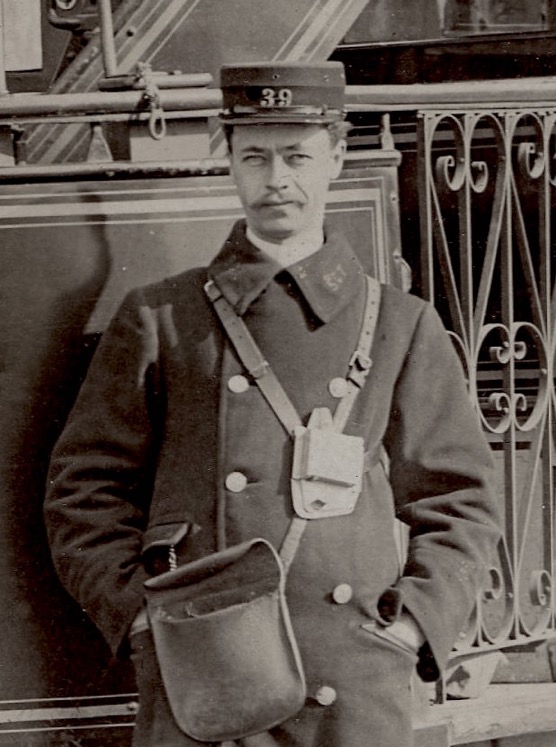
Another enlargement of the above photograph, this time showing the conductor. In contrast to the motorman, his kepi-style cap simply bears an employee number (39) — on a dark-coloured hat band — in individual metal numerals, almost certainly brass.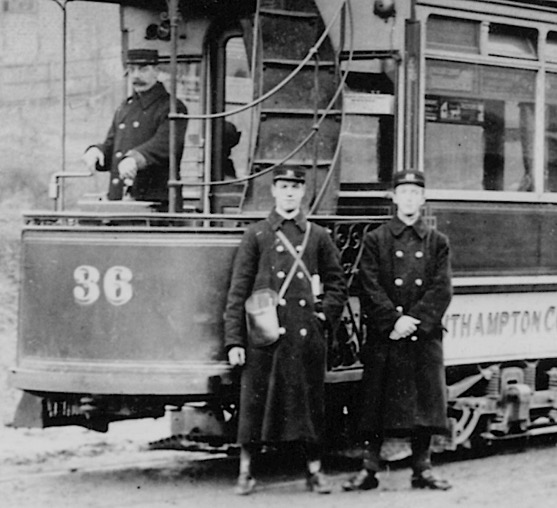
Tramcar No 36 stands at Hampton Park with a motorman and Conductor Harry Henwood, both in heavy-duty greatcoats — photo undated, but probably taken in 1903/4. The two men standing in front of the tram probably have employee numbers on their caps, whilst the motorman more than likely has the same type of cloth badge as in the previous photo. Photo courtesy of the Tramways and Light Railway Society, with thanks to David Voice.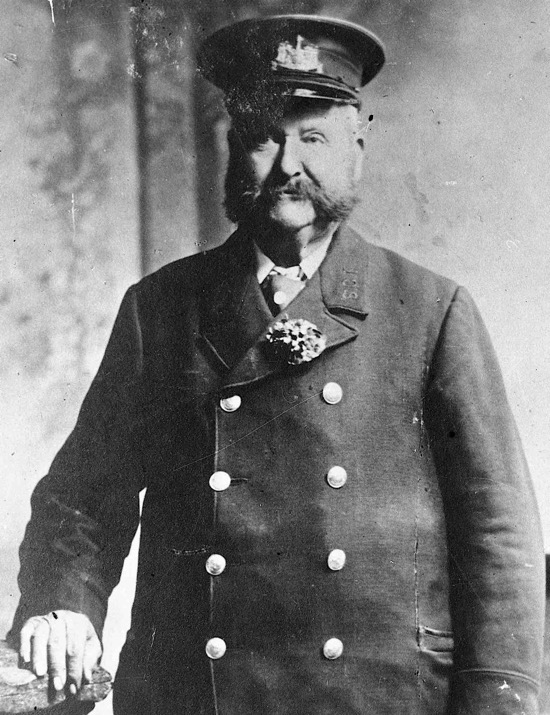
A studio portrait of a Southampton Corporations Tramways motorman purportedly taken in 1900, but which must have been taken in the mid-Edwardian era given that the subject is wearing a tensioned-crown peaked cap bearing a pattern of cap badge that was only introduced then. Photo courtesy of the National Tramway Museum.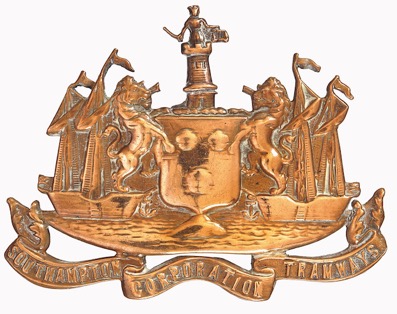
Southampton Corporation Tramways cap badge, worn from the mid-Edwardian era through to the Great War — brass. Author's Collection.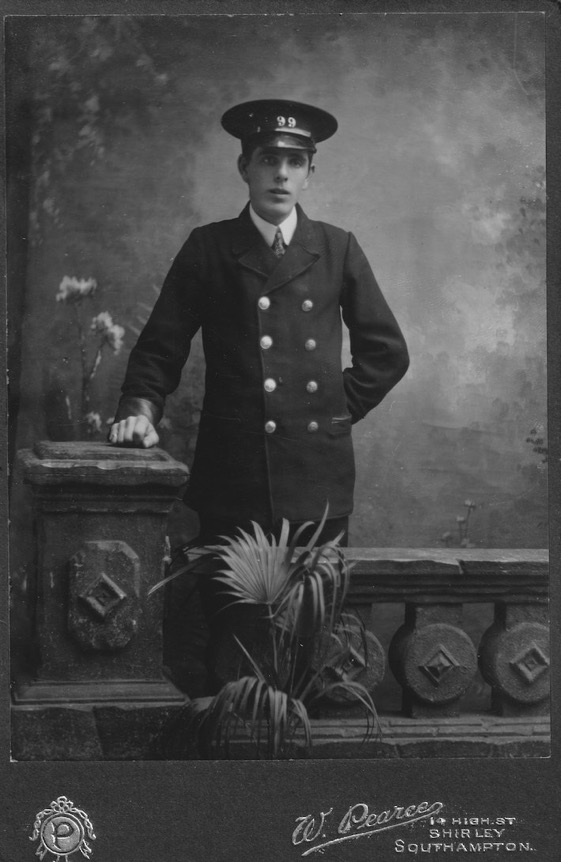
A studio portrait of a Southampton Corporation Tramways employee, almost certainly a conductor — photo undated, but probably taken in the mid-Edwardian era. The subject is wearing a wide-crown peaked cap that bears only an employee number (99); his uniform is otherwise devoid of insignia. Author's Collection.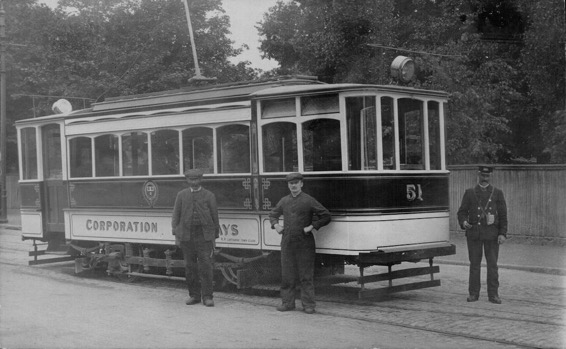
What would appear to be a brand-new Tramcar No 51, dating the photo to 1906. Author's Collection.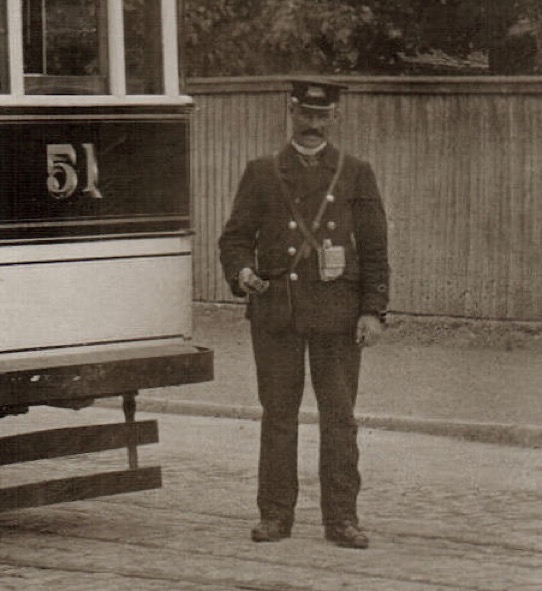
An enlargement of the above photograph showing the conductor, in tensioned-crown peaked cap bearing the new, elaborate cap badge.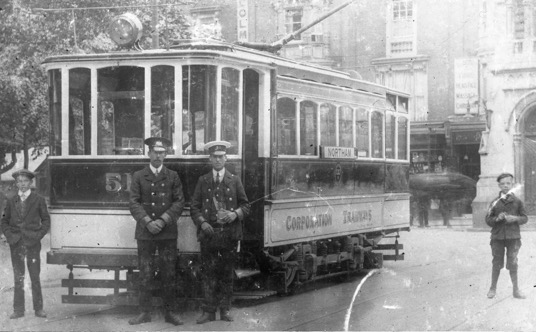
Another shot of what would appear to be a brand-new Tramcar No 51, dating the photograph to 1906. Photo courtesy of the National Tramway Museum. 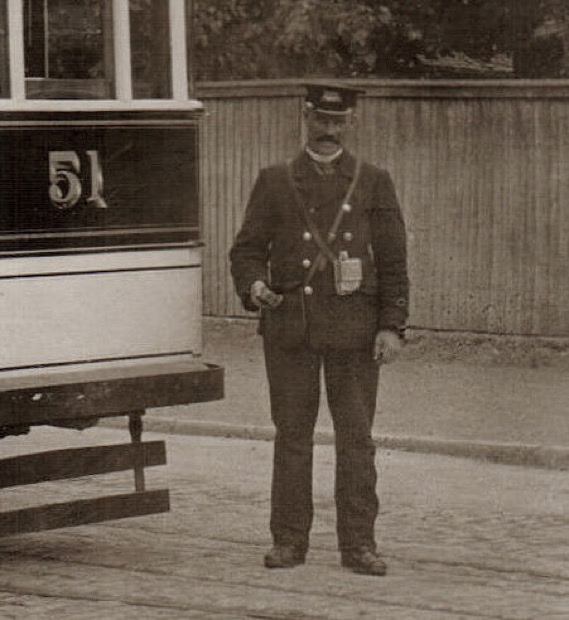
An enlargement of the above photograph showing the crew. Whilst the motorman's cap bears the newly introduced elaborate cap badge, his colleague's cap bears just an employee number.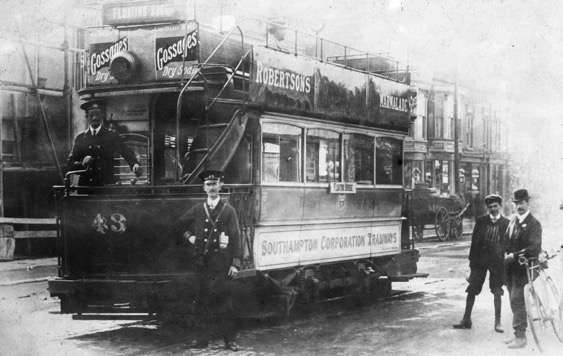
The crew of Tramcar No 43 near the station with a service for Floating Bridge — photo undated, but probably taken in the mid-to-late Edwardian era. Photo courtesy of the National Tramway Museum.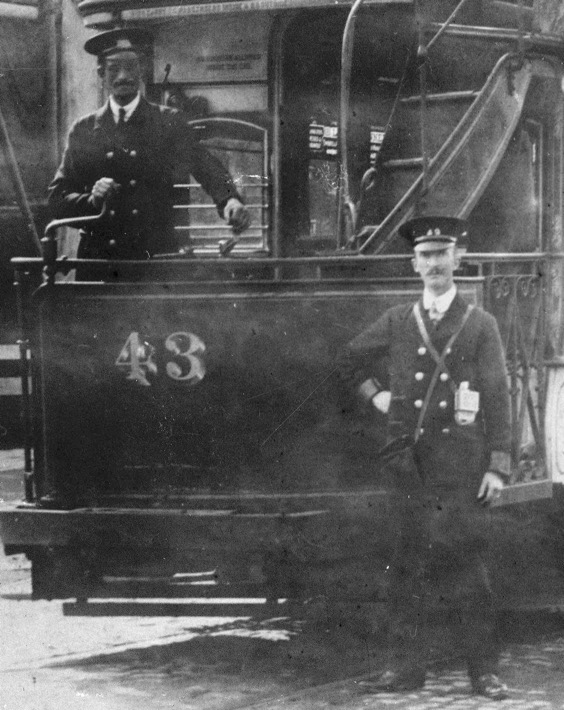
An enlargement of the above photograph, which once again shows a motorman wearing the new cap badge on his wide-crown peaked cap, but the conductor wearing just an employee number on his. 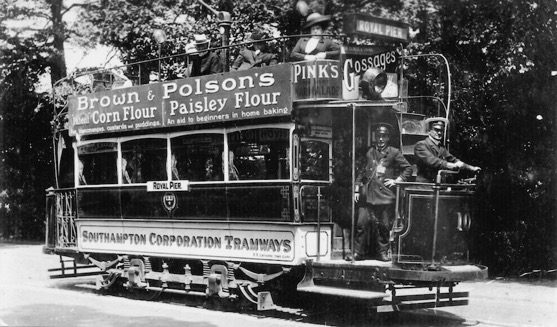
The crew of Tramcar No 10 with a service for the Royal Pier — photo undated, but probably taken between 1911 and the Great War. Photo courtesy of the Tramways and Light Railway Society, with thanks to David Voice.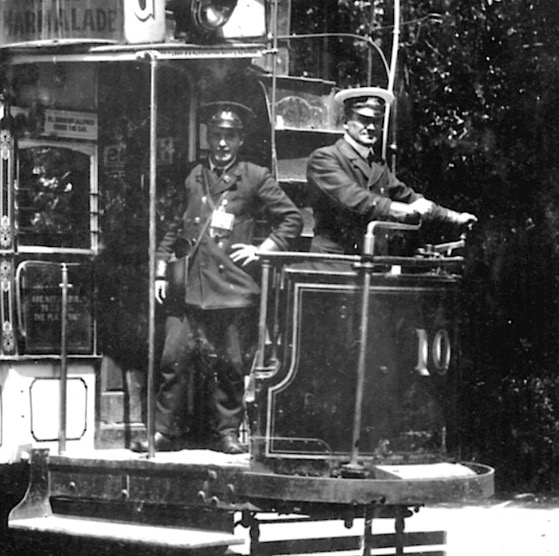
An enlargement of the above photograph showing the conductor and the motorman.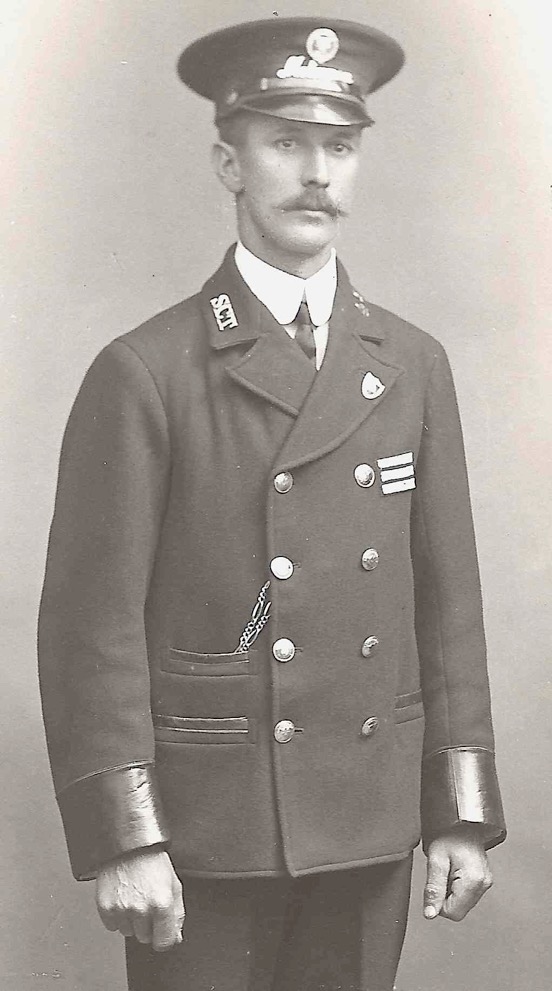
Southampton Corporation Tramways motorman — the rear of the postcard is dated July 1918, so the portrait was certainly taken no later than this. The new, round cap badge is clearly seen, as is the one-piece ‘SCT’ collar badge. The three stripes on the subject's left breast probably denote 'good conduct' or 'long service'. The meaning of the shield-shaped badge on the jacket lapel is unclear. Author's Collection.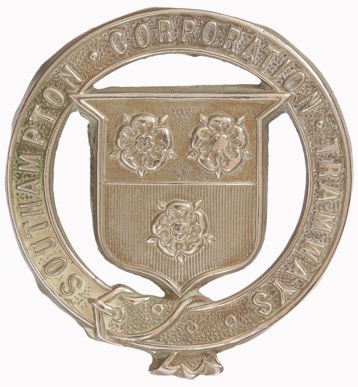
Southampton Corporation Tramways cap badge, worn from around the start of the Great War through to closure — nickel.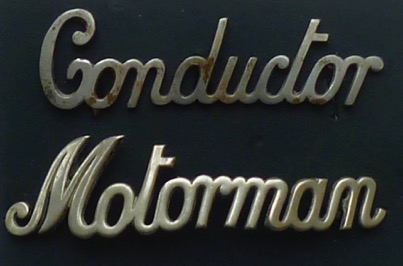
Standard, off-the-shelf, script-lettering grade badges of the type used by the SCT from around the time of the Great War through to closure — nickel. Author's Collection.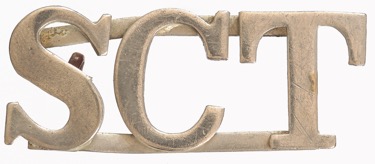
SCT collar badge, used from the Great War through to closure — nickel. Author's Collection.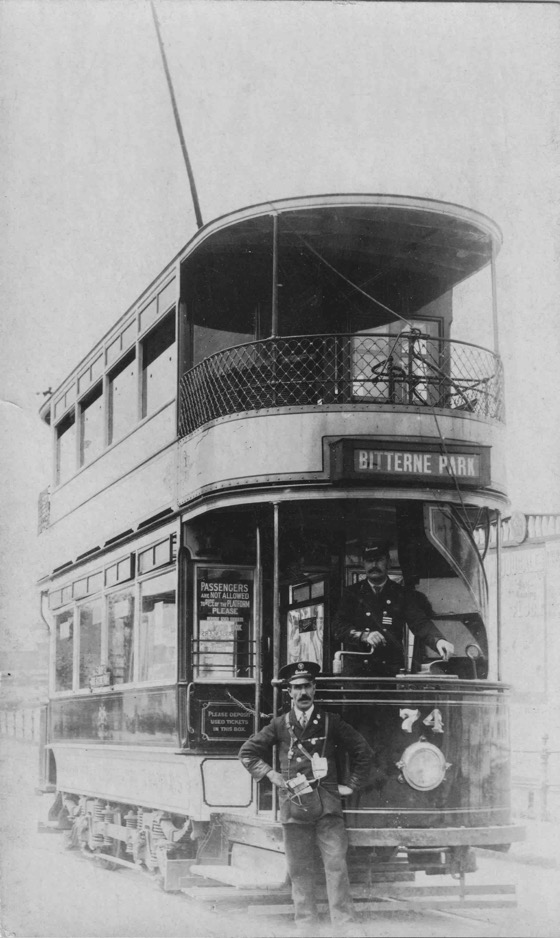
The crew of a rather pristine-looking Tramcar No 74 pose for the cameraman — photo undated, but probably taken not long after it was built in 1917. Author's Collection.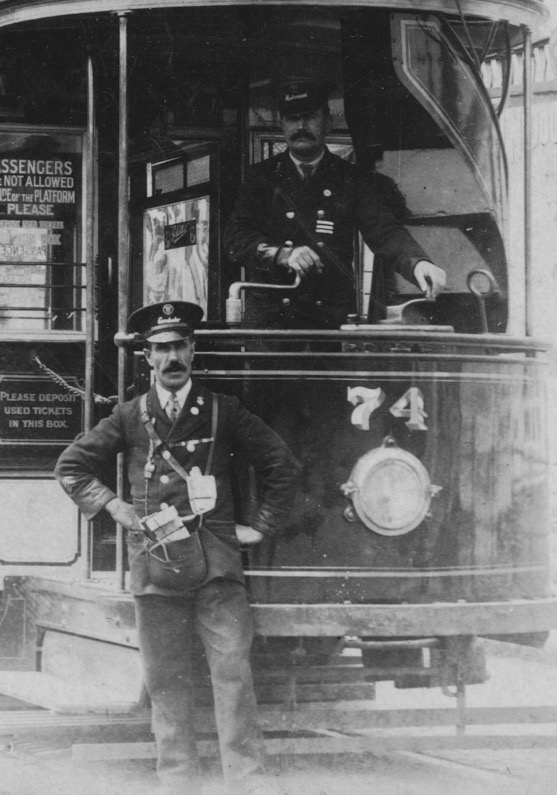
An enlargement of the above photograph showing the tramcar crew. The motorman has three horizontal stripes on the left breast of his jacket, whereas the conductor (Employee No 40) has inverted chevrons on his right jacket sleeve. These probably denoted either 'good conduct' or 'long service'.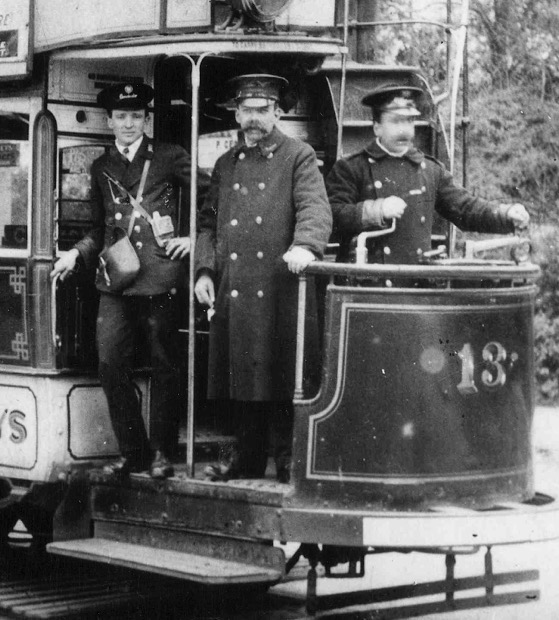
A conductor, an inspector and a motorman aboard the platform of Tramcar No 13 at the Rest Camp terminus in the Avenue — photo thought to have been taken in 1921 or thereabouts. The inspector is Frances Burlefinger, who started his career with the Tramway Company in 1890 (see below).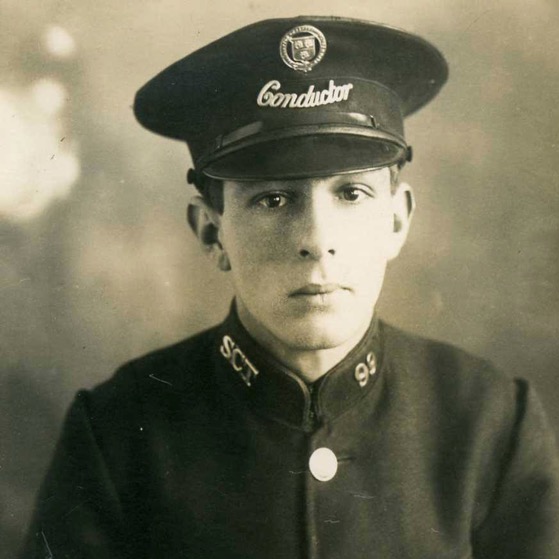
Conductor Frederick Mayzes — Employee No 99 — taken some time during the 1920s. He is wearing a single-breasted jacket with stand-up collars. Source unknown.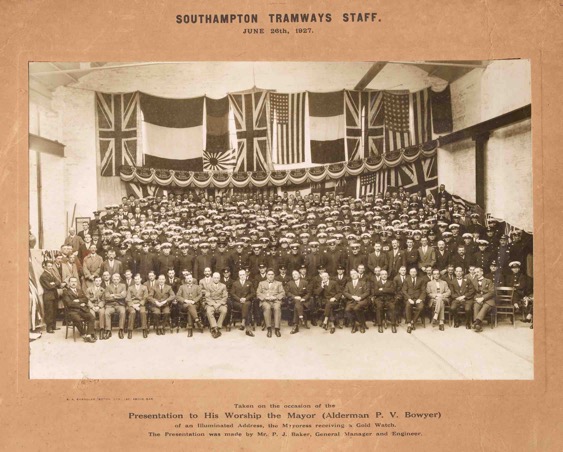
A rather unusual survivor, a precisely dated photograph (26th June 1927) of what is probably the entire Corporation Tramways department, with not a single woman amongst them. The photograph was taken to mark the presentation to His Worship the Mayor (Alderman P, V. Bowyer) of an Illuminated Address, the Mayoress receiving a Gold Watch. The Presentation was made by Mr. P. J. Baker, General Manager and Engineer. Author's Collection.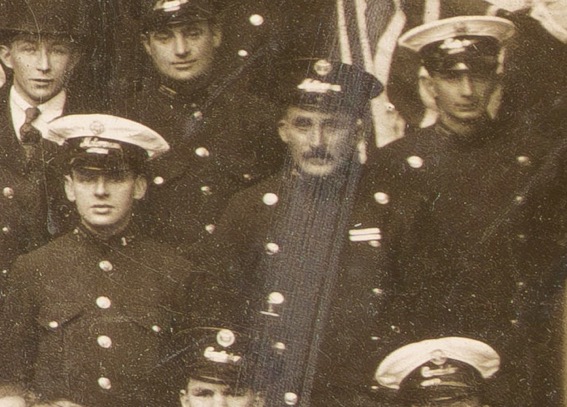
An enlargement of the above photograph showing four of the uniformed staff, two conductors and two motormen. Although one of the latter is wearing a single-breasted jacket, examination of the larger photograph indicates that the single-breasted jackets were generally worn by conductors, with motormen wearing double-breasted, lancer-style tunics.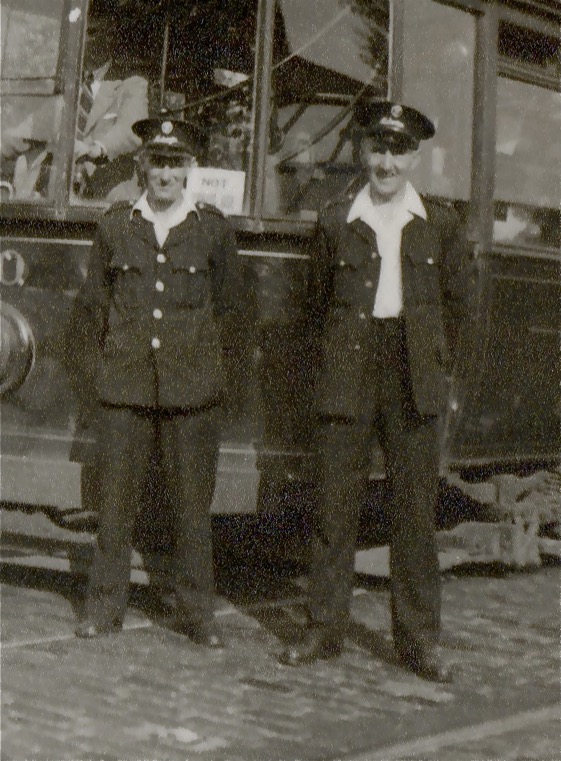
Motorman Lilly and his conductor pose for the cameraman with Tramcar No 50 at Millbrook on 1st June 1947. Author's Collection.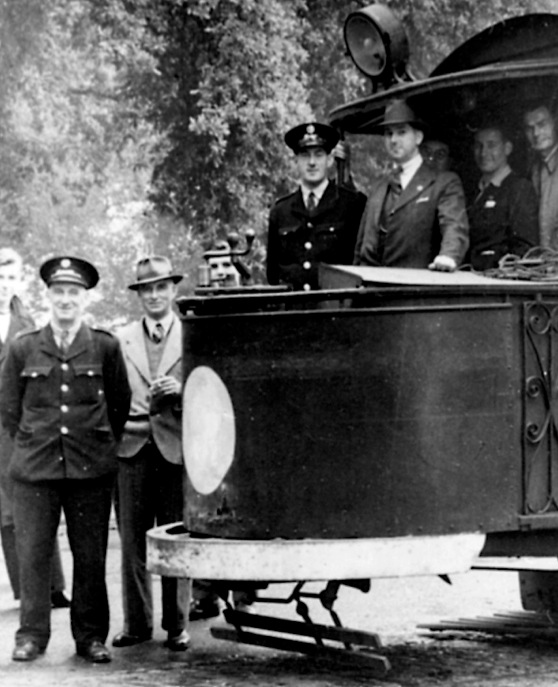
A photo of what is possibly Tramcar No 45, which was sold to the Light Railway and Transport League in 1949 (probably the occasion marked by the photo). Photo courtesy of the Tramways and Light Railway Society, with thanks to David Voice.
Senior staff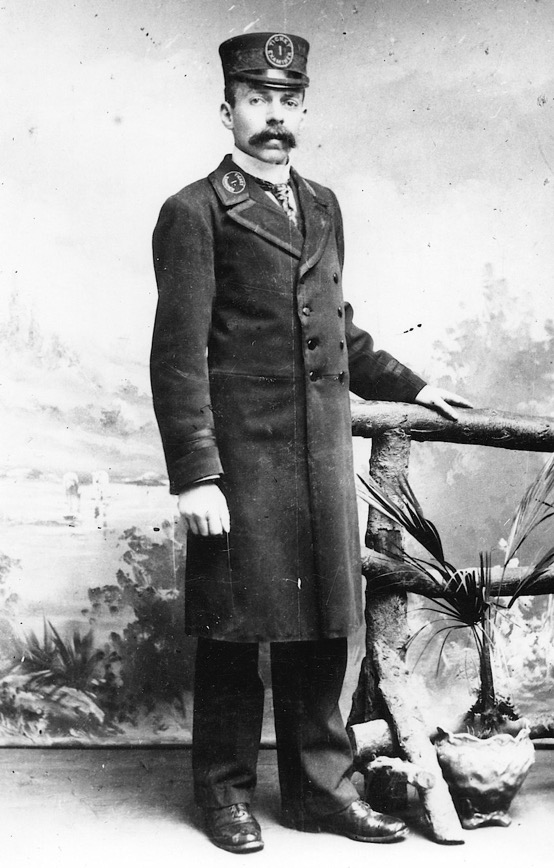
The young Frances Burlefinger in 1900, newly promoted to the grade of Ticket Examiner. Author's Collection.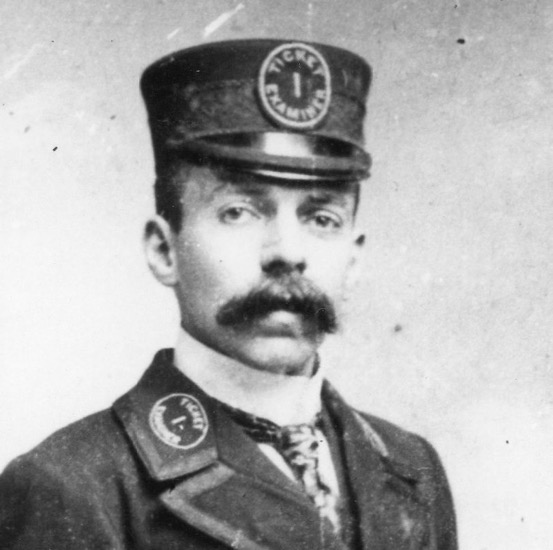
An enlargement of the above photograph showing details of the cap and collar badges. His cap is of the drooping-peak type.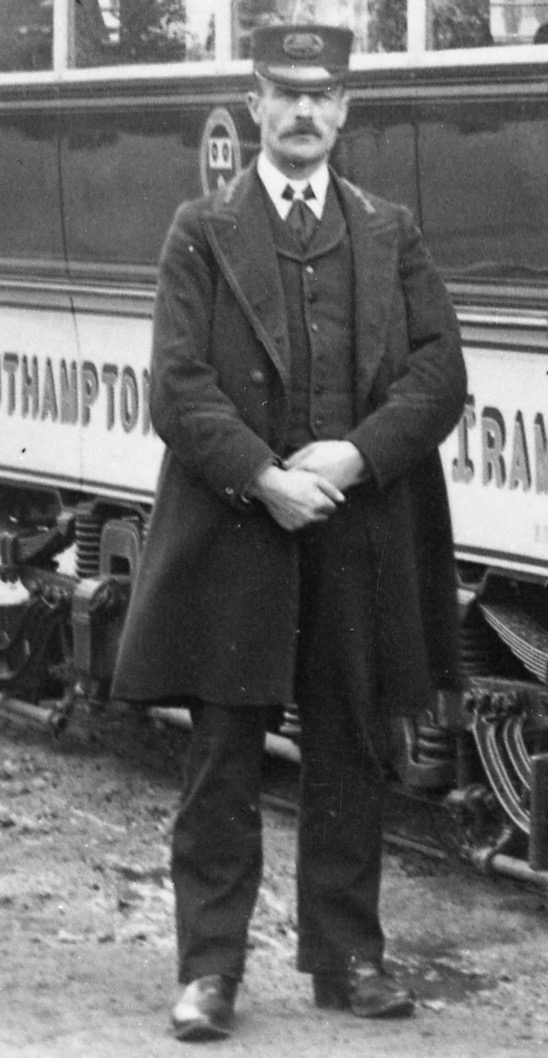
An enlargement of the October 1900 photograph of Tramcar No 20 above showing the senior member of staff, who is probably a ticket inspector. By this time, the large oval cap badge had been replaced by an oval embroidered cloth badge, and its counterpart on the collars by an embroidered script-lettering grade badge.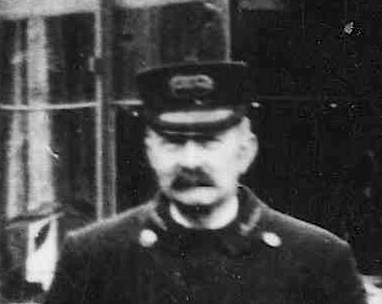
An enlargement of the photograph above of Tramcar No 12, showing the inspector, who is wearing a drooping-peak cap topped by a pom pom, with embroidered insignia on both his collars and his cap.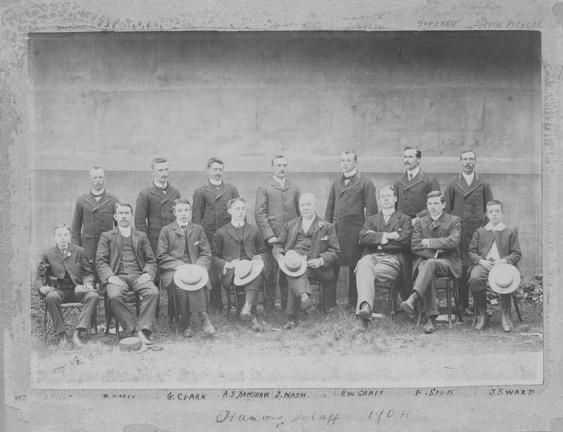
A photograph taken in 1904 of six Southampton Corporation Tramways inspectors along with a number of clerical staff. Back row, left to right: Victor Bryant; unknown; unknown; unknown, unknown; Smyth; Ernest Claude Pickett. Front row, left to right: Wright; Eagle; Clark; Alfred Stewart Ramshaw (clerk); J. Nash (cashier); Edward William Grace (clerk); Frank Silk (clerk); J. S. Ward. Author's Collection.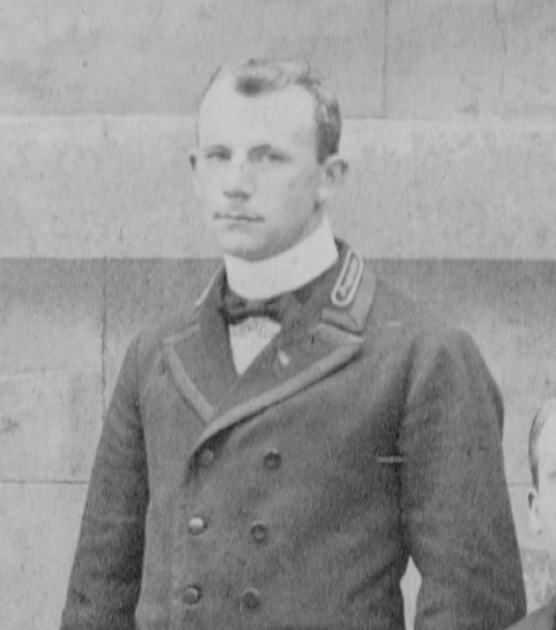
An enlargement of the above photograph showing one of the inspectors, whose name, unfortunately, can no longer be read. He is, like his colleagues, wearing a long, double-breasted coat with lapels and unmarked buttons. The collars of the coat bear a lozenge-shaped cloth badge bearing his grade — 'Inspector' — in embroidered script lettering.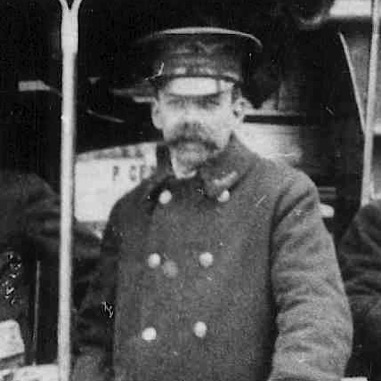
An enlargement of the photograph of Tramcar No 13 above showing Frances Burlefinger in 1921, by which time he had risen to the grade of inspector. His overcoat, and probably his cap too, bear his grade, 'Inspector'.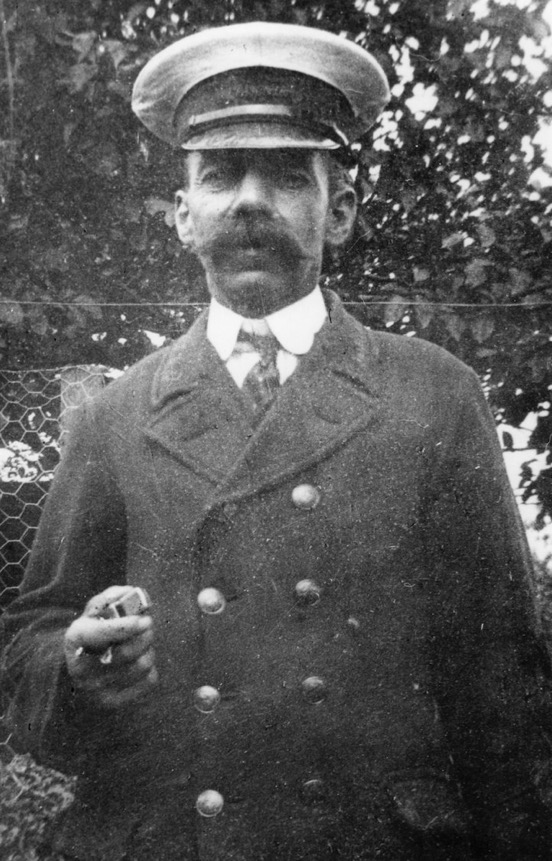
Inspector Francis Burlefinger once again, but probably taken some 20+ years on from his 1900 studio portrait (i.e., the 1920s). The badge on the tensioned-crown cap is difficult to make out, but is probably an embroidered script-lettering grade badge: 'Inspector'. Author's Collection. 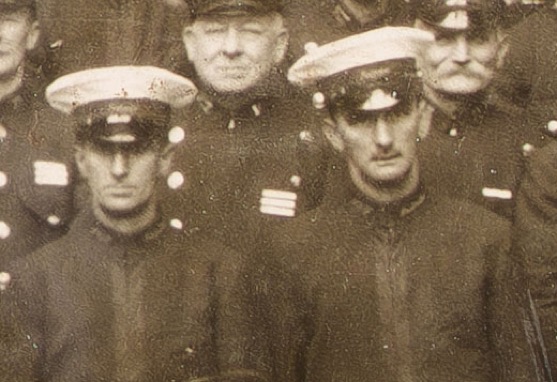
An enlargement of the 1927 staff photograph above showing two of the inspectors. By this date, employees of this grade were clearly being issued with typical tramway inspector garments, single-breasted and edged in material of a finer quality than the main garment.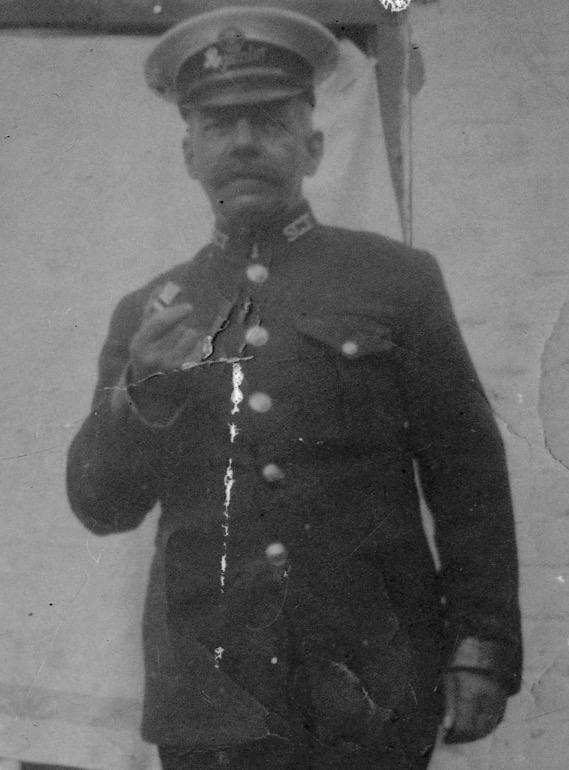
A still later photograph of Frances Burlefinger, when he was a traffic regulator at Portswood Junction — photo undated, but probably taken in the late 1930s as he held this position for the last five year's of his career. The grade of Traffic Regulator was usually junior to that of Inspector, so he perhaps took on the less onerous position for age-related reasons. Photo courtesy of the National Tramway Museum. 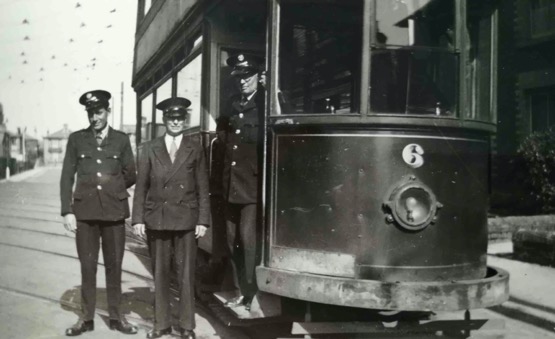
Motorman Bill Knopp, Inspector Barnes and Motorman Norman Stockwell pose for the camera of C G Stevens in Settle Close — photo undated, but probably taken in the late 1940s (No 6 was withdrawn in 1948). Photo courtesy of Martin Petch.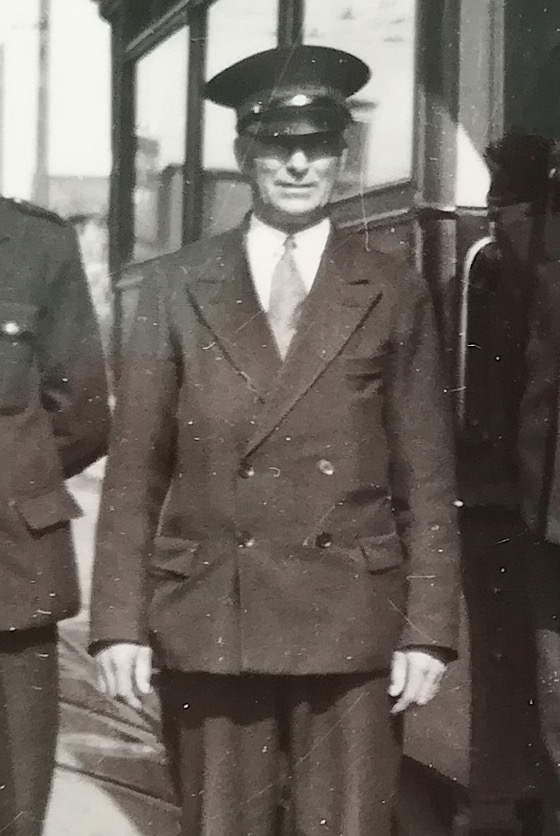
An enlargement of the above photograph showing Inspector Barnes. His uniform takes the form of a lounge suit, with plain buttons and lacking insignia of any kind; his cap bears a hat band with embroidered lettering, most probably 'Chief Inspector'.
Female staff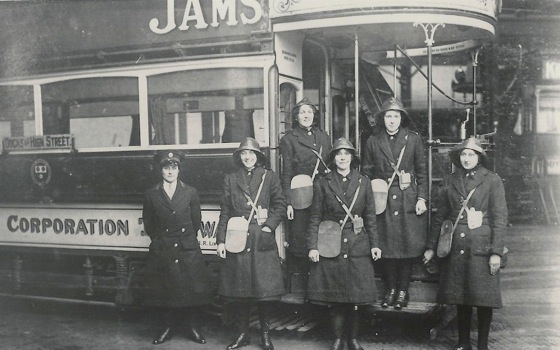
A photograph purportedly showing Southampton's first intake of Great War conductresses — photo undated, but probably taken in July 1915. Stephen Howarth Collection.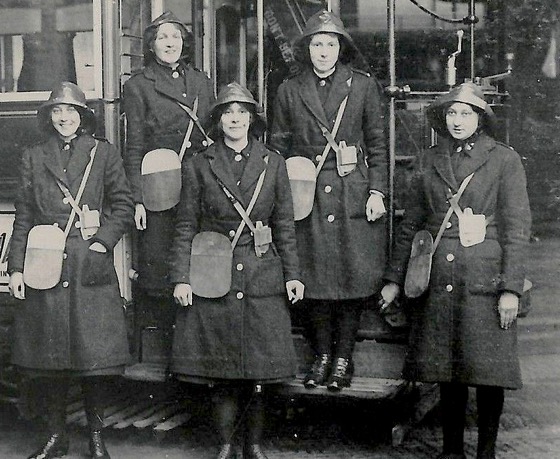
An enlargement of the above photograph showing details of the uniforms; all the conductresses are wearing long, single-breasted top coats and sou'wester style waterproof bonnets.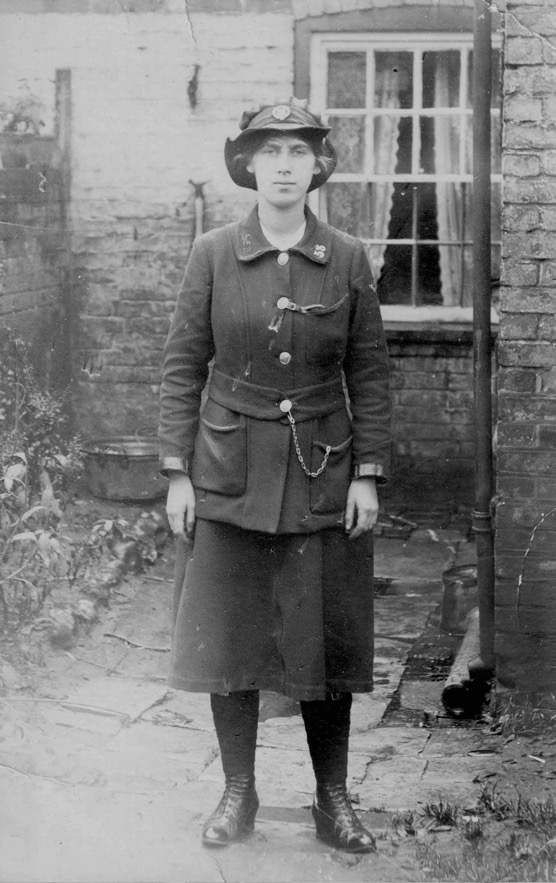
Southampton Corporation Tramways Great War conductress, Employee No 53. Author's Collection.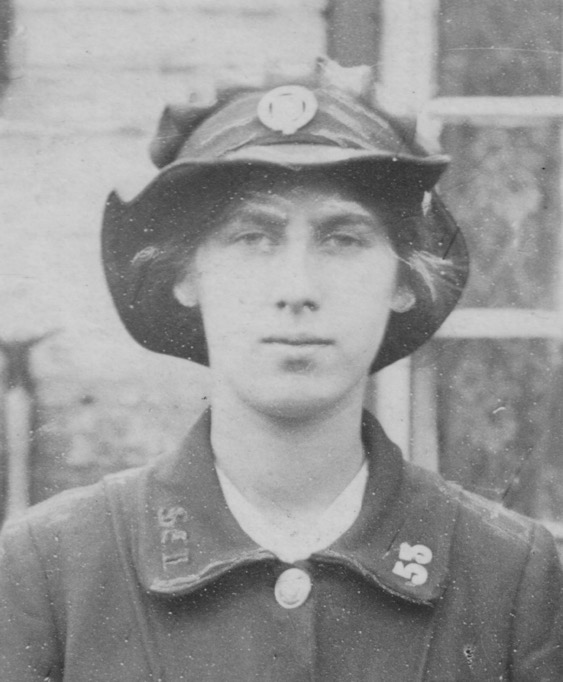
An enlargement of the above photograph showing details of the uniform insignia. The left-hand collar of her single-breasted uniform jacket bears her employee number in metal numerals, the other side system initials, but embroidered rather than metal. Her cloth bonnet, which is pleated, bears the standard SCT circular cap badge, which was introduced around this time.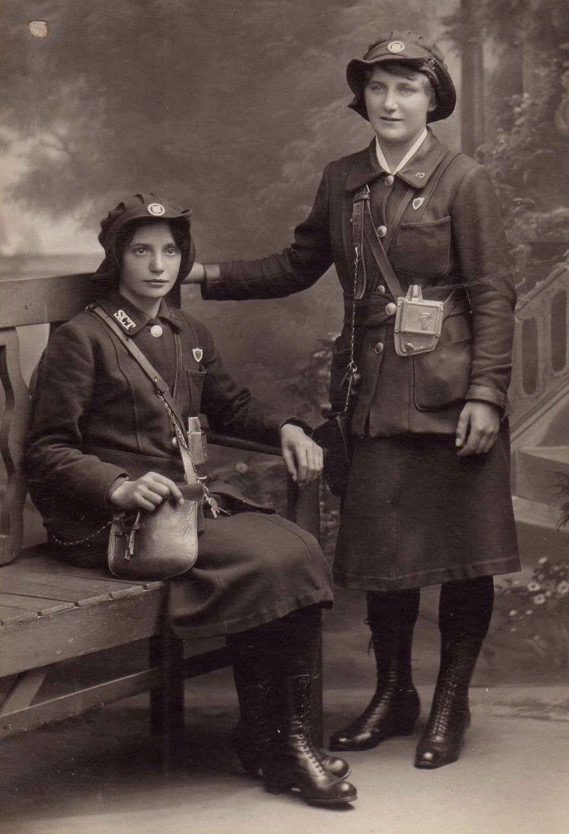
A charming studio portrait of two Southampton Corporation Tramways Great War conductresses. Both ladies are wearing single-breasted jackets, knee-length skirts and high lace-up boots, along with the unusual pattern of pleated cloth bonnet. The lady on the left has a one-piece system-initials badge on her right-hand collar rather than the earlier embroidered badge; the lady on the right does not have a badge on her right-hand collar, but does have an employee number ('3') on her left-hand collar. Both ladies are wearing a small shield-shaped badge on their left jacket breasts, the purpose of which is unclear. Photograph courtesy of the Stephen Howarth Collection.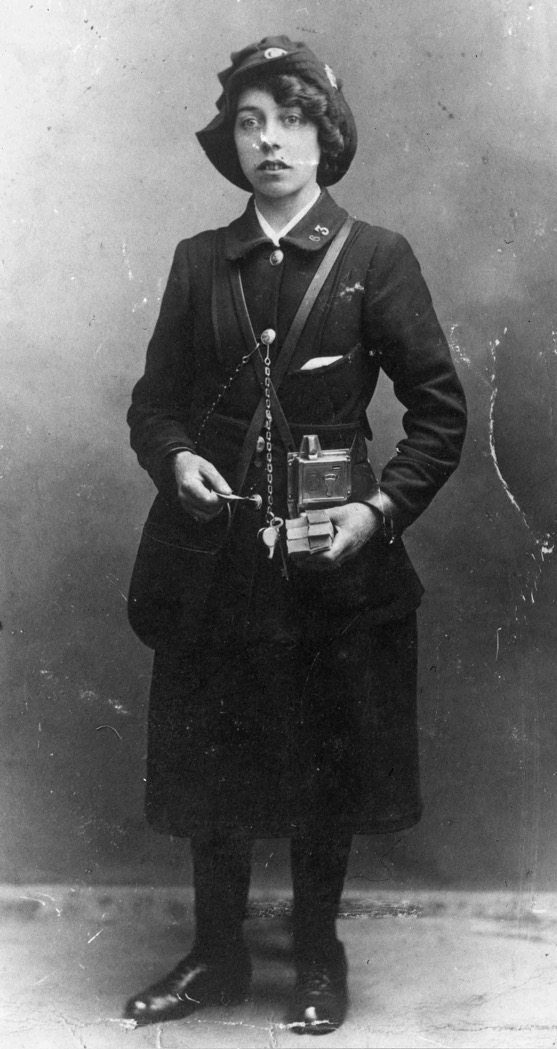
Another studio portrait of a Great War Southampton Corporation Tramways conductress, this time Employee No 63. She is wearing the same style of uniform as the two ladies in the previous photograph, but also has a large badge on the underneath of her upturned bonnet brim; this was more than likely a regimental badge. Photo courtesy of the National Tramway Museum. 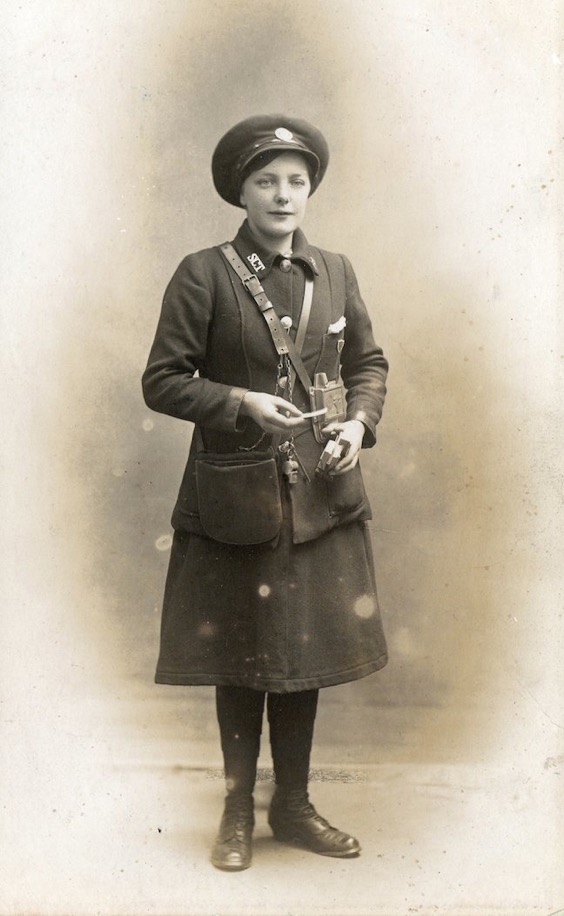
A Southampton Corporation Tramways conductress, possibly called 'Gladys' — photo undated, but almost certainly taken during the Great War. By the time this photograph was taken, the pleated bonnets had evidently been superseded by baggy peaked motor caps. Once again, the subject has a small shield-shaped badge (of unknown purpose) on the left-breast pocket. Author's Collection.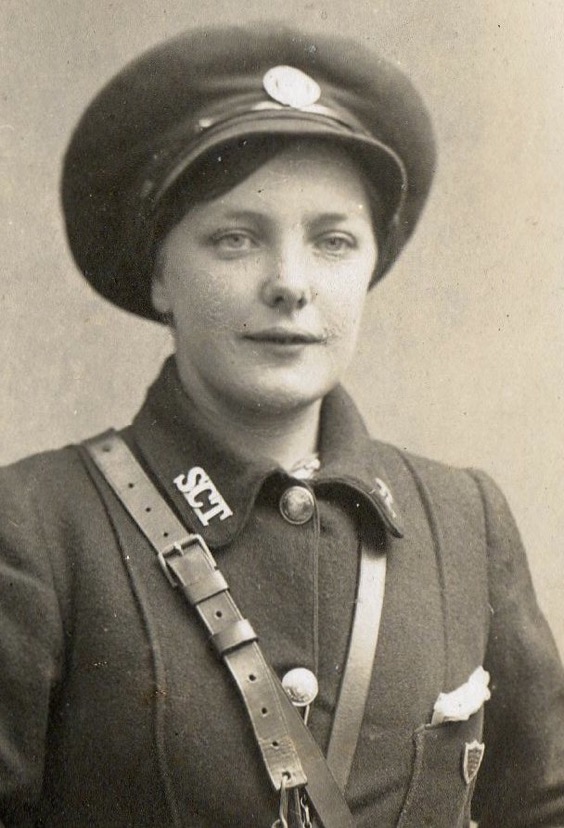
An enlargement of the above photograph showing details of the badges.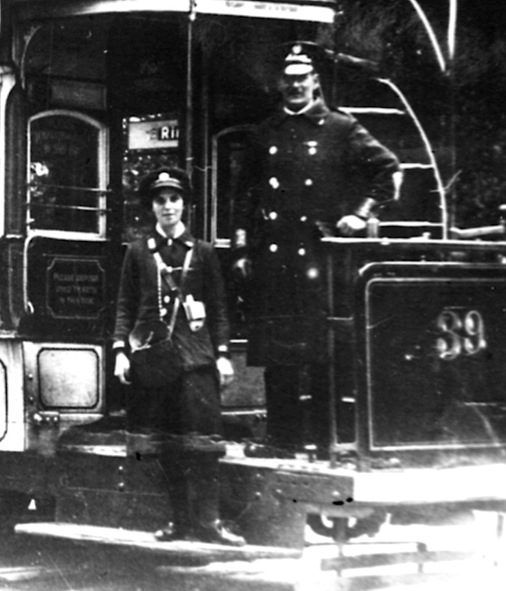
A conductress and a motorman with Tramcar No 39 on a service for the Royal Pier — photo undated, but almost certainly taken during or shortly after the Great War (No 39 was withdrawn in 1922). Photo courtesy of the Tramways and Light Railway Society, with thanks to David Voice.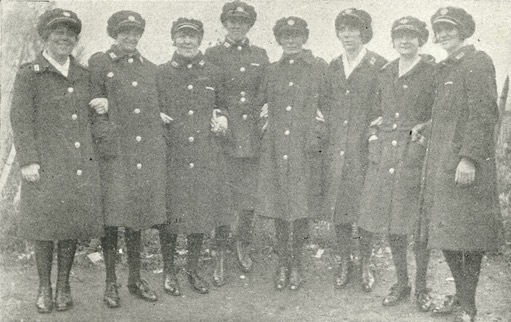
A poor quality image, but one which depicts a group of conductresses taken on the last day of female conducting in 1919. Photo courtesy of the Stephen Howarth Collection.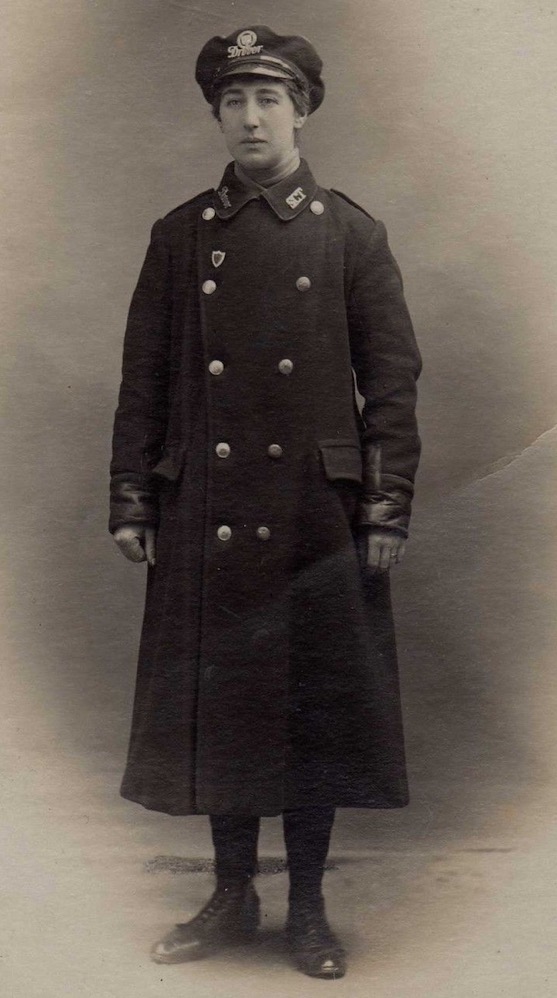
A rare studio portrait of an SCT motorwoman in her long, lancer-style topcoat. Both her motor cap and the right-hand collar of her topcoat carry a script-lettering grade badge. Her topcoat also bears the small enamel shield badge seen in several other Great War photos. Photo courtesy of the Stephen Howarth Collection.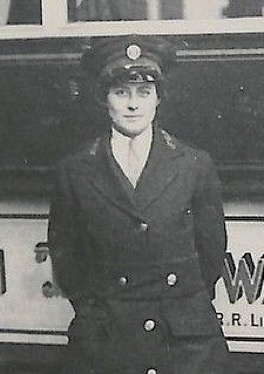
An enlargement of the July 1915 photograph above, showing the inspectress.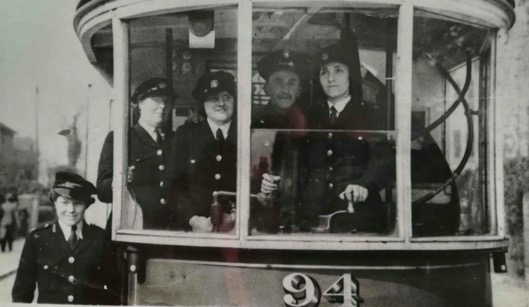
A group of four motorwomen with Tramcar No 94, all receiving driving tuition from Instructor Wheeler — photo taken early in the Second World War. Photo courtesy of the Martin Petch Collection.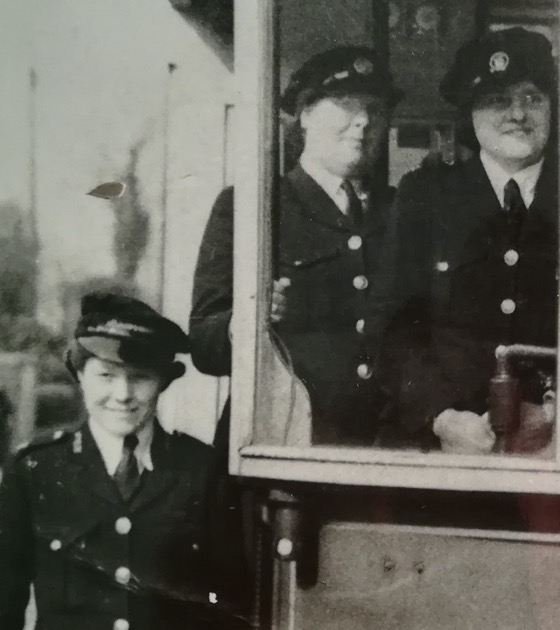
An enlargement of the above photograph showing three of the motorwomen in their smart single-breasted jackets and baggy motor caps. All are wearing the standard circular SCT cap badge, though only the lady on the left has a grade badge too.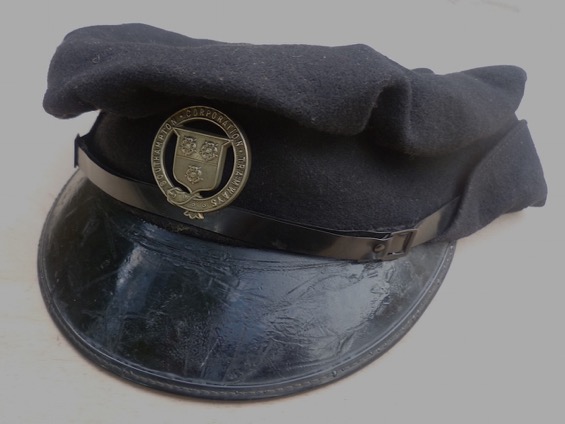
Southampton Corporation Tramways Second World War conductress's baggy motor cap. Despite the undertaking having been called 'Southampton Corporation Transport' since the mid-1930s, the cap bears a 'Tramways' cap badge, possibly because existing stocks were used for the women rather than ordering new 'Transport' issues. Author's Collection.