South Metropolitan Electric Tramways
History
The South Metropolitan Electric Tramways were owned and operated by the South Metropolitan Electric Tramways and Lighting Company, which was a subsidiary of the much larger British Electric Traction Company (BETCo), a concern which at its zenith either owned, part-owned or leased almost 50 tramway concerns across the British Isles.
In the late 1890s, the BETCo was aggressively purchasing horse and steam-operated tramways across the British Isles, with the intention of converting them to electric traction, and in 1898, it cast its glaze in the direction of Croydon, where it sought to gain control of a local horse tramway, the Croydon Tramways Company. The BETCo's efforts were, however, to be thwarted by Croydon Corporation, who acquired the CTCo on the 22nd January 1902. Perhaps surprisingly, the corporation chose not to operate the services itself, instead leasing the system to the BETCo; somewhat unusually, the BETCo initially worked the system directly rather than through a subsidiary, which was its usual modus operandi. The first electric services in Croydon, which were operated by the BETCo, ran on the 26th September 1902.
Operating Croydon Corporation's tramway system under a lease arrangement was, however, only one component of the BETCo's territorial ambitions around Croydon, and it was soon clear that the company intended to seek or acquire powers for tramways to the northeast, northwest and southwest of Croydon. In order to realise its ambitions, the BETCo created the SMET&LCo on the 4th August 1904, by the simple expedient of renaming an inactive company that it had registered in 1899. Unfortunately, the corporation were less than pleased to find themselves forming the core of a company network, and despite the company's best efforts, it had clearly misjudged the situation, and relations between the two deteriorated rapidly, culminating in a corporation decision not to renew the company's lease. The corporation took over operation on the 1st June 1906, leaving the BETCo's plans for an integrated network centred on Croydon in several unconnected pieces.
The BETCo had meanwhile completed its lines from the corporation boundary at Selby Road to Crystal Palace and to Penge, and these opened shortly before the end of Croydon lease. However, as soon as the corporation took over, it ensured that its services, which had previously run through, now stopped at Selby Road, leaving the BETCo (or rather the SMET) to run its own cars beyond. To the west of Croydon, the SMET opened the first portions of its Mitcham and Sutton lines on the 26th May 1906 and the 21st December 1906, respectively.
Common sense finally prevailed on the 24th June 1907 when the company and corporation reached an agreement on through running, with the corporation operating all services between West Croydon and Penge, and the SMET between West Croydon and Crystal Palace. However, the new found spirit of co-operation did not encompass the SMET's lines Mitcham and Sutton, which remained unconnected to those of the corporation, despite terminating within the borough boundary. A third player arrived on the scene in the form of the London County Council Tramways who opened an extension from Streatham — on the 13th October 1907 — which met the SMET's Mitcham line at Tooting Junction; the lines were, however, not connected, as the LCCT used conduit current collection, and the SMET overhead current collection.
The SMET was transferred into the London & Suburban Traction Company on the 14th June 1913, where it joined the Metropolitan Electric Tramways, the Tramways (M.E.T) Omnibus Company, and London United Tramways. The L&STCo was a holding company jointly owned by the Underground Electric Railways Company of London and BETCo, and it played a strong coordinating role across all its operating companies, ensuring, for example, that the LGOC buses did not directly compete with the SMET trams.
The isolated western-half of the SMET's system was finally connected to the corporation system in September 1922, though it was only ever used to transfer tramcars, as the operation of passenger-carrying services would have required parliamentary powers. At the northwestern extremity of the system, agreement was finally reached with the LCCT for the latter to work through to Mitcham Cricket Green — using tramcars equipped for conduit and overhead current collection — which it first did on the 4th of November 1926, SMET services from Croydon thereafter terminating at Mitcham Fair Green.
On the 1st July 1933, the SMET — along with 13 other London tramway systems— passed into the hands to the newly created London Passenger Transport Board.
The last tram of all over former SMET metals, operated by the LPTB, ran on the 11th September 1937.
Uniforms
The photographs below clearly show SMET staff wearing the familiar and largely regulation BETCo uniform. Although jackets appeared to vary somewhat between BETCo systems, as well as across the decades, the cap badges, collar designations and buttons invariably followed a standard pattern. The majority of photographs show both conductors and motormen wearing single-breasted jackets with five buttons, two breast pockets (with button closures), and stand-up collars; the latter carried individual ‘S M T’ letters on the right and an employee number on the left, all presumably brass to match the buttons. A minority of employees, but particularly motormen, wore double-breasted, lancer-style tunics with five pairs of buttons (narrowing from top to bottom) and stand-up collars; these carried the same insignia as the single-breasted jackets. Both these tunics differed markedly from the 'naval' style of jackets used on the BETCo's other large London system (the Metropolitan Electric Tramways), very possibly due to the relative late date that the SMET began operating.
The tensioned-crown peaked caps bore a standard brass BETCo ‘Magnet & Wheel’ badge (see below), which was worn above a script-lettering cap badge ('Conductor' or 'Motorman'); this was certainly not standard BETCo practice, so why it was done on this system and at this relatively late date, is unclear. The grade badges were, however, quickly dispensed with, leaving just the 'Magnet & Wheel' badge.
Motormen and conductors always appeared in service wearing enamel Public Carriage Office licence badges issued by the Metropolitan Police (see link); these were usually worn on the left breast, suspended by a leather strap.
Following the transfer of the SMET into the London & Suburban Traction Company in 1913, no change appears to have been made to the uniform policy; however, shortly after the end of the Great War, uniforms were standardised across all three constituent tramways, the SMET, the LUT and the MET. A double-breasted style of jacket with lapels was now used (navy blue with red piping), similar to that used on the MET; the lapels carried one-piece brass 'SMET' system initial badges, which have survived with and without a lozenge-shaped surround, the significance of which is unclear. The standard BETCo 'Magnet & Wheel' cap badge was superseded by a large nickel and blue enamel cap badge in the shape of the Underground Group 'bullseye', which bore the word 'TRAMWAYS' across the centre bar, with 'SOUTH MET' above and 'ELECTRIC' below.
Tramcar crews were also issued with double-breasted greatcoats with four pairs of buttons, and lapels; the latter appear to have carried 'SMET' initials, probably embroidered, at least up until the end of the Great War, and thereafter probably metal.
Cap and lapel badges also exist (see below) which are just marked 'TRAMWAYS'; these were more than likely issued to staff who worked across all three Underground Group tramway systems, such as ticket issuers/collectors, etc. Bullseye badges also exist for specific grades — 'OFFICIAL' and 'MESSENGER' are known — with all three constituent tramways marked on the badge. The 'OFFICIAL' badge has a button-hole back, so would presumably have been worn by a non-uniformed official.
In the early days, inspectors wore uniforms which followed standard BETCo practice, namely, a single-breasted jacket with hidden buttons (or more likely a hook and eye affair) and stand-up collars, with the pockets and the jacket edged in a finer material than the main body; the collars carried the grade — 'Inspector' — in embroidered script lettering. The tensioned-crown peaked caps bore a hat band with the standard BETCo 'Magnet & Wheel' badge, along with 'Inspector' in embroidered script lettering. Inspectors were also issued with double-breasted overcoats with lapels; the latter probably bore 'Inspector' in embroidered script lettering. Around the end of the Great War or in the early 1920s, the cap badge was changed to a 'bullseye' pattern bearing 'INSPECTOR' across the centre bar, with 'SOUTH MET.' above and 'ELEC. TRAMWAYS' below. By the early 1920s, inspectors' uniform jackets had been changed to a double-breasted design with five pairs of buttons and lapels, with the top pair of buttons mounted between the jacket collars and the lapels; the latter bore system initials ('S M E T') and the grade ('Inspector'), in embroidered script lettering over two lines. Curiously, rather than the standard BETCo 'Magnet & Wheel' button worn by tramcar crews, inspectors' jackets used buttons bearing a stylised 'S', possibly with 'MET' across the centre. District Inspectors — a more senior grade — were issued with small circular brass and blue enamel cap badges.
Female staff were employed in significant numbers during the Great War (from late 1915 onwards), and were in all likelihood issued similar uniforms to those used on the BETCo's other major London system, the MET (see link). The sole surviving photo unfortunately shows female employees in their winter overcoats (see below), so details of the uniform worn underneath are unknown, though in all probability, they were the same style as those worn by their MET brethren, namely: tailored single-breasted jackets with five buttons, lapels and a waist belt (with button fastening), along with a medium-length matching skirt and lace-up gaiters. The lapels may have borne 'SMET' in embroidered letters.Headgear was a dark-coloured, wide-brimmed straw bonnet, to which a standard BETCo badge was affixed (on a hat band). Overcoats were single-breasted with the buttons offset to the wearer's left-hand side, along with epaulettes and high fold-over collars; the latter seem to have borne 'SMET' on the bearer's right-hand side (in large embroidered letters), and an employee number on the left (possibly in individual brass numerals).
Further reading
For a history of the SMET, see: 'The Tramways of Croydon' by G E Baddeley; Light Rail Transit Association (1983).
Images
Motormen and conductors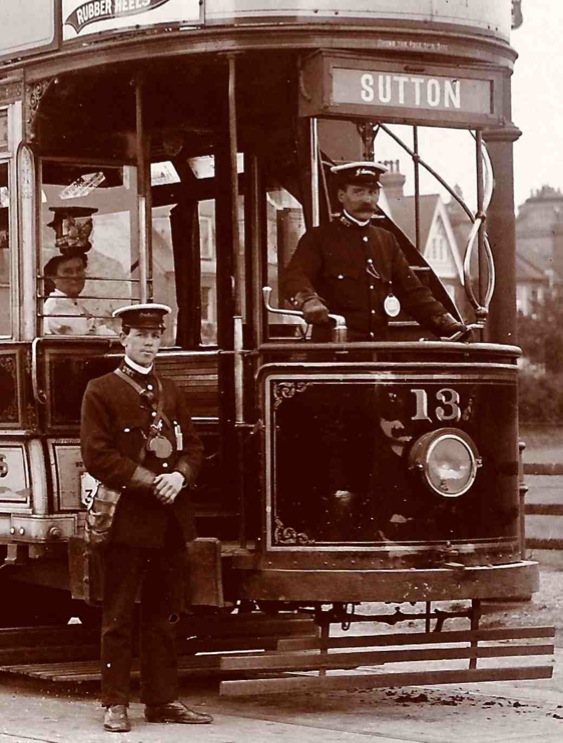
A conductor and a motorman pose with Tramcar No 13 in Stafford Road, Waddon Village, most probably in the first year, or at least the very early years, of operation, i.e., 1906/7. Both men have script-lettering cap badges; although the distinctive ‘Magnet & Wheel’ cap badge of the parent company — the British Electric Traction Company — appears to be absent, it is possible that they are oresent but obscured by the cap rain covers. With thanks to Richard Rosa.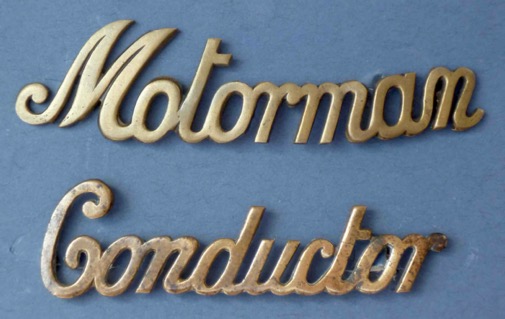
General pattern script-lettering cap badges — 'Motorman' and 'Conductor' — brass. These badges appear only to have been used during the first one or two years of operation. Author's Collection.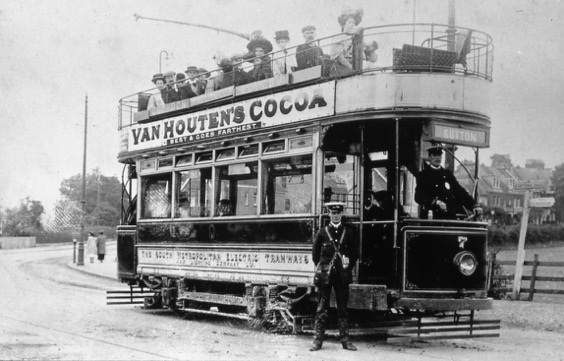
A conductor and motorman pose in the same location as the previous photo, but this time with Tramcar No 7 — photo undated, but probably taken in 1906/7. Photo courtesy of the Tramways and Light Railway Society, with thanks to David Voice.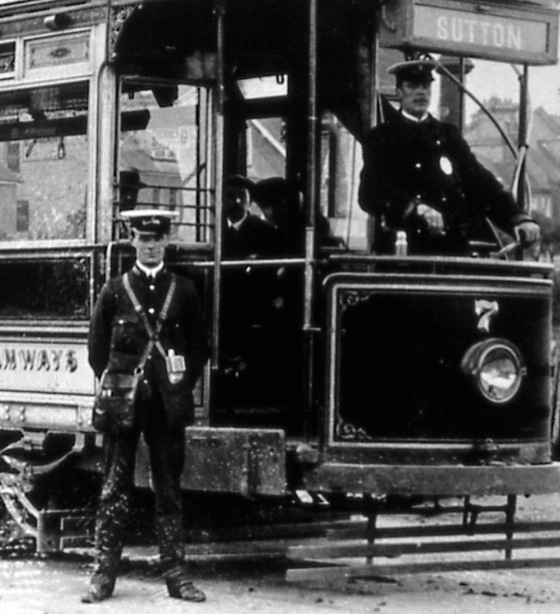
An enlargement of the above photograph showing the conductor and the motorman. Although the conductor is wearing a script-lettering grade badge, the motorman is clearly not; both men also have the standard BETCo 'Magnet & Wheel’ badge on their caps. 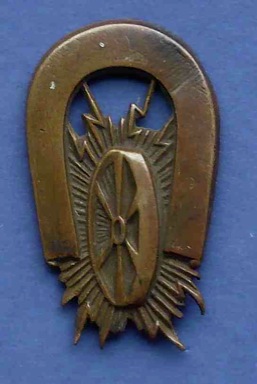
Standard British Electric Traction Company ‘Magnet & Wheel’ cap badge. This was worn from around 1907 to around the end of the Great War. Author's Collection.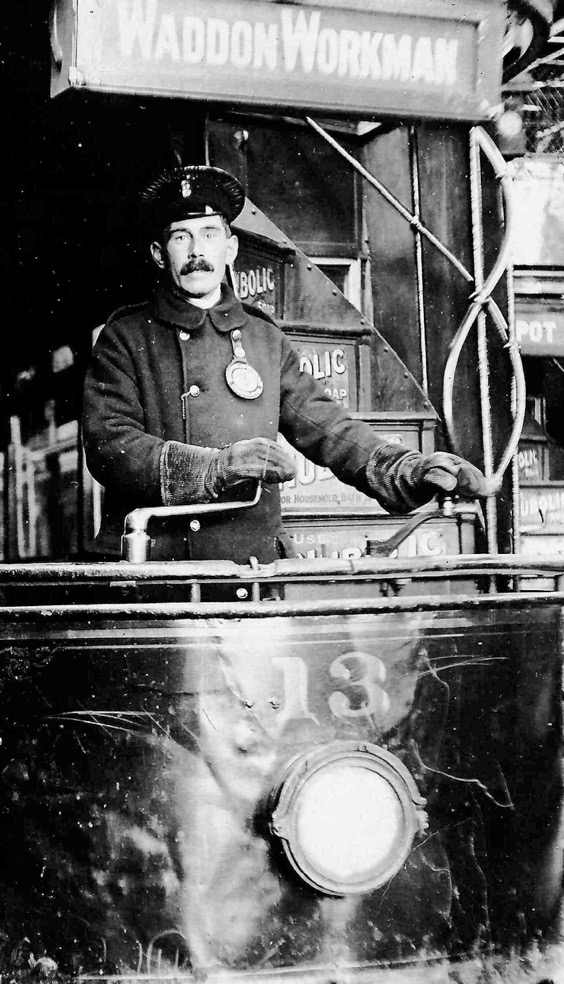
A SMET motorman at the helm of Tramcar No 13, though now looking distinctively battered and scratched — photo undated, but probably taken shortly before the Great War. It’s possible that he is the same individual as in the first photograph above. The earlier script-lettering 'Motorman' cap badge had by this time been replaced by the standard issue BETCo ‘Magnet & Wheel’ cap badge. The PCO licence badge appears on magnification to bear the number ‘3’, which is amazingly low considering that most examples I’ve seen run to 4 or 5 digits! This type of licence badge had a white enamel centre with dark blue digits, surrounded by blue enamel with white lettering: ‘STAGE DRIVER AND CONDUCTOR – MECHANICAL POWER’. With thanks to Richard Rosa.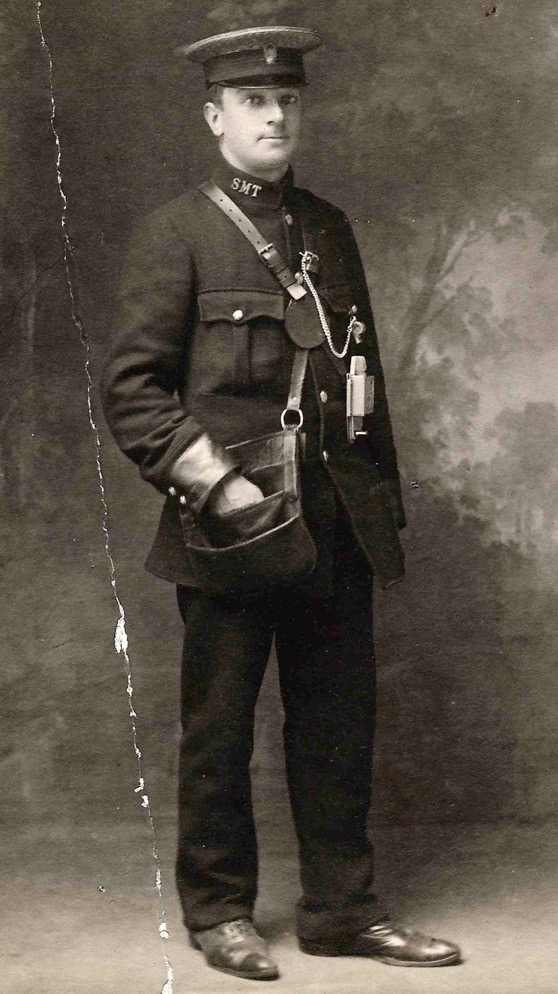
A studio portrait of a SMET conductor dated 4th September 1914, but possibly taken earlier. The subject is wearing the standard BETCo ‘Magnet & Wheel’ cap badge. With thanks to Richard Rosa.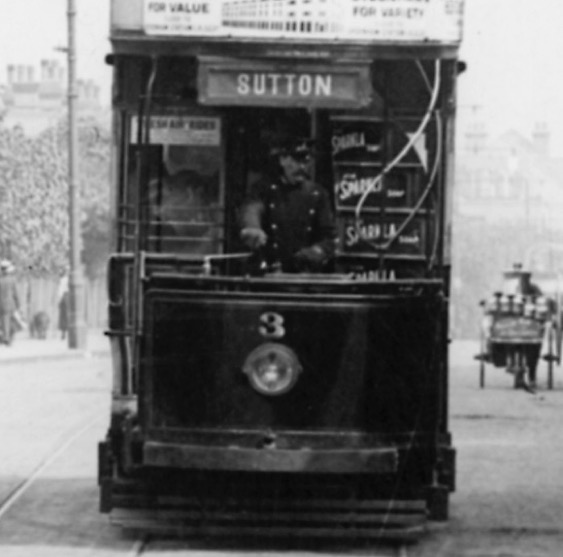
A motorman at the controls of Tramcar No 3 on a service for Sutton, approaching the junction with Woodcote Road, Wallington — photo undated. He is wearing a double-breasted lancer-style tunic, and his cap appears to have both a 'Magnet & Wheel' and a script-lettering cap badge. Photo courtesy of the Tramways and Light Railway Society, with thanks to David Voice.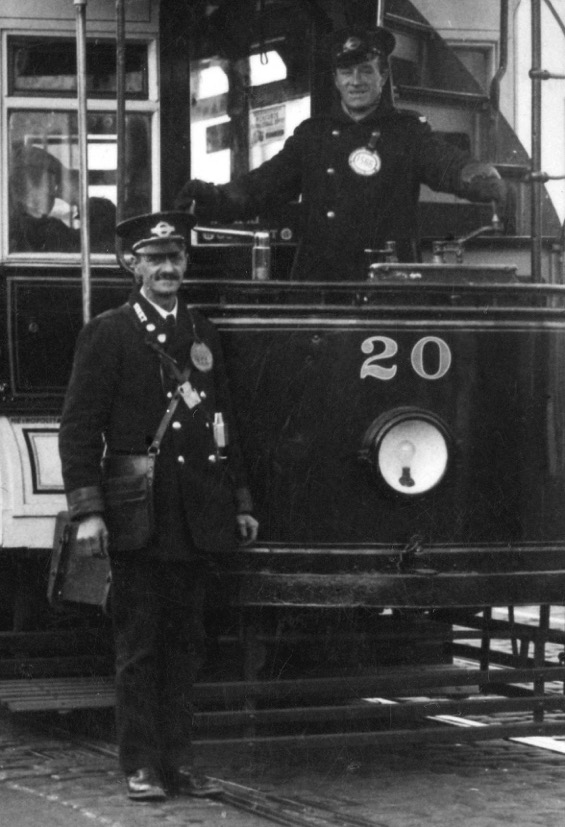
A conductor and a motorman pose with Tramcar No 20 at Mitcham Fair Green with a service bound for Croydon — photo dated 9th November 1929. The 'Underground Group' SMET cap and collar badges are easily seen. The motorman is wearing a 'STAGE DRIVER MECHANICAL POWER' PCO licence badge, probably Number '1566'. Photograph by Dr Hugh Nicol, courtesy of the National Tramway Museum.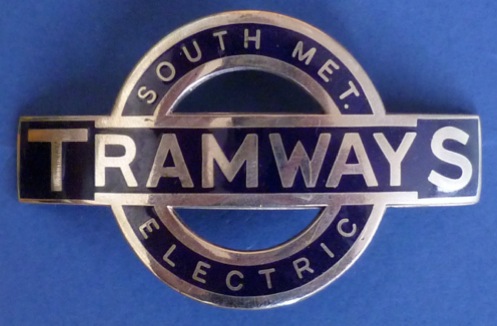
South Metropolitan Electric Tramways 'Underground Group' era cap badge — nickel and blue enamel — worn from c1920 until the creation of the London Passenger Transport Board in 1933. Author's Collection.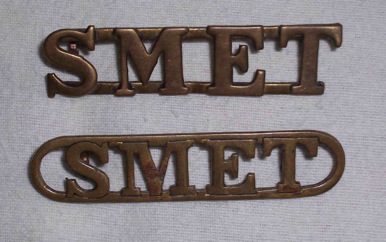
'Underground Group' era SMET collar badges — brass — worn from c1920 until the creation of the London Passenger Transport Board in 1933. Author's Collection.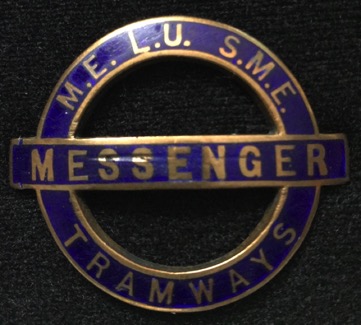
Underground Group 'Messenger' cap badge — nickel and blue enamel (c1920 to 1933). Note that in contrast to the Official's cap badge below, each of the constituent tramway initials misses the 'T' off. Photo courtesy of Matt Lodge.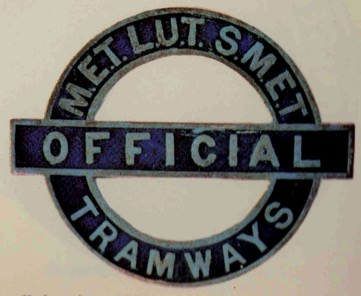
Official's badge — nickel and blue enamel. This has a button-hole fixing on the rear, so it was almost certainly worn by non-uniformed staff when travelling on company business. With acknowledgement to 'Wheels of London', Times Newspapers Ltd, 1972). Worn from c1920 to 1933).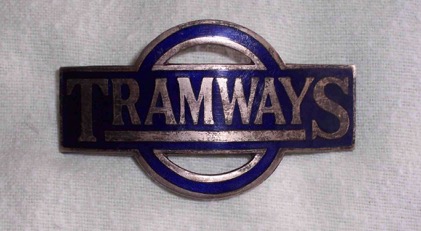
General 'Underground Group' Tramways cap badge — nickel and blue enamel (c1920 to 1933). Author's Collection.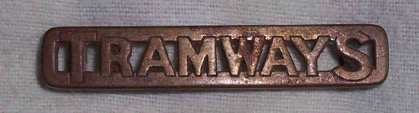
General 'Underground Group' Tramways collar badge — brass (c1920 to 1933)
Senior staff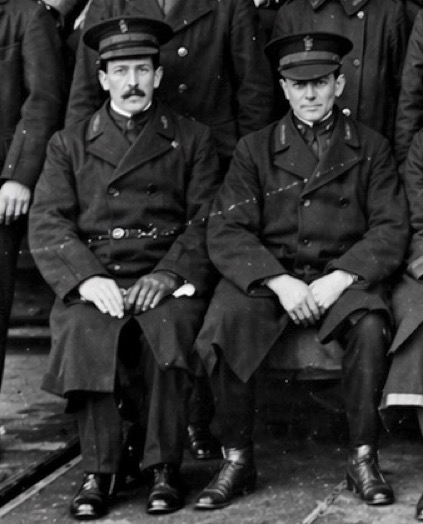
Three inspectors at Sutton Depot — taken from a Great War staff photograph (see below). The man on the left may well be Inspector Florence Fitzpatrick (see below). With thanks to The Friends of Honeywood Museum (Sutton Local Studies Collection).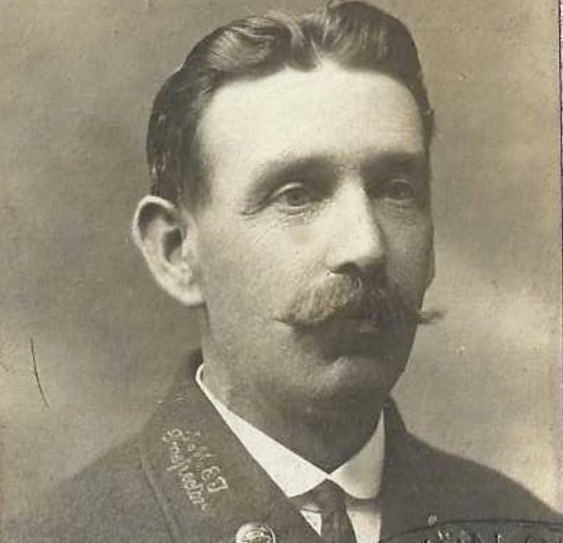
A passport photograph of SMET Inspector Florence 'Frank' Fitzpatrick, dated the 9th November 1926. Inspector Fitzpatrick was born in Newmarket, Cork on the 25th March 1875, and at some point moved to London; in the 1911 census, he was living in Croydon and described himself as a Chief Ticket and Traffic Inspector for the SMET&LCo. Around 1926, he moved to Shanghai, before moving permanently to America in 1928. The two-line, embroidered script-lettering badge on his collar reads: 'S M E T Inspector'. Curiously, the button situated between the jacket collar and the lapel is not a standard BETCo 'Magnet & Wheel' button, but one with a stylised 'S'. My thanks to Florence Fitzpatrick's great grandson, Steve Fitzpatrick, for the photograph and background information.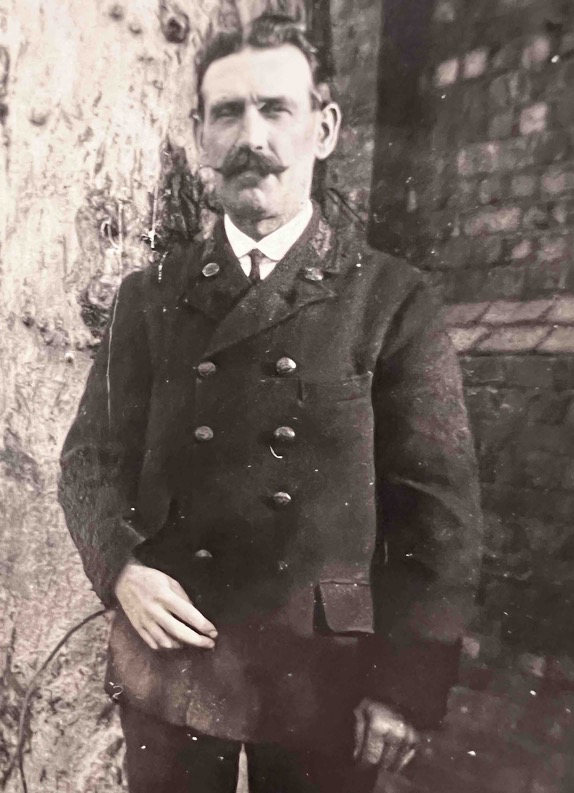
Another photograph of Inspector Florence Fitzpatrick, thought to have been taken a little earlier than the previous photo, in 1922. Photo courtesy of Steve Fitzpatrick.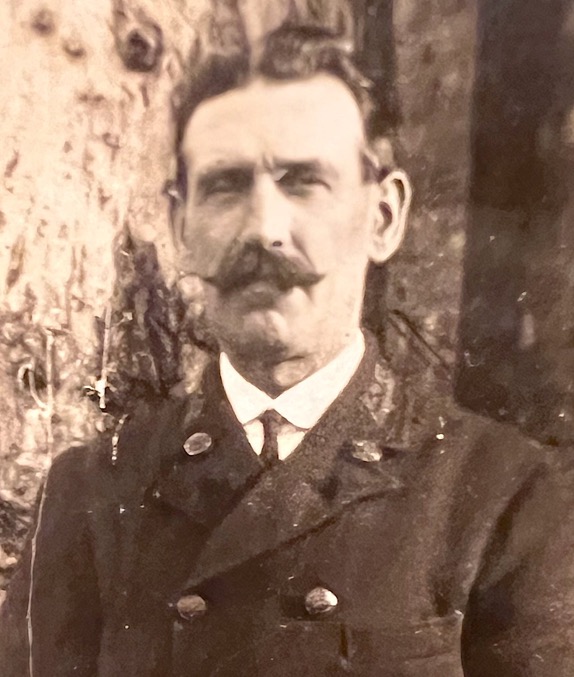
An enlargement of the above photograph showing the collar insignia and buttons, the latter once again being a stylised 'S" rather than the standard BETCo 'Magnet & Wheel' design.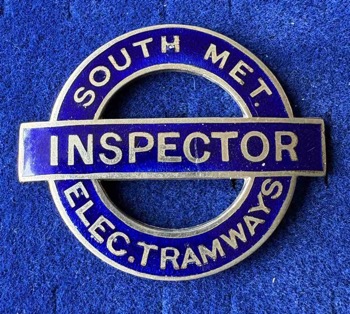
A South Metropolitan Electric Tramways inspector's cap badge — nickel and blue enamel — worn from c1920 up until the creation of the London Passenger Transport Board in 1933. Author's Collection.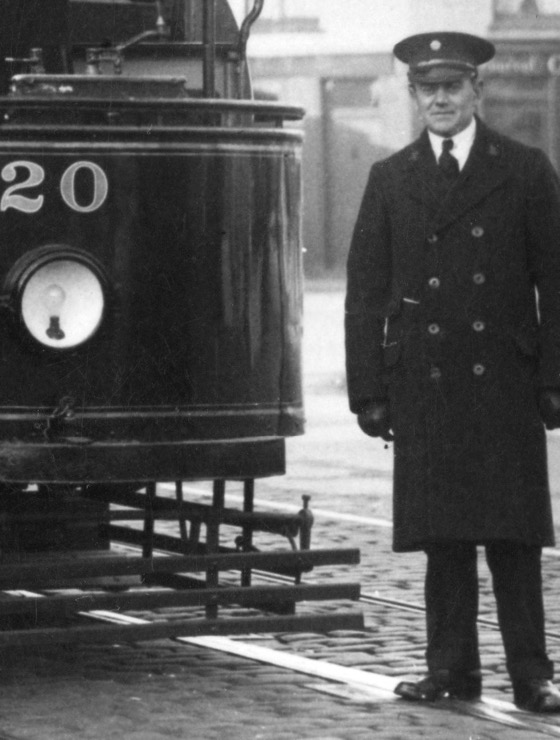
This photograph, which is a cropped image taken from the same photo as the image of Tramcar No 20 above, possibly shows a SMET District Inspector — 9th November 1929. The cap badge is definitely not an 'Underground Group' Inspector's badge, but is suspiciously similar in size to badges issued to District Inspectors by the Metropolitan Electric Tramways (see link) and London United Tramways (see link); the MET and LUT were of course also members of the 'Underground Group'. Photograph by Dr Hugh Nicol, courtesy of the National Tramway Museum.
Female staff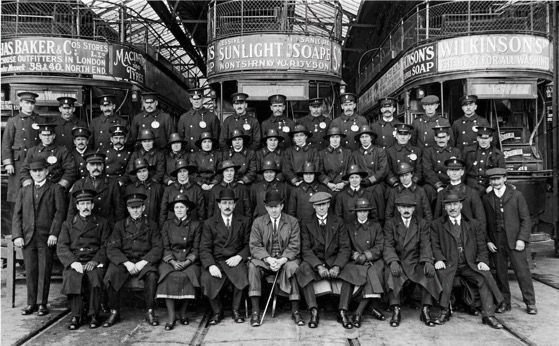
A staff photograph taken at the Sutton Depot on Westmead Road during the Great War. With thanks to The Friends of Honeywood Museum (Sutton Local Studies Collection).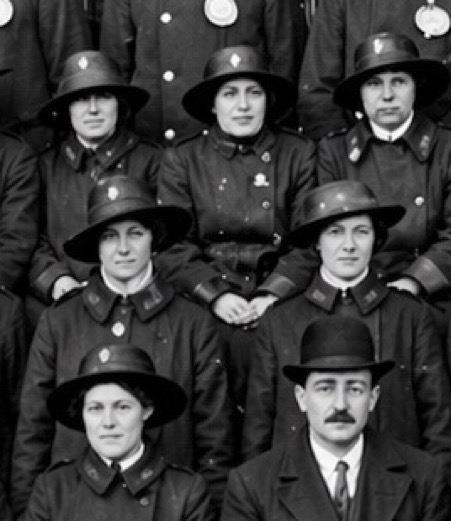
An enlargement of the above photograph, showing details of the ladies' uniforms.